

The U.S. political scene and global financial markets have just experienced a violent 'earthquake.' Just this past weekend, three major events almost simultaneously ignited: Trump's proud tariff stick was directly interrupted by the Supreme Court, with over 100 billion dollars in taxes facing refunds; clouds of war are thick over the Persian Gulf, and U.S. aircraft carrier strike groups are on high alert; while Bitcoin, which should serve as 'digital gold' to hedge risks, unexpectedly staged a high diving act, diverging from the soaring physical gold that has taken on a 'trumpet shape.'
This series of abnormal signals is revealing a profound truth to global investors: when the real storm arrives, money only recognizes the oldest sense of security.
One, the hundred billion tariff policy 'flips', Trump hurriedly patches it.
● On February 20, for Trump, who wields the 'trade big stick', it was undoubtedly an embarrassing 'Waterloo day'. On that day, the U.S. Supreme Court ruled by a 6-3 vote that the Trump administration's previous imposition of large-scale tariffs under the International Emergency Economic Powers Act was illegal and overstepped its authority.
● This is not a small amount. According to the ruling, the ad valorem tariffs imposed on nine executive orders signed since February 2025 will no longer be effective, meaning U.S. Customs must stop collecting related tariffs and faces the embarrassing situation of refunding more than $100 billion in massive tax refunds to businesses.
○ The White House is trying to downplay the impact in the public opinion arena, but the body is honest — the U.S. Department of Homeland Security's Customs and Border Protection issued a notice overnight, officially stopping the collection of the ruled illegal tariffs from February 24.
● However, Trump clearly is not willing to concede defeat. On the very day the ruling was announced, he swiftly signed a new executive order, attempting to 'patch' it under Section 122 of the Trade Act of 1974, announcing a temporary import surcharge of 10% on global goods, and soon stated on social media that he would raise the rate to 15%.
● But this operation is more like walking a tightrope politically. According to Section 122, this new tariff can only last a maximum of 150 days unless Congress approves an extension.
○ The market is well aware: this is just a temporary 'band-aid', and the uncertainty of U.S. trade policy has been further amplified. As pointed out by Caixin Securities Research Institute, the rejection of the IEEPA Act, while theoretically benefiting risk assets in the short term, simultaneously increases the sense of chaos in global trade.
Two, aircraft carriers and negotiations: the U.S.-Iran situation ignites the gold 'powder keg'.
If the tariff issue only confused the market, then the rapidly escalating U.S.-Iran confrontation in the Middle East directly ignited the fuse of risk aversion.
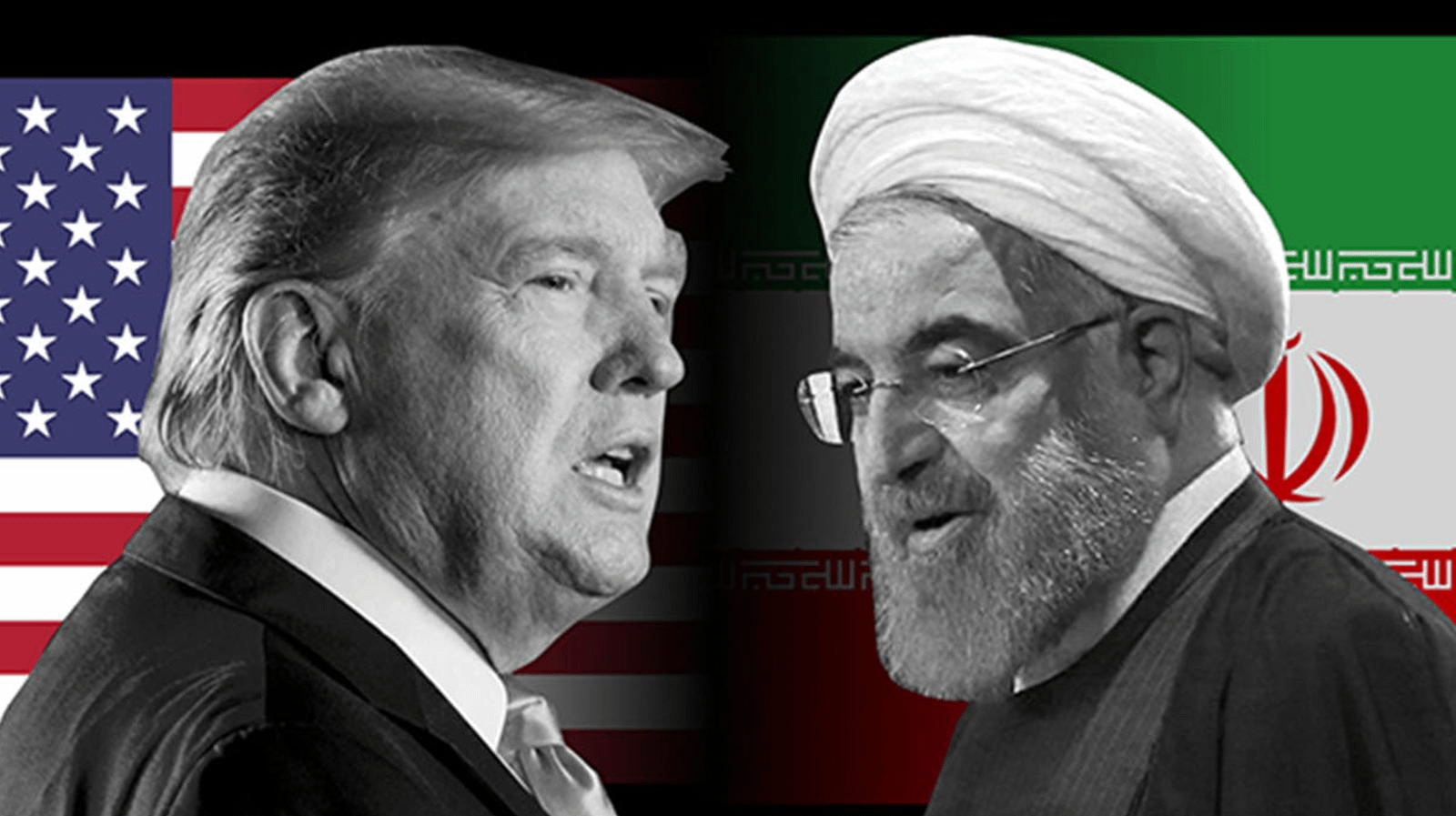
● Just as all parties look forward to the new round of negotiations in Geneva on February 26 between the U.S. and Iran, Washington is preparing for 'two hands'. On one hand, the presidential envoy and Trump's son-in-law Jared Kushner are preparing to go to the negotiating table; on the other hand, the largest U.S. aircraft carrier strike group, the 'Gerald R. Ford', has arrived at an important base in the eastern Mediterranean, with several U.S. military aircraft landing in Israel. The U.S. State Department has also unusually issued a high-level warning requesting non-emergency personnel stationed in Lebanon to evacuate.
● According to informed sources, Trump himself is inclined to consider a 'preemptive strike' against Iran, although this plan has been strongly questioned by the chairman of the Joint Chiefs of Staff, who believes it could lead to a protracted conflict.
● This negotiation, with the coexistence of artillery fire and extreme pressure, has made the market sense a strong smell of gunpowder. Iran responded firmly, stating that any attack would be considered aggression. Against this backdrop of heightened tension, gold, as the ultimate safe-haven asset, surged instantly.
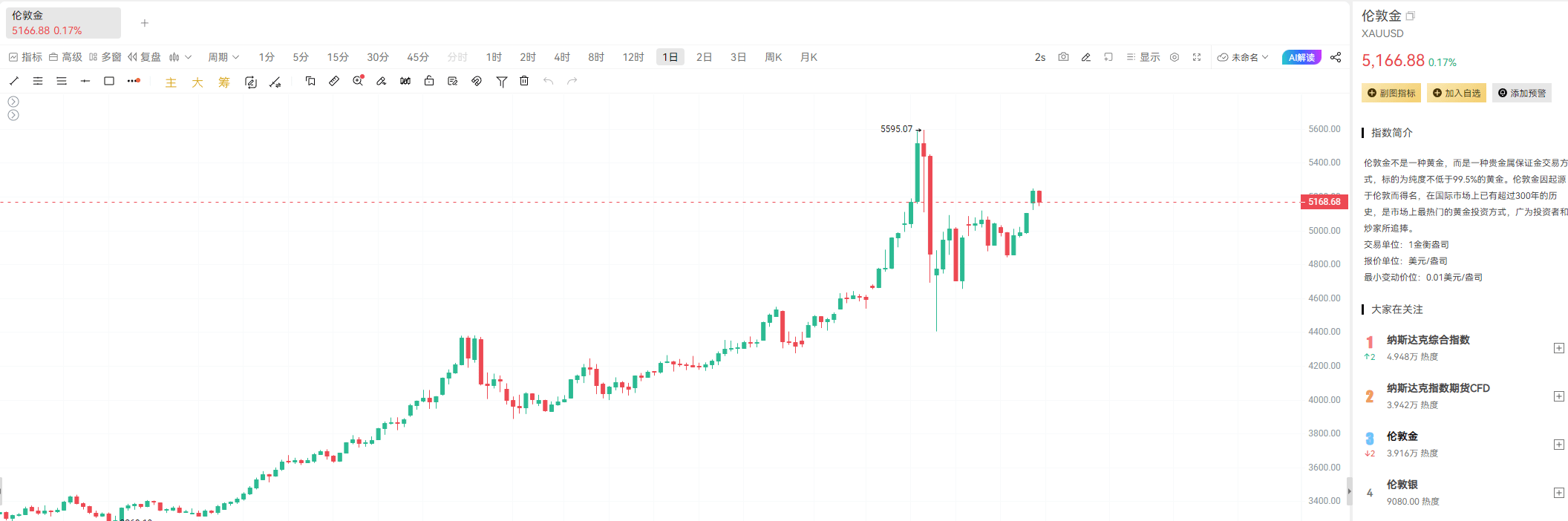
● On April 23, gold futures on the New York Commodity Exchange surged by $117.9, strongly breaking through the $5200 per ounce mark, closing at $5247.9, with a rise of 2.3%. UBS analysts even boldly predicted that by June, gold prices might rise another $1000. The market is voting with real gold and silver, indicating that in the face of potentially uncontrollable geopolitical risks, only precious metals with physical properties can be the true 'Noah's Ark'.
Three, Bitcoin falls behind: the myth of 'digital gold' shattered?
● However, the most heartbreaking plot for crypto believers is also unfolding simultaneously. Logically, with the weakening of the dollar, chaotic policies, and the overlapping risks of geopolitical war, this should be the highlight moment for Bitcoin, the 'digital gold'. But the reality is a bloody divergence.
● On the same day that gold skyrocketed past $5200, Bitcoin plummeted sharply, briefly falling below the $65000 mark, with a low of $64232.8 per coin, reflecting a decline of over 4.4% in 24 hours.
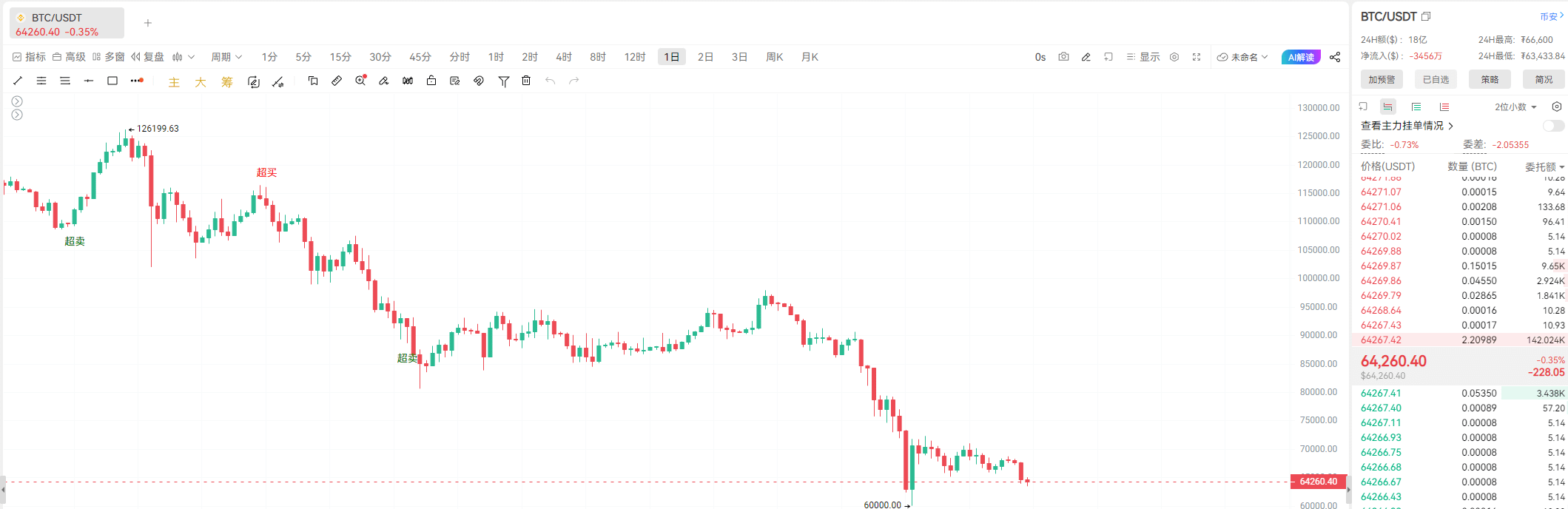
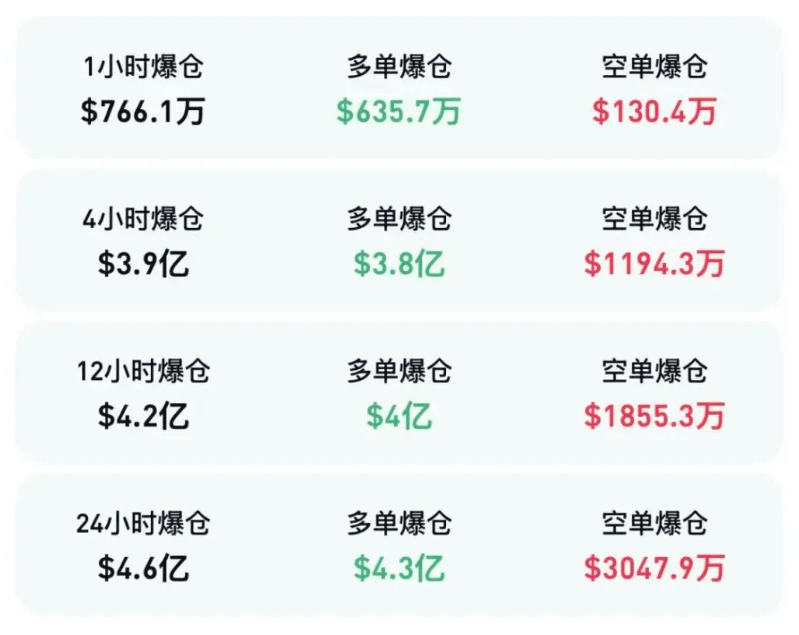
● The entire cryptocurrency market is in despair, with the number of liquidated positions exceeding 130,000, amounting to a total liquidation value of $463 million.
● Why? Professor Liu Jin of the Cheung Kong Graduate School of Business sharply analyzed: Although Bitcoin is called 'digital gold', its trend is significantly different from gold, and is actually highly correlated with the Nasdaq index, and should be viewed as a technology asset. The previous surge was mainly based on expectations of policy support for digital currency after Trump's election, but the reality is that after taking office, no strong policies were introduced, leading to a significant correction as expectations fell through.
● Traders from the crypto analytics company CryptoQuant are pessimistically believing that Bitcoin has entered a bear market, even predicting that if the bear market evolves into a 'winter', the price could be further halved to $31000. When real war risks and geopolitical turmoil arrive, funds will choose not the ephemeral digital code, but the tangible gold that has been passed down for thousands of years. The narrative of 'digital gold' appears particularly pale in the face of this real crisis.
Four, the reconstruction of safe-haven logic: money only recognizes 'hard assets'.
If we piece these events together, we can clearly see the current logic of global capital flow: the demand for safe-haven assets is extremely polarized, with funds abandoning 'stories' and embracing 'physical assets'.
● The chaotic situation of Trump's tariffs, combined with the Damocles sword of the U.S.-Iran war, has led the market to form a typical 'Risk-Off' mode. However, this time, money did not flow into the previously popular Bitcoin, nor did it fully flow into the dollar (the dollar index weakened after the announcement), but surged into traditional assets like gold and silver.
● The day's increase in silver even exceeded that of gold, reaching 4.06%, closing at $88 per ounce. This reflects the market's real choice under the dual risks of repeated inflation and geopolitical conflict. Even the 15% new tariff hastily introduced by Trump only adds fuel to the fire — because it not only fails to solve the fiscal problem but exacerbates the market's concerns about U.S. economic stagflation.
● From the dramatic reversal of the hundred billion tariff policy, to the shadow of cruise missiles over the Persian Gulf, to the joys and sorrows of gold and Bitcoin, this grand drama at the beginning of 2026 has given all investors a vivid lesson in risk education.
● In the face of real storms, the bubble of stories is most likely to burst. Only those 'hard assets' that have traversed thousands of years of human civilization cycles can serve as the final safe haven. When Trump's executive order is overturned by the Supreme Court and the aircraft carrier strike group arrives at the front lines, the market's physical reaction is the most honest — the 'safe-haven triangle' remains the dollar, U.S. Treasuries, and gold, while Bitcoin, for now, can only sit on the cold bench of technology stocks.