
I entered the circle from 120,000 to 100,000 to 2,002,000
In the third year, it reached 590,000
In August of the fourth year, it reached 3,780,000
In November, it reached over 7,000,000.
Until a few years ago, I could easily withdraw 30,000,000 from the cryptocurrency circle.
What is the most brutal way to make money in the cryptocurrency circle? Just one word: roll!
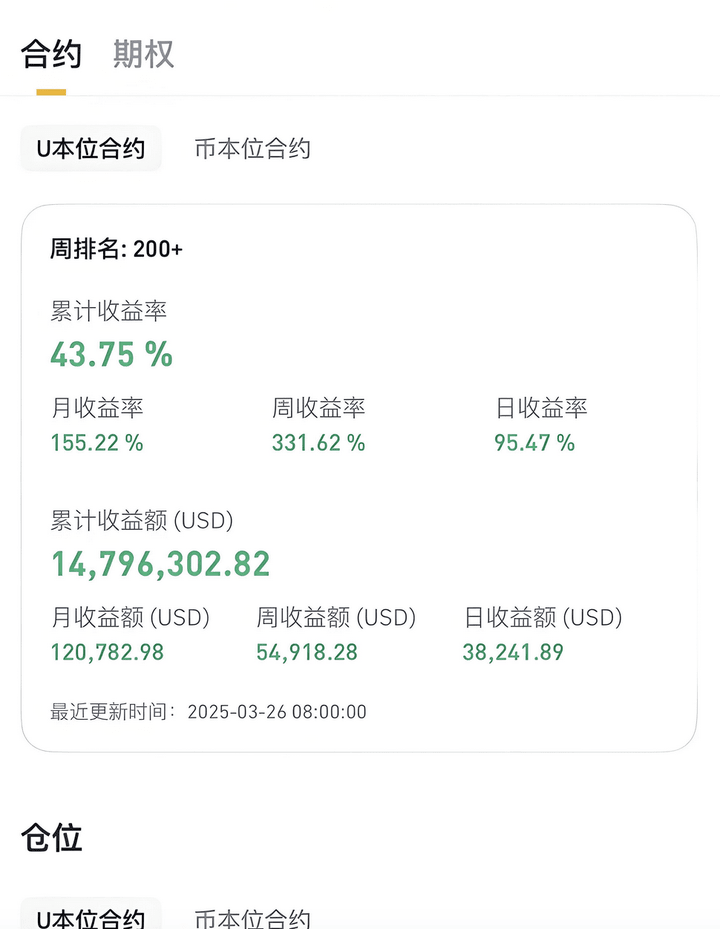
My personal account went from 300,000 to 1,000,000 over nearly 10 years, but when it hit 1,000,000, it felt like a breakthrough, shooting directly to 40,000,000. Today, I will share a few key points, these experiences are worth 60,000,000, hoping to help you.
The core is just one sentence: rely on contract trading to amplify profits! But don’t rush in, first exchange these 2,000 yuan for 300 U (approximately 300 dollars), let’s take it step by step:
Step 1: Small capital snowballing (300U 1100U). Take out 100U each time to play, targeting the most popular coins recently. Remember two things:
① Run away once you double your money (for example, turn 100 into 200 and immediately cash out). ② Cut losses at 50L. With good luck, winning three times in a row can roll to 800U.
(100-200400800). But take profits when you see gains! Play up to three rounds; if you earn around 1100U, stop. This stage relies heavily on luck, so don't be greedy!
Step 2: When you have more money, make a combination attack (starting from 1100U). At this point, split the money into three parts to play different tricks.
1. Quick in and out type (100U) only plays with 15-minute fluctuations, stable coins like Bitcoin/Ethereum. For example, if you see Bitcoin suddenly surge in the afternoon, immediately follow it, earning 3%-5% and then running away, similar to street vendors, thin profits but more sales.
2. Buddhist-style fixed investment (15U per week). Invest a fixed amount of 15U weekly to buy Bitcoin contracts (for example, if it's currently 50,000, you believe it can rise to 100,000 in the long term). Treat it as a piggy bank; don’t panic if it drops, wait for half a year to a year, suitable for those who don't have time to monitor the market.
3. The main trend order (the rest is all in) watch for major trends and act decisively! For example, if you find that the Federal Reserve is going to lower interest rates, Bitcoin may surge, directly entering a long position. But you must think ahead: How much to earn before running away (for example, doubling), and how much to recognize a loss (maximum 20%). This trick requires understanding news and technical analysis; beginners should not act recklessly!
Important reminder:
① Bet a maximum of 1/10 of your capital each time, don’t go all in!
② Every trade must set a stop-loss!
③ Play a maximum of 3 trades per day; if you feel itchy, go play games.
④ Cash out when you hit your target; don’t think about 'making another wave'!
Remember: Those who turn around using this method are fierce people who are tough on others and even tougher on themselves!
Points to note when rolling over:
Sufficient patience; rolling profits are substantial. As long as you can roll successfully a few times, you can at least earn tens of millions or even billions. Therefore, you cannot roll easily; you need to find high-certainty, very stable opportunities.
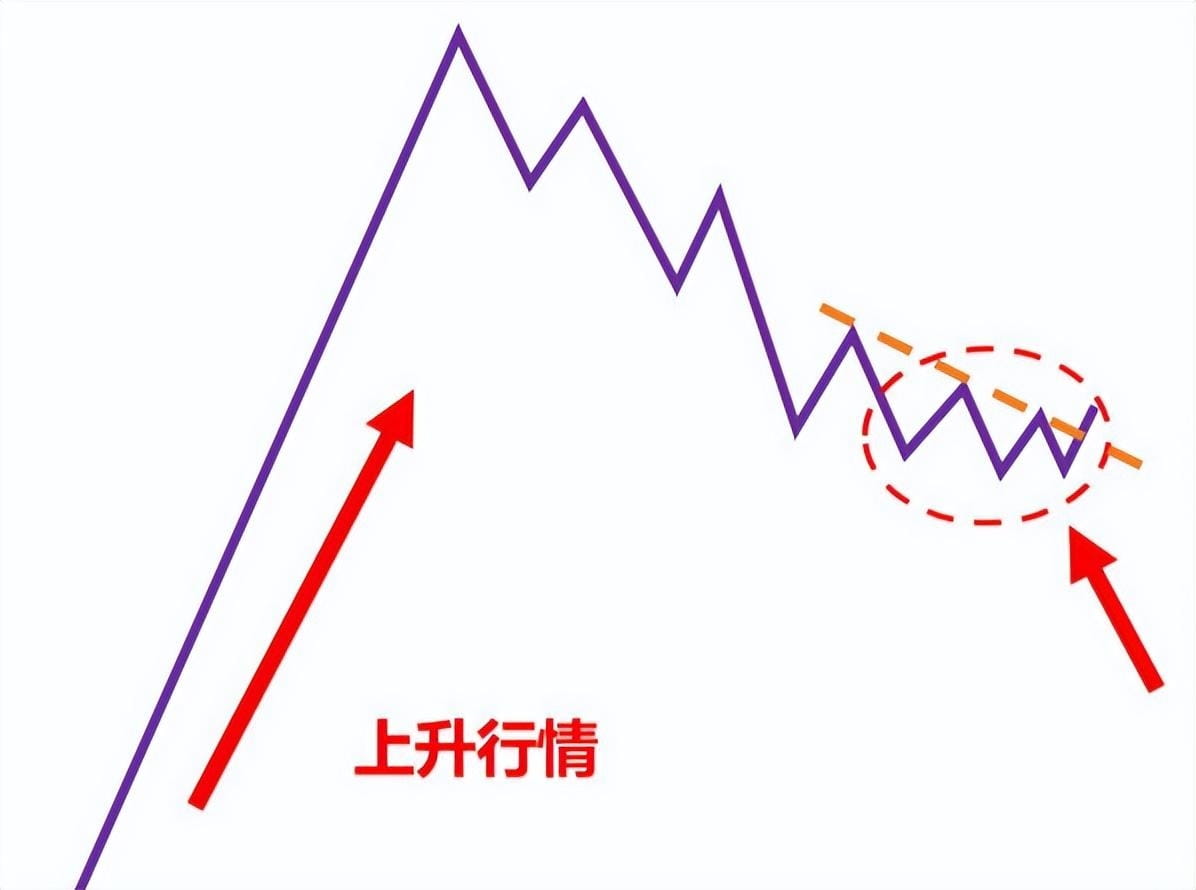
2. What is a high-certainty opportunity? It is that kind of situation where the price drops sharply, then starts to oscillate sideways, and then suddenly surges upwards. At such times, the trend is likely to reverse, and you have to jump on board quickly to seize the opportunity. 10%-100% version
① Only 10% of people in this market can make money because it is destined to be a zero-sum game.
② The money you can earn will only come from 20% of the bull market time; the rest of the time will eliminate those without investment logic and patience.
③ Always maintain a mindset to endure a 30%-50% retracement to laugh until the end; otherwise, the process will be a torment for you.
④ 40% of the retail investors may end right at the beginning; the pitfalls in this circle are more than you can imagine.
⑤ At least 50% of people in this market will choose to play contracts, and most will ultimately end up with nothing and lose everything. Remember, contracts are gambling.
⑥ People trading spot in a bull market have a 60% or more chance of making a profit; those who can hold steady throughout the entire bull market cycle will be the ultimate winners.
⑦ It is estimated that 70% of people are continuously recharging without cashing out; the cryptocurrency circle is far more cruel than you think.
⑧ 80% of people are unable to return to the past due to the wealth effect of this circle, just like being addicted to drugs;
⑨ 90% of people ultimately are just passersby in this market, but everyone thinks they are the chosen ones.
In the end, it will reach 1,000,000 dollars, always believe in this.
3. Only roll long;
4. Setting appropriate stop-loss and take-profit points is very important.
Rolling short is a high-risk strategy, and market fluctuations can lead to significant losses. When entering trades, we should set a reasonable stop-loss level. Once the market trend goes against our expectations, we should stop loss promptly to control losses. It is equally important to set appropriate take-profit points to protect profits. This ensures we gain enough profit before the market reverses.
5. Reasonable fund management is also the key to steady profits.
When conducting rolling short operations, we should allocate funds reasonably and not invest all funds into one trade. Diversified investment can reduce risks and improve overall stability. We should also adhere to risk control principles and avoid over-leveraging to prevent larger losses.
6. Timely tracking of market dynamics is also key to profitability.
Market conditions are constantly changing, and we should maintain sensitivity to the market and adjust strategies in a timely manner. Keeping up with and learning relevant technical indicators and trading tools can help us better analyze market trends and improve prediction accuracy.
Rolling short in the cryptocurrency market can be a strategy for making profits, but it requires cautious operation. By accurately predicting market trends, setting appropriate stop-loss and take-profit points, managing funds wisely, and tracking market dynamics timely, we can steadily gain profits in the market.
Of course, if it's Eth
This cryptocurrency can also try to use forced rollovers to conduct staking, lending, or inputting into liquidity pools to achieve safer returns, and specific currencies should be analyzed to avoid liquidity issues.
Having traded cryptocurrency professionally for these years, I have achieved some success. I personally tested methods that turned 500,000 into 10 million, relying solely on the wedge pattern, with a win rate as high as 99%, suitable for everyone! Worth liking and saving!
The wedge pattern is a pattern that often appears in charts. I personally also really like trading this pattern. However, the wedge pattern is the hardest to accurately identify, and it is divided into ascending wedges and descending wedges.
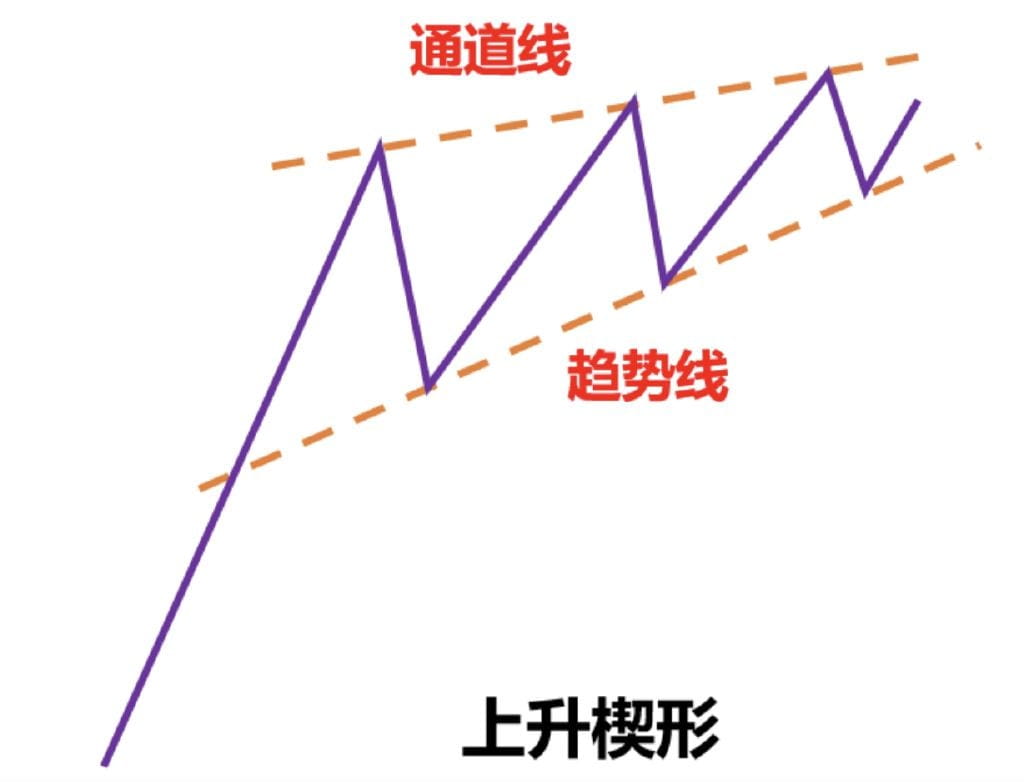
We start with the ascending wedge. The ascending wedge, also known as a rising wedge, is a bearish reversal pattern. As shown in Figure 3.8-1,
 Front insert line, back insert line
Figure 3.8-1
This pattern occurs in an upward trend. When the price pulls back from the top, it begins to enter a converging fluctuation. As the price moves upward, the converging range becomes narrower.
Connecting the low points below as the trend line and connecting the high points above as the channel line, generally speaking, in an ascending wedge, the slope of the trend line is much steeper than that of the channel line.
This means that the formation speed of higher lows is much faster than that of higher highs, thus forming a wedge pattern.
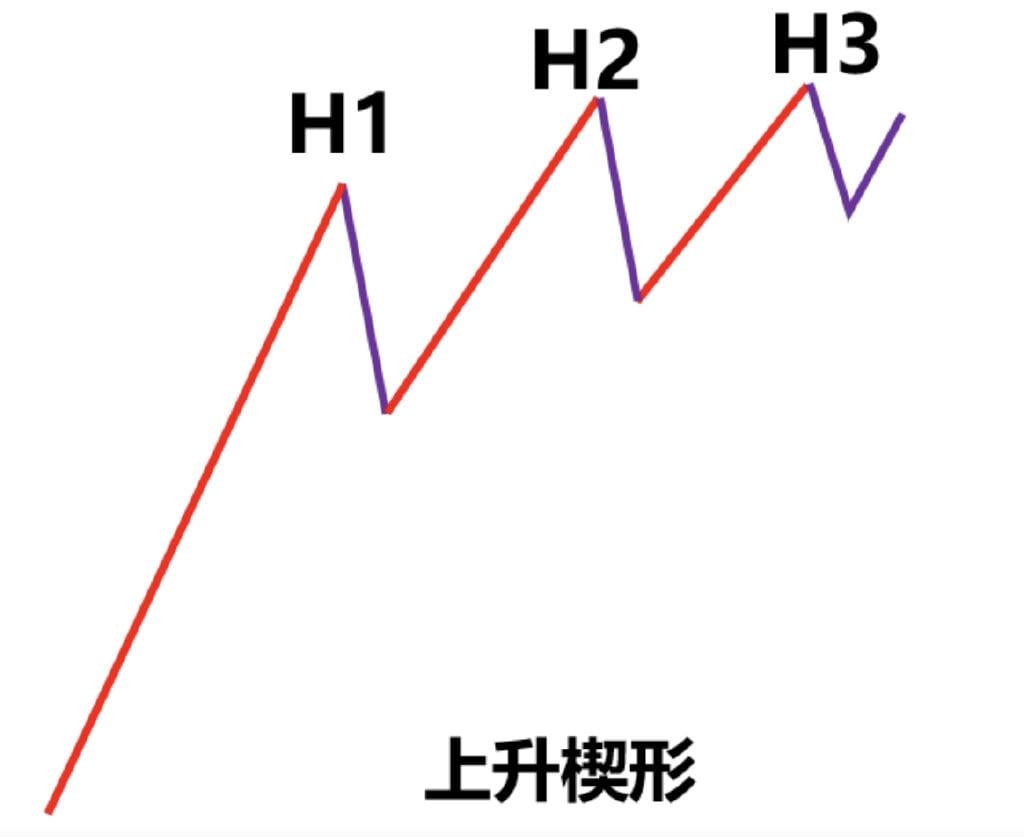
At the same time, we can clearly see that each segment of the upward trend is becoming flatter, as shown by the red line in Figure 3.8-2.
 Front insert line, back insert line
Figure 3.8-2
Although this pattern also continuously creates higher highs, this series of higher highs and higher lows makes many novice buyers feel that the trend is still bullish.
But we can see that the distance between each high is getting smaller, as shown in Figure 3.8-2. That is, the height of H3 minus the height of H2 should be less than the height of H2 minus the height of H1, which is H3-H2<H2-H1.
This also means that buying power is becoming weaker. Momentum is weakening, and if you use momentum indicators like MACD, RSI, or KDJ, you can observe the emergence of a top divergence.
In fact, divergence is not that magical; it is just a lack of momentum. You can see it without indicators. Of course, it is normal for beginner traders to observe using indicators.
Therefore, the ascending wedge pattern is a pattern of insufficient bullish momentum, and most of the time it pushes three times, meaning it has pushed up three times, so this pattern is also called a three-push wedge. Of course, there can also be two pushes and four pushes.
We have learned a saying before: once and again, it declines, three times it exhausts. If it cannot gain more momentum after pushing three times, at this point, the buyer also realizes the strength of the seller and gives up continuing to buy.
At this time, the sellers dominate, which may cause a reversal. The reason for the reversal is insufficient momentum, but insufficient momentum does not necessarily lead to a reversal.
In fact, many traders will think that the bearish confirmation of this pattern will only be possible after the upward-sloping trend line is broken. At the time of the breakdown, the trading volume should expand or rise, which can be considered as confirmation.
Personally, I prefer to consider a valid breakout only when it breaks below the recent swing low. The breakout of a horizontal support line is always more effective than the breakout of a trend line and easier to confirm, because trend lines always have multiple interpretations.
Now that we have learned how to identify the ascending wedge, we can discuss how to trade the ascending wedge pattern, which is the entry method for the ascending wedge.
Generally speaking, the ascending wedge pattern is a bearish reversal pattern. Many traders will only be interested in the breakout of the trend line, and they will trade based on the breakout of the trend line and pullback.
Personally, I am still interested in horizontal support lines. There are no rights and wrongs in this. Therefore, the entry methods for the ascending wedge are divided into the following three types. You can also use these three methods to trade the breakout of the trend line.
Method 1: Enter at market price after breaking the horizontal support line.
Method 2: Enter at market price when breaking below the lowest price of the bearish candle.
Method 3: Enter when breaking below the horizontal support line and retesting the support line.
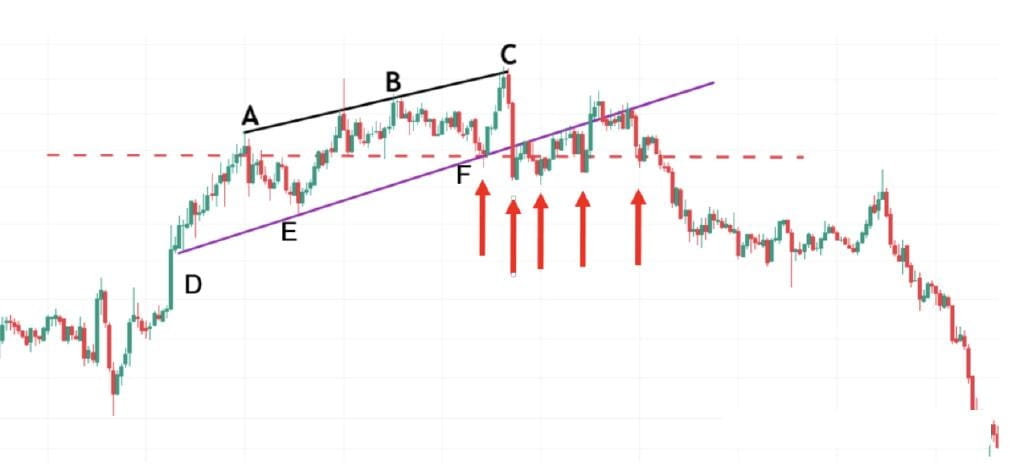
Let's first look at Method 1, as shown in Figure 3.8-3.
 Front insert line, back insert line
Figure 3.8-3
We can see that the high points are continuously rising, but the amplitude is also gradually decreasing.
Connect the high points A, B, and C, which is the channel line, and draw the trend line through points D, E, and F, with point F as the horizontal support line. The red dashed line in the figure is the drawn support line.
We can see that the K-lines at the red arrow have broken the support line, but each time after breaking, they are pulled back and do not form effective breakouts. So the first method is the most aggressive entry method, entering directly at market price when the price breaks below the horizontal line.
The advantage of this technique is that you might get the best entry price. But the downside is that the price may reverse, which can easily lead to a false breakout, and you can easily be stopped out.
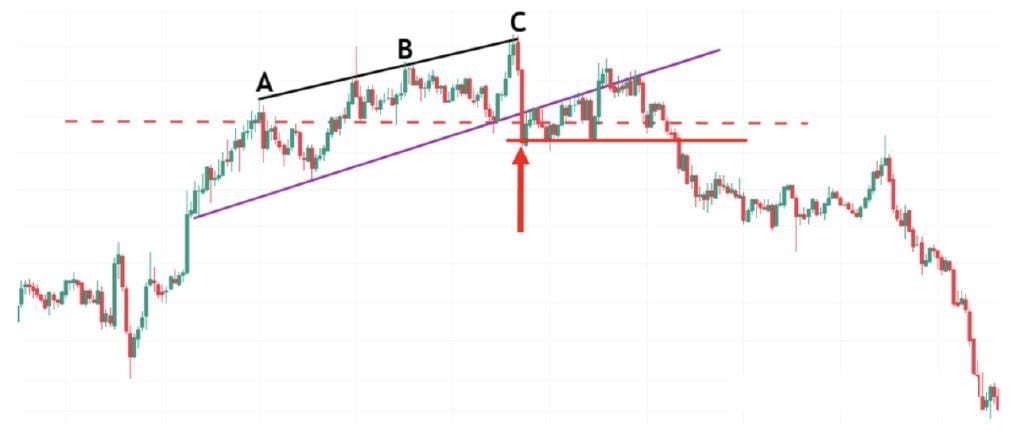
Let's look at Method 2, as shown in Figure 3.8-4.
 Front insert line, back insert line
Figure 3.8-4
In the figure, we find the bearish candle that breaks the support line. The red arrow marked K-line is the one we draw a red horizontal line based on the lowest price of this bearish candle. When the next K-line breaks this horizontal line, we directly enter at market price. This is the method of entering at market price when the lowest price of the bearish candle breaks through.
We can also see that there were several false break candles before this breaking candle, but those candles did not break again after they were broken.
So using Method 2 greatly reduces the probability of false breakouts. This is the advantage of this method, reducing false breakouts.
The downside of this method is that if the sellers are too strong, the closing price of the waiting bearish candle will be relatively low, meaning your entry price will be lower than Method 1. However, it is relatively more conservative than Method 1.
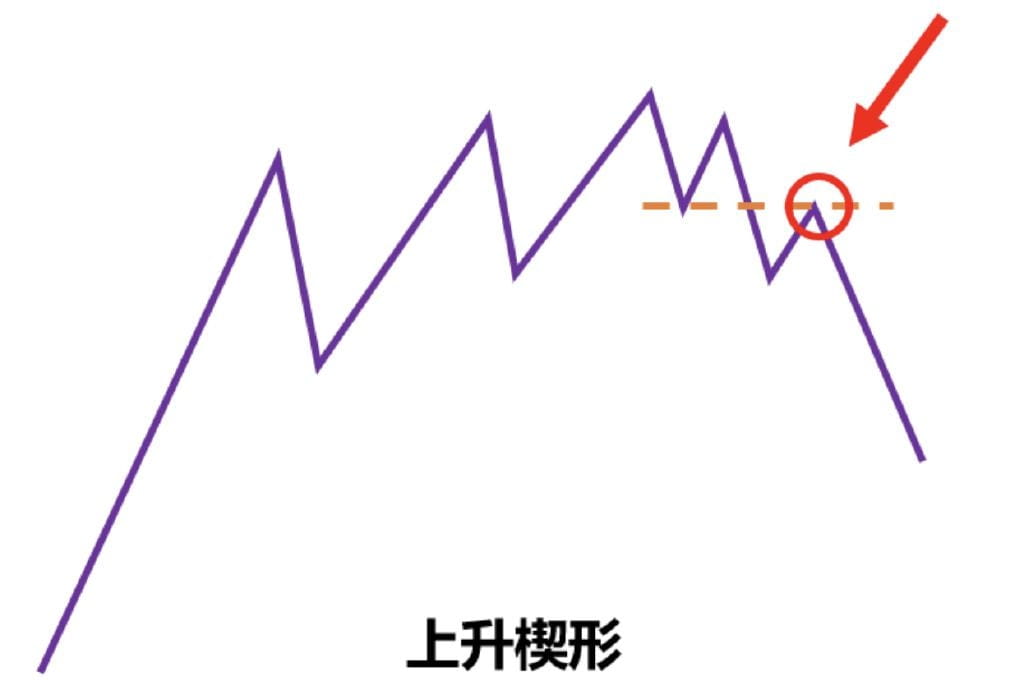
Let's look at Method 3, which is after breaking below the support line. When it retests the support line, if a bearish signal K-line appears near the support line, then enter directly at the market price of the lowest price of the bearish signal K-line, taking the double top as an example, as shown in Figure 3.8-5.
 Front insert line, back insert line
Figure 3.8-5
The method of waiting for a rebound to go short has the advantage of being low-risk and having a high risk-reward ratio. However, sometimes it may not give you a chance for a rebound; the price may drop sharply, and you can only watch anxiously.
Through the explanation of the above three methods, I believe you will have a clearer understanding of entering the ascending wedge. You may wonder which method is better. In fact, there is no best method; you need to decide on your entry strategy and continuously practice in numerous trades.
Let's talk about how to set stop-loss for the ascending wedge.
As I have discussed multiple times, the stop-loss should be set at a position that, once broken, will invalidate this trade setup. Facing the ascending wedge pattern, the stop-loss should be at a position that completely invalidates this pattern.
For the ascending wedge, some people will use the channel line to place orders for left-sided trading. When traders notice that the market price has pushed up twice, they will realize that this may be a rising three-push wedge pattern. At this time, they will draw trend lines and channel lines based on two highs and two lows.
Most ascending three-push structures do not reach the channel line at the high point of the third push. Even if they touch the upper channel line, they will quickly be suppressed by sellers, indicating insufficient buying momentum.
So placing orders with the channel line is also a trading method for some left-sided traders, who generally choose their stop-loss above the channel line.
However, once the channel line is strongly broken, it will reach these traders' stop-loss points, causing more buying power and driving the price up.
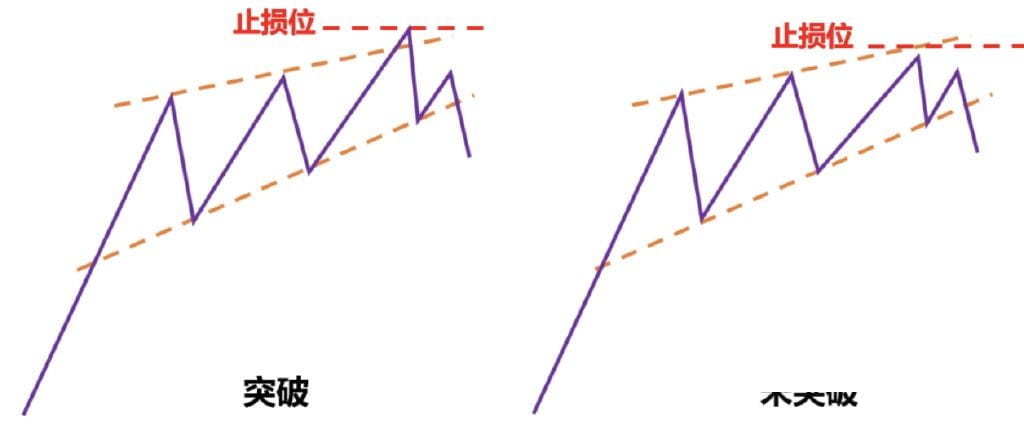
So, no matter which method you use to enter, you can observe whether the highest point of the ascending wedge has broken through the channel line.
If the channel line is broken, you can set the highest point as the stop-loss point. If it is not broken, then set it near the channel line, as shown in Figure 3.8-6.
 Front insert line, back insert line
Figure 3.8-6
Of course, if you use Method 3, then you can use this as your wide stop-loss position and set the recent small wave high as your narrow stop-loss position.
For the same take-profit target, a narrow stop-loss will definitely yield a higher risk-reward ratio than a wide stop-loss. However, the win rate will also relatively decrease. How to balance these two relationships varies from person to person.
Finally, let's see how to set take-profit to maximize profits. You can use three commonly used techniques, which are the three methods we discussed earlier in the continuation of patterns, and they also apply to reversal patterns.
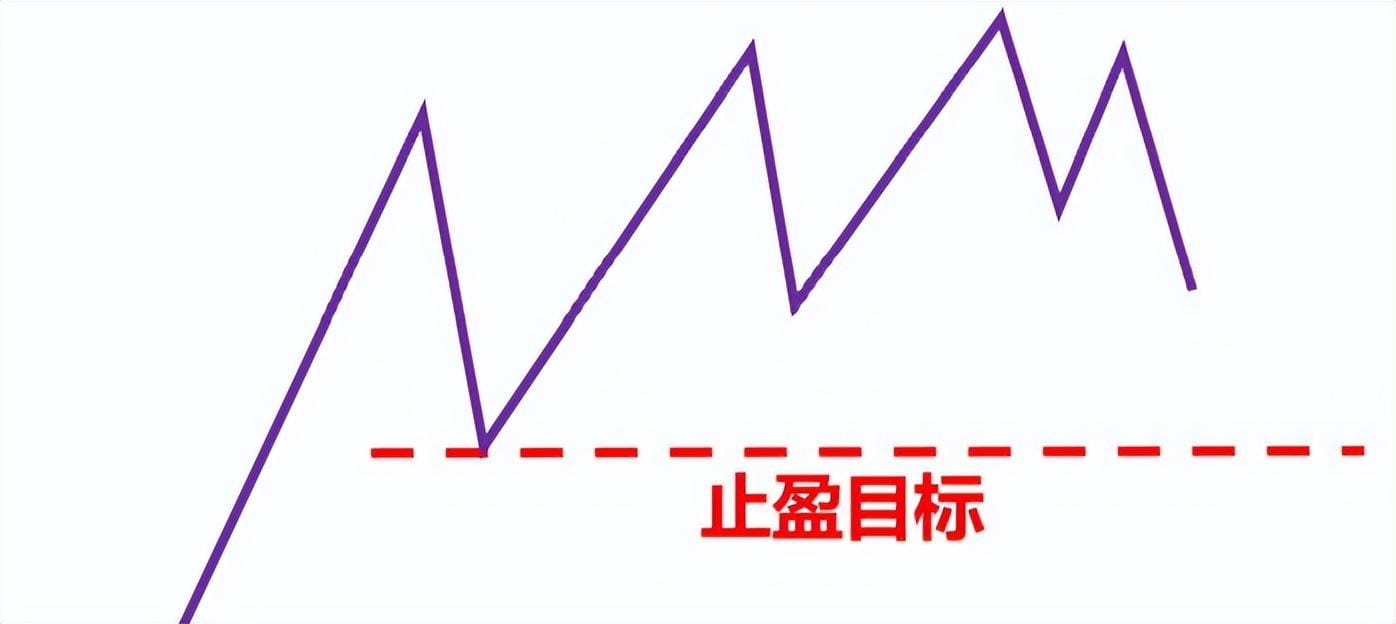
Method 1: Fixed take-profit method, as shown in Figure 3.8-7.
 Front insert line, back insert line
Figure 3.8-7
The ascending wedge is a bearish reversal signal, meaning that this market was originally a healthy upward trend but due to insufficient buying momentum or other reasons, the price could not continue to push up. At this time, we do not know whether the buyer will give up or is willing to buy again at a lower price.
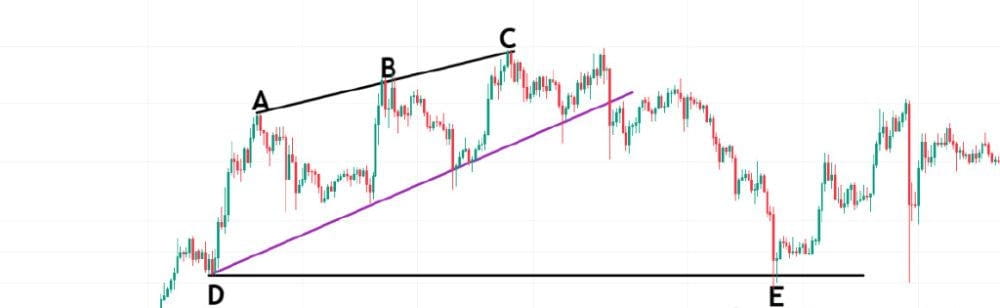
So for a bullish market, most traders will look for support at the swing lows and trade with the trend. That position is the take-profit position for counter-trend trading, which is also the starting point of the wedge pattern, as shown in Figure 3.8-8.
 Front insert line, back insert line
Figure 3.8-8
We can see that we draw a horizontal support line from the starting point D of the wedge pattern. We see that the price subsequently reached point E in the figure and received support, which is the starting point of the first push, belonging to an aggressive take-profit method.
Of course, if this wedge causes a counter-trend reversal, it will lead to a larger downward trend, so we also need Method 2 - moving take-profit.
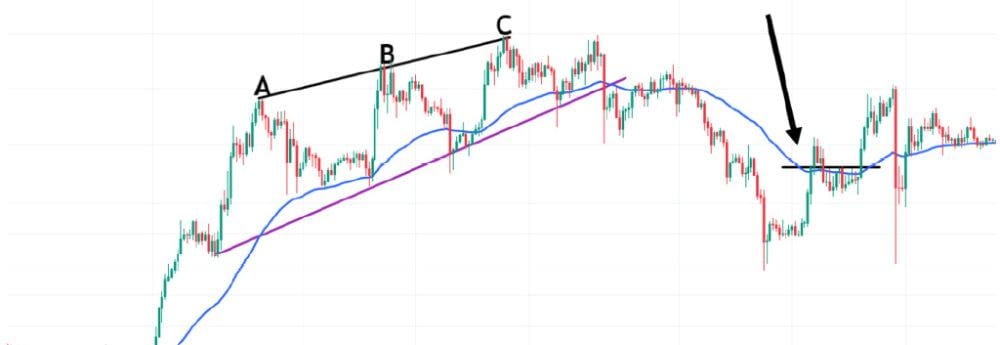
As mentioned many times before, moving take-profit can use tools like moving averages (MA), exponential moving averages (EMA), or trend lines to move take-profit. Only when the market closes above the tool you choose do you exit the trade.
For example, if you are using the exponential moving average EMA50, then when the price breaks EMA50, you need to be prepared to exit, as shown in Figure 3.8-9. The horizontal line marked by the black arrow is directly exited at market price once broken.
 Front insert line, back insert line
Figure 3.8-9
Of course, this is just an example. Whether to use MA or EMA, whether to use EMA20, EMA50, or EMA200 depends on your choice, as long as you maintain consistency.
In addition to the above two methods, there is a third method, which combines Method 1 and Method 2, and the effect is also good. This way you can use the fixed take-profit method to predict future trends in advance, thereby locking in some profits, and then use the moving take-profit method to control the remaining profits.
This is how to truly let profits run. Even if a sudden reversal occurs, you can still protect what you have and not give back the profits you've earned.
After reading the above explanation, I believe you have a clear understanding of the ascending wedge and know that it is a reversal pattern that belongs to counter-trend trading.
I have emphasized earlier that we should trade with the trend rather than against it. Therefore, how to more effectively use this pattern to profit in the trend is key. So how do we achieve this?
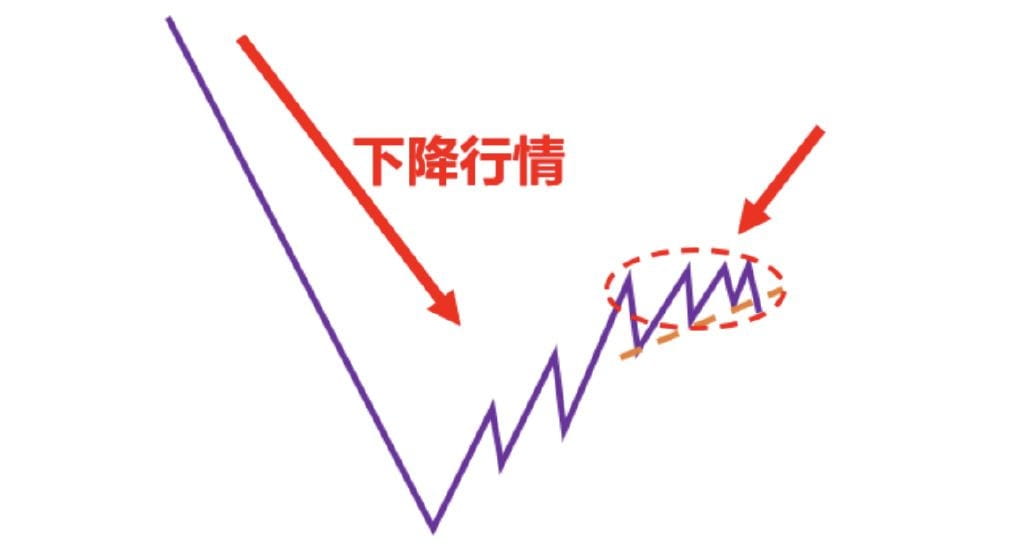
It's simple; we need to trade this pattern when the larger scale is in a downward trend, and when the smaller scale appears in an ascending wedge pattern, as shown in Figure 3.8-10.
 Front insert line, back insert line
Figure 3.8-10
Because when the smaller scale appears in an ascending wedge, it means that there may be a potential reversal in the smaller scale, and the potential reversal of the smaller scale may cause the market to reverse from an upward trend to a downward trend.
And our larger scale just happens to be a bearish pattern, so at this time, the smaller scale goes against the larger scale, and this is an opportunity for us to participate.
It is important to note that we need to switch the trading chart cycle to a smaller time frame, rather than observing in a larger time frame.
The purpose of doing this is to find more detailed entry signals. More importantly, your take-profit target is not just an equal distance; you can set it at the swing low of the larger time frame or based on Fibonacci tools.
This will greatly enhance your risk-reward ratio. If you operate in such a trending market using a fixed plus moving take-profit method, you will have a good profit space.
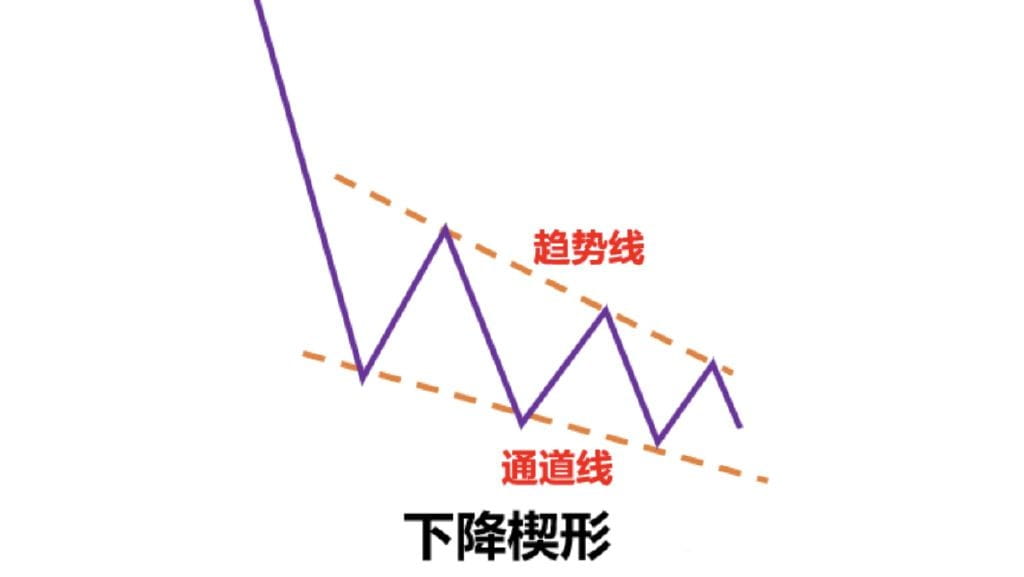
Having finished discussing the ascending wedge, we will now explain the descending wedge. The descending wedge is a bullish reversal pattern, as shown in Figure 3.8-11.
 Front insert line, back insert line
Figure 3.8-11
This pattern occurs in a downward trend. When the price rebounds from the bottom, it begins to enter a converging fluctuation, and as the price moves downward, the converging range becomes narrower and narrower.
Connecting the low points below as the channel line and connecting the high points above as the trend line, generally speaking, in a descending wedge, the slope of the trend line is much steeper than that of the channel line. This means that the formation speed of lower highs is much faster than that of lower lows, thus forming a wedge pattern.
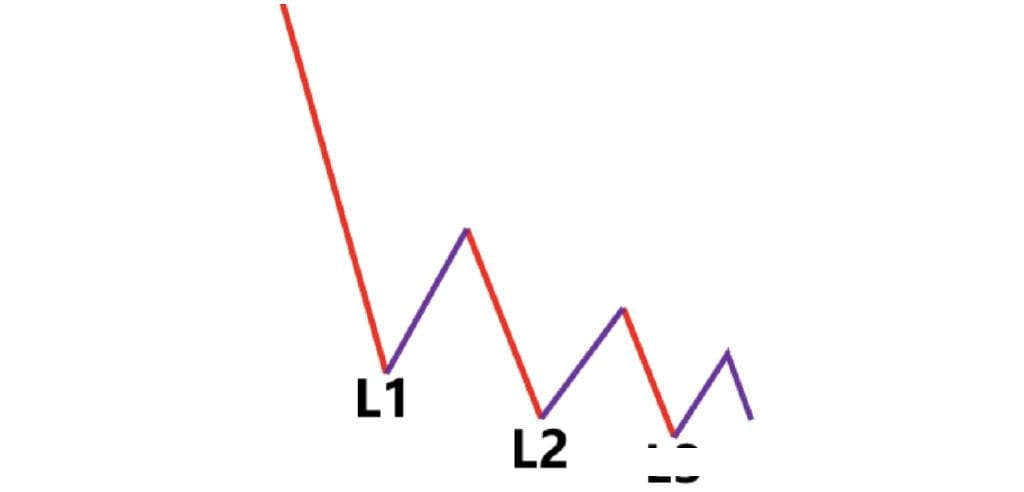
At the same time, we can clearly see that each segment of the decline is becoming flatter, as shown by the red line in Figure 3.8-12.
 Front insert line, back insert line
Figure 3.8-12
Although this pattern also continuously creates lower lows, this series of lower lows and lower highs makes retail buyers feel that the trend is still bearish.
But we can see that the distance between each low is getting smaller, as shown in Figure 3.8-. That is, the height of L3 minus the height of L2 should be less than the height of L2 minus the height of L1, which is L3- L2< L2- L1.
This also means that selling power is becoming weaker, and momentum is weakening. If you use momentum indicators, regardless of whether it is MACD, RSI, or KDJ, you can observe the emergence of a bottom divergence.
Therefore, the descending wedge pattern is a pattern of insufficient bearish momentum, and most of the time it pushes three times, meaning it has pushed down three times, so this pattern is also called a three-push wedge. Of course, there can also be two pushes and four pushes.
Therefore, at this time, the buyers dominate, which may cause a reversal. The reason for the reversal is insufficient momentum, but insufficient momentum does not necessarily lead to a reversal.
In fact, many traders will think that the bullish confirmation of this pattern will only be possible after the downward-sloping trend line is broken. At the time of the breakout, the trading volume should expand or rise, which can be considered as confirmation.
Personally, I prefer to consider a valid breakout only when it breaks above the recent swing high. The breakout of a horizontal resistance line is always more effective than the breakout of a trend line and easier to confirm, because trend lines always have multiple interpretations.
Now that we have learned how to identify the descending wedge, we can discuss how to trade the descending wedge pattern, which is the entry method for the descending wedge.
Generally speaking, the descending wedge pattern is a bullish reversal pattern. Many traders will only be interested in the breakout of the trend line, and they will trade based on the breakout of the trend line and pullback.
Personally, I am still interested in horizontal resistance lines. Therefore, the entry methods for the descending wedge are divided into the following three types. You can also use these three methods to trade the breakout of the trend line.
Method 1: Enter at market price after breaking the horizontal resistance line.
Method 2: Enter at market price when the highest price of the bullish candle breaks through.
Method 3: Enter when the price breaks through the horizontal resistance line and retests the resistance line.
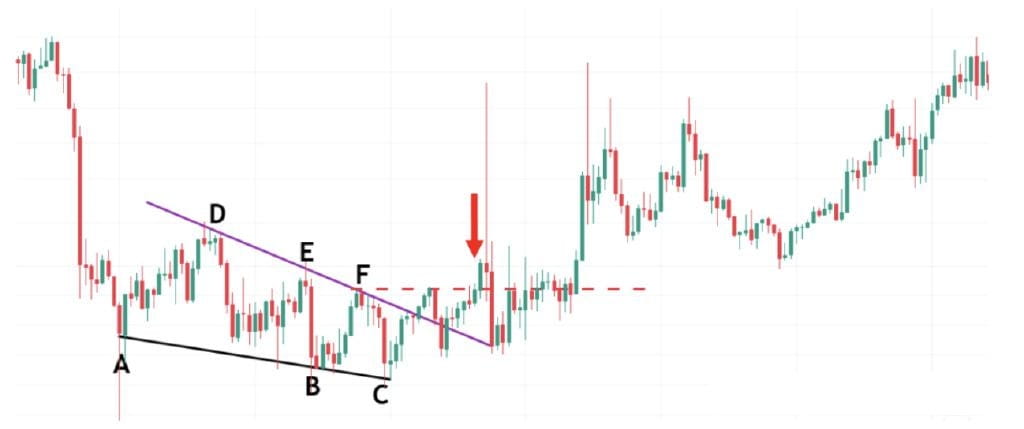
Let's first look at Method 1, as shown in Figure 3.8-13,
 Front insert line, back insert line
Figure 3.8-13
We can see that the figure continuously creates new lows, but the amplitude of the lows is getting smaller. Connecting points A, B, and C forms the channel line.
At the same time, connect points D, E, and F to form the trend line, while we draw a horizontal resistance line from point F.
When the price breaks through the horizontal resistance line, directly enter at market price. This is the first aggressive method.
The advantage of this technique is that you might get the best entry price. But the downside is that the price may reverse, which can easily lead to a false breakout, and you can easily be stopped out.
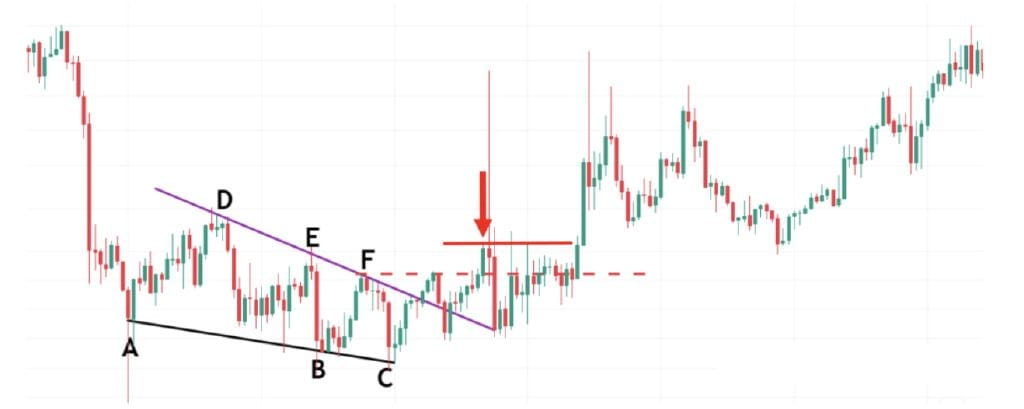
Let's look at Method 2, as shown in Figure 3.8-14.
 Front insert line, back insert line
Figure 3.8-14
In the figure, we find the bullish candle that breaks the support line. The red arrow marked K-line is the one we draw a red horizontal line based on the highest price of this bullish candle. When the next K-line breaks this horizontal line, we directly enter at market price. This is the method of entering at market price when the highest price of the bullish candle breaks through.
So using Method 2 greatly reduces the probability of false breakouts. This is the advantage of this method, reducing false breakouts.
The downside of this method is that if the buyers are too strong, the closing price of the waiting bullish candle will be relatively high, meaning your entry price will be higher than Method 1. However, it is relatively more conservative than Method 1.
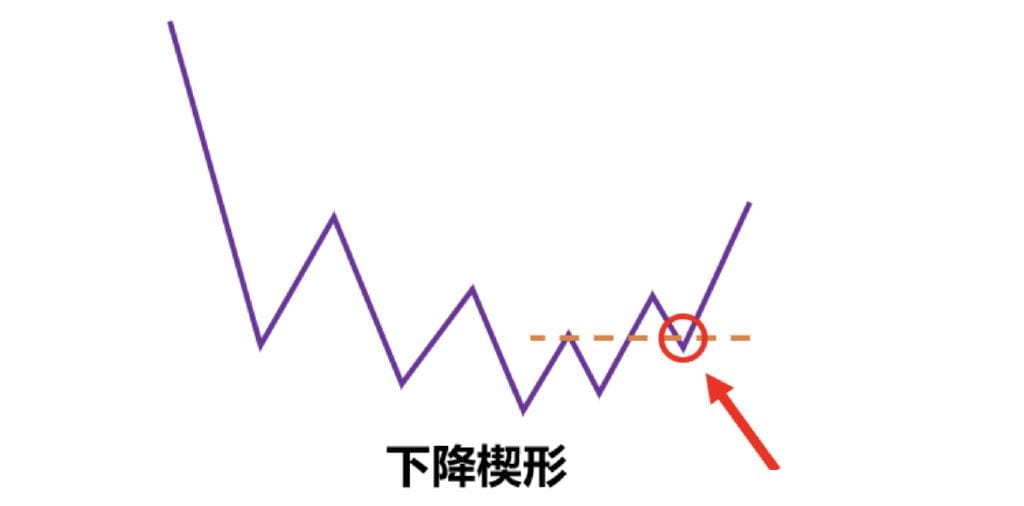
Let's look at Method 3, which is after breaking through. When it retests the resistance line, if a bullish signal K-line appears near the resistance line, then enter directly at the market price of the highest price of the bullish signal K-line, as shown in Figure 3.8-15.
 Front insert line, back insert line
Figure 3.8-15
Waiting for a retest to go long has the advantage of being low-risk and having a high risk-reward ratio. However, sometimes it may not give you a chance to pull back; the price could break through directly and fall sharply, leaving you anxiously watching.
Through the explanation of the above three methods, I believe you will have a clearer understanding of entering the descending wedge. You may wonder which method is better. In fact, there is no best method; you need to decide on your entry strategy and continuously practice in numerous trades.
Let's talk about how to set stop-loss for the descending wedge.
As I have discussed multiple times, the stop-loss should be set at a position that, once broken, will invalidate this trading pattern. Facing the descending wedge pattern, the stop-loss should be at a position that completely invalidates this pattern.
For the descending wedge, some will also use the channel line to place orders for left-sided trading.
This means that when traders notice that the market price has pushed down twice, they will realize that this may be a descending three-push wedge pattern. At this time, they will draw trend lines and channel lines based on two highs and two lows.
Most descending three-push structures do not reach the channel line at the low point of the third push. Even if they touch the lower channel line, they will quickly be suppressed by buyers, indicating insufficient selling momentum.
So placing orders with the channel line is also a trading method for some left-sided traders, who generally choose their stop-loss below the channel line.
However, if the channel line is strongly broken, it will reach these traders' stop-loss points, causing more selling pressure and driving the price down.
So, no matter which method you use to enter, you can observe whether the lowest point of the descending wedge has broken through the channel line. If it has broken through the channel line, then you can set the lowest point as the stop-loss. If it has not broken, then set it near the channel line, as shown in Figure 3.8-16.
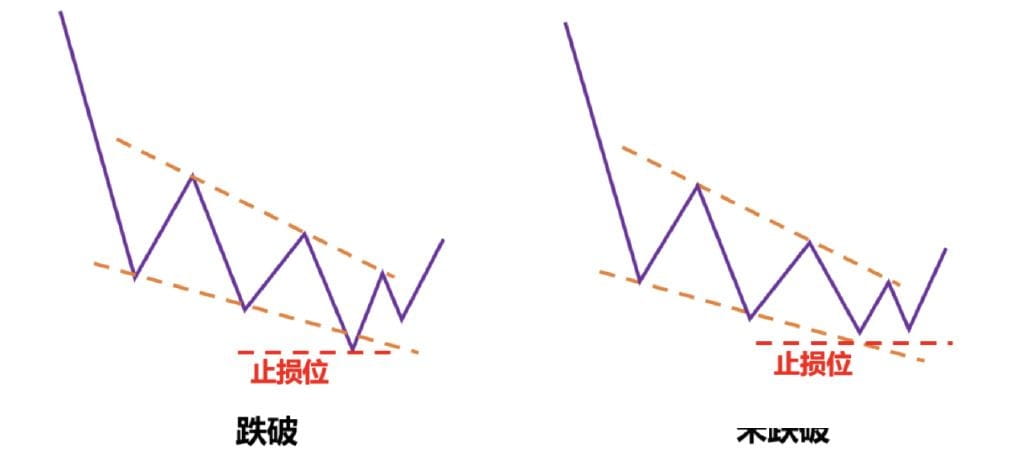 Front insert line, back insert line
Figure 3.8-16
Of course, if you enter with Method 3, then you can use this as your wide stop-loss position and set the recent small wave low as your narrow stop-loss position.
For the same take-profit target, a narrow stop-loss will definitely yield a higher risk-reward ratio than a wide stop-loss. However, the win rate will also relatively decrease. How to balance these two relationships varies from person to person.
Finally, let's see how to set take-profit to maximize profits. You can use three commonly used techniques, which are the three methods we discussed earlier in the continuation of patterns, and they also apply to reversal patterns.
Method 1: Fixed take-profit method, as shown in Figure 3.8-17,
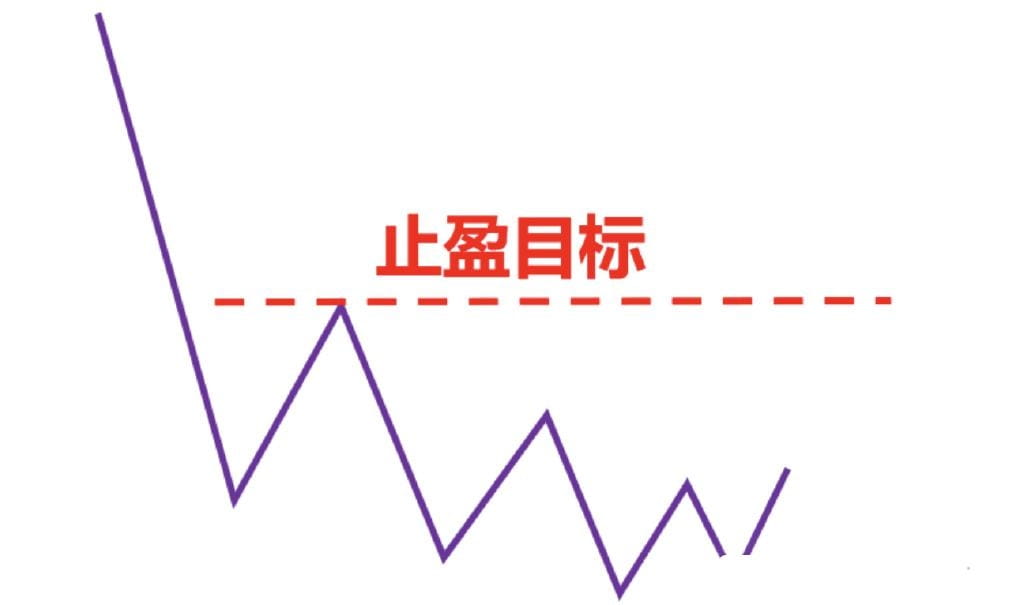 Front insert line, back insert line
Figure 3.8-17
The descending wedge is a bullish reversal signal, meaning that this market was originally a healthy downward trend, but due to insufficient selling momentum or other reasons, the price could not continue to push down. At this point, we do not know whether the seller will give up directly or is willing to short again at a higher price.
So for a downward market, most traders will look for resistance at the swing highs and trade with the trend. That position is the take-profit position for counter-trend trading, which is also the starting point of the wedge pattern, as shown in Figure 3.8-18.
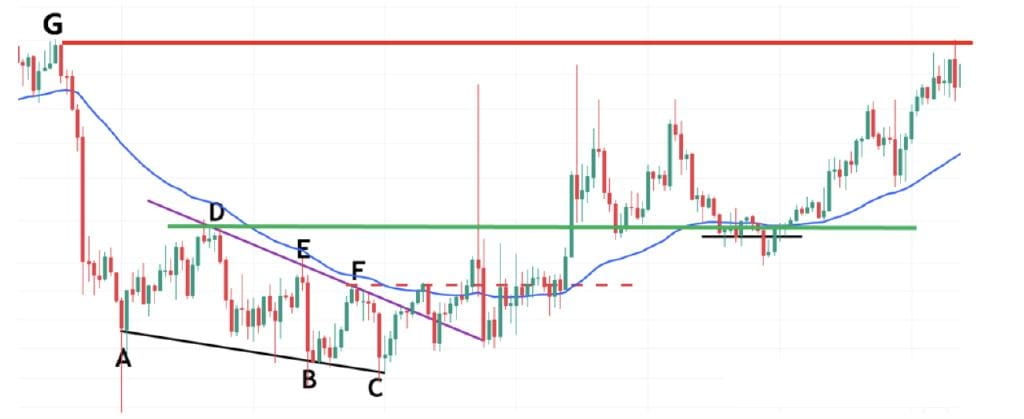 Front insert line, back insert line
Figure 3.8-18
We can see that we draw a red horizontal resistance line from the starting point G of the wedge pattern. We see that the price subsequently reached this horizontal line and was met with resistance, which is the starting point of the first push, belonging to an aggressive take-profit method.
You can also draw a green horizontal resistance line from point D. We see that the price subsequently reached this horizontal line and met with resistance, which is the starting point of the second push, belonging to a conservative take-profit method.
Of course, if this wedge causes a counter-trend reversal, it will lead to a larger upward trend, so we also need Method 2: moving take-profit.
As mentioned many times before, moving take-profit can use tools like moving averages (MA), exponential moving averages (EMA), or trend lines to move take-profit. Only when the market closes above the tool you choose do you exit the trade.
For example, if you are using the exponential moving average EMA50, then when the price drops below EMA50, you need to be prepared to exit, as shown in Figure 3.8-19. The horizontal line marked by the black arrow is directly exited at market price once broken.
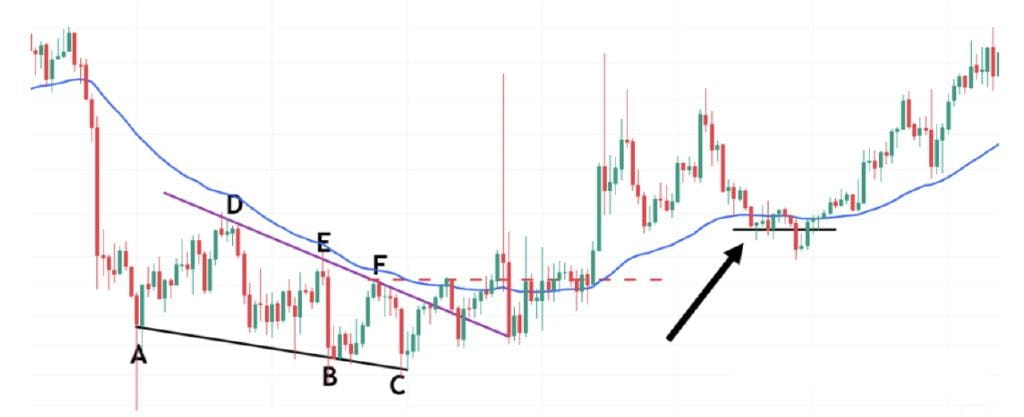 Front insert line, back insert line
Figure 3.8-19
Of course, this is just an example. Whether to use MA or EMA, whether to use EMA20, EMA50, or EMA200 depends on your choice, as long as you maintain consistency.
In addition to the above two methods, there is a third method, which combines Method 1 and Method 2, and the effect is also good. This way you can use the fixed take-profit method to predict future trends in advance, thereby locking in some profits, and then use the moving take-profit method to control the remaining profits.
This is how to truly let profits run. Even if a sudden reversal occurs, you can still protect what you have and not give back the profits you've earned.
After reading the above explanation, I believe you have a clear understanding of the descending wedge and know that it is a reversal pattern that belongs to counter-trend trading.
I have emphasized earlier that we should trade with the trend rather than against it. Therefore, how to more effectively use this pattern to profit in the trend is key. So how do we achieve this?
It's simple; we need to trade this pattern when the larger scale is in an upward trend, and when the smaller scale appears in a descending wedge pattern, as shown in Figure 3.8-20.
 Front insert line, back insert line
Figure 3.8-20
Because when the smaller scale appears in a descending wedge, it means that there may be a potential reversal in the smaller scale, and the potential reversal of the smaller scale may cause the market to reverse from a downward trend to an upward trend.
And our larger scale just happens to be a bullish pattern, so at this time, the smaller scale goes against the larger scale, and this is an opportunity for us to participate.
It is important to note that we need to switch the trading chart cycle to a smaller time frame, rather than observing in a larger time frame.
The purpose of doing this is to find more detailed entry signals. More importantly, your take-profit target is not just an equal distance; you can set it at the swing low of the larger time frame or based on Fibonacci tools.
This will greatly enhance your risk-reward ratio. If you operate in such a trending market using a fixed plus moving take-profit method, you will have a good profit space.
The above is a complete explanation of the wedge pattern, including its characteristics, entry methods, stop-loss methods, and take-profit target settings. In the next chapter, we will start discussing neutral patterns.
I am Xiaodantao, a professional analyst and teacher, a mentor and friend on your investment journey! As an analyst, the basic requirement is to help everyone make money. Solve your confusion and help you when you are lost. Follow Xiaodantao for guidance.

