

The crypto market in 2025 is no longer that speculative feast where you can get rich by closing your eyes and buying, nor is it the carnival where KOLs' shouts can trigger FOMO. In this new cycle, the thresholds of information, barriers of strategies, speed of execution, and gaps in cognition are gradually widening the distance between retail investors and the market core; trading is increasingly resembling a form of 'capital permission.'
In today's world of high-frequency trading, black-box models, on-chain arbitrage, and emotional signals, the rules of the market game have long been restructured. For the vast majority of ordinary investors, they are faced not with 'which coin to buy,' but with a more fundamental dilemma — where do strategies come from?
One, when the threshold for trading is no longer capital, but 'strategy assets.'
The market is increasingly resembling a game with limited seats.
You will find that true alpha is not in the hot lists of public domain traffic, nor in the rapid news forwarded by KOLs. It hides in some undisclosed trading groups, in some undisclosed models, or in some on-chain arbitrage paths known only to leading strategy traders.
Strategies have already transformed from 'public knowledge' into 'private assets.'
It is no longer a logic that can be articulated, but a closed resource that can only be obtained through 'buying courses,' 'renting models,' 'subscribing to signals,' and 'joining groups.' In this structure, retail investors are not investing but paying for the entry threshold — paying tuition to enter a closed-loop knowledge monopoly system.
In other words, trading has become a service industry, and you are the recipient of the service, not the producer of the strategy.
Two, KOLs do not bring cognitive upgrades, but judgment outsourcing.
The existence of KOLs essentially replaces systematic cognition with some personalized narrative.
In a market filled with chaotic information and tight rhythms, most people do not have the time or ability to independently build their strategy models, so they start to 'outsource' their judgments to one more 'authoritative' person after another. Those with more followers, louder voices, and frequent calls are given the label of 'worthy of trust.'
You no longer ask 'Why do this?' but only ask 'Did he buy it?'
Over time, a dangerous trading method has been quietly accepted: not thinking before placing an order, but acting only when seeing a signal. But the real problem is that this dependence is precisely the inertia that the market structure wants you to form.
When judgments are outsourced, risks are also outsourced; when you only focus on 'results' and ignore 'principles,' you are destined to play the role of the 'last baton holder.'
Three, what AIW3 cares about is not 'who can take you flying,' but 'can you become a producer of strategies.'
In a time when most platforms are selling 'signals,' what AIW3 aims to do is something more fundamental and challenging: to make strategies no longer a service, but an asset that can be put on-chain, verified, composed, and shared.
It is not about making you a smarter follower, but about making you someone who can 'publish strategies.'
We raise a more fundamental question:
When every trading action can be recorded and structured, when every piece of logic can be encapsulated into modules, does it mean that — trading strategies already possess all the elements to become a 'composable asset on-chain'?
If possible, then trading is no longer a purely personal act, but a product that can be packaged, disseminated, and operated. A strategy is not just an 'idea' shown in a screenshot, but an executable 'contract object'; you are not betting on a single direction, but accumulating your own trading portfolio.
Four, AIW3 is not a 'signal square,' but a complete 'strategy casting system.'
AIW3 is not just a platform, but provides a complete infrastructure for strategy generation, validation, deployment, and profit distribution.
We hope —
The behaviors you generate in daily trading can be automatically captured as potential strategy prototypes;
The logic you combine can be published as a standard strategy with one click;
The strategies you are willing to share can be called upon and reused by other users, with profits automatically calculated by contracts;
The strategy combinations you design can even generate corresponding strategy tokens, serving as long-term on-chain asset certificates.
Press enter or click to view image in full size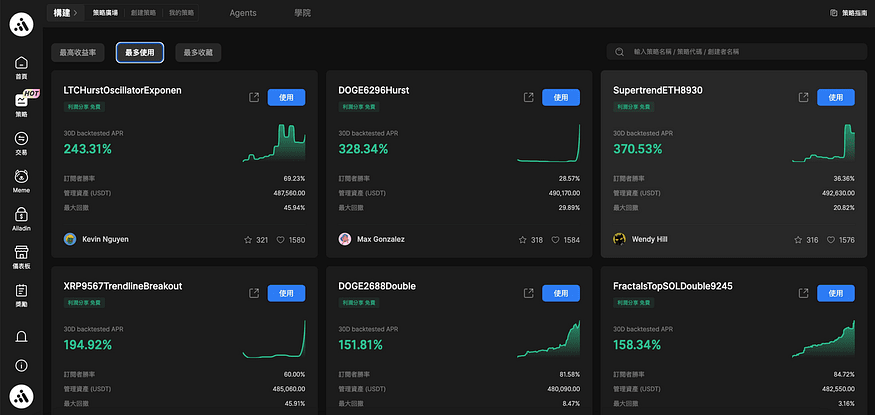
You are no longer an anonymous, passive market participant, but a member of the strategy production network, where your actions, thoughts, and logic will accumulate into your own on-chain IP.
In the future on AIW3, every trader can have their own Sharpe ratio, win rate, number of subscriptions, and asset level, just like developers on GitHub accumulate prestige through projects — strategies are also a form of code, a type of work.
Five, breaking the 'strategy gap' between retail investors and institutions is not about education, but about tools.
The gap between retail investors and institutions has never been about cognition, but about system capabilities.
The vast majority of people do not lack understanding of the market, but lack the tools to translate their judgments into structured strategies. Each of their entry and exit judgments is based on experience and intuition, leaving no trace to follow, verify, or optimize afterward.
Institutions are different. They do not trade directly; instead, they first set up models, make small trial-and-error attempts, and then continuously scale up execution through parameter optimization. This is not because they are smarter, but because they have better 'strategy reproduction capabilities.'
AIW3's goal is to decentralize this capability of 'strategy industrialization' to ordinary users.
Press enter or click to view image in full size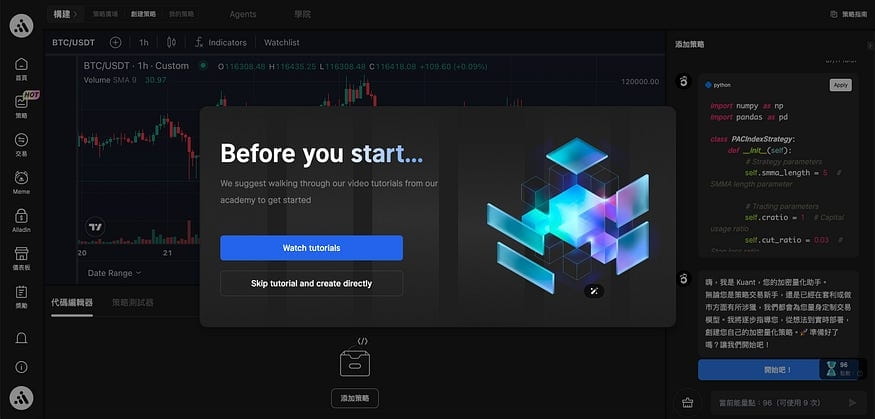
Everyone should have the right to transform their trading behavior into strategy modules and earn usage profits based on effectiveness. Every judgment should not be wasted, but should leave a trace in the system, to be called upon by their future selves or others.
Six, in conclusion: If 2021 was the year of calls, 2025 should be the 'year of strategy assetization.'
We are often asked one question: What is different about AIW3 compared to other platforms?
Our answer is very simple:
They make you rely on others for profit; we hope you rely on yourself for profit and let others profit from using your strategies.
They make you copy homework; we hope you write textbooks.
They treat strategies as services, while we treat strategies as assets.
If the past market resembled a game of information asymmetry, where the fast win and the strong eat first; then what AIW3 aims to do is to truly turn strategies into a 'public good on-chain' that can be owned, called upon, and monetized by everyone.
It is no longer a series of signal indicators, but a complete trading operating system.
Next time when you want to ask 'which coin to buy now,' perhaps you can think in a different direction:
'Can I create a strategy that others are willing to pay to use?'
AIW3 is here to address this issue.
🔗Platform entrance
Website : https://aiw3.ai/
X : https://x.com/AIW3_ai
Docs :https://aiw3.ai/docs
Telegram community: https://t.me/AIW3_ai