

In the eyes of most traders, a strategy is a kind of logic, a model that iterates on historical data, a craft of 'gambling on others' expectations' during speculative cycles. However, from AIW3's systematic perspective, a strategy is not just a thinking model, but an 'asset unit' that is about to enter the main stage of trading — just like liquidity, order books, and PnL, it becomes an underlying module that can be run, verified, used, and profited.
The problem is: For a strategy to become a true asset, it is far from enough to rely solely on encapsulated logic; it must also be able to 'execute', be 'run in real markets', be 'placed on high-quality liquidity', and leave a verifiable performance track. Only then can a strategy meet the conditions for transformation from content to product, from model to asset.
And this is precisely the structural breakthrough that AIW3's current round of integration upgrade has achieved.
I. The core obstacle to the assetization of strategies is not 'design', but 'deployment'.
For a long time, strategy creators in the crypto world have faced a harsh reality: designing a strategy is difficult, but running a strategy is even more difficult.
You may have repeatedly optimized a logically clear opening and closing system in Python or TradingView, or debugged a parameter set with dazzling annualized returns through historical data. But when you genuinely try to deploy the strategy to the trading scene, you find that you are faced with a broken execution path:
CEXs cannot execute across platforms; market data on Binance cannot be synchronized on OKX;
The gap between simulated strategies' slippage, delay, and real trading is huge, making it difficult for subscribers to trust performance;
On-chain strategies, while having transparency, lack deep order market and trading matching efficiency;
Without a unified strategy execution engine, the user's calling path and profit settlement system are disconnected at multiple levels.
Therefore, 'strategy assets' often stop at PPT and cannot be transformed into real chain units that can be called, subscribed to, executed, and profited. The logic is strong, but it cannot run; it can run, but it cannot receive money; someone subscribes, but it is difficult to verify; ultimately, it can only brush data in simulated competitions and miss the real assetization window.
II. AIW3 builds a three-layer execution closed loop: Logic → Execution → Profit Sharing
AIW3's system upgrade is not a simple functional update of 'integrating multiple exchanges', but a full-chain reconstruction of strategy execution paths, profit realization paths, and user usage paths. We decompose the operational foundation of strategy assets into three key layers:
Logical Layer (Strategy Logic)
Users can encapsulate each trading behavior (such as long-short judgment, take-profit stop-loss, indicator triggers) into structured strategy templates through the AIW3 platform, with accompanying parameter settings, input signals, and risk control rules.
Execution Layer
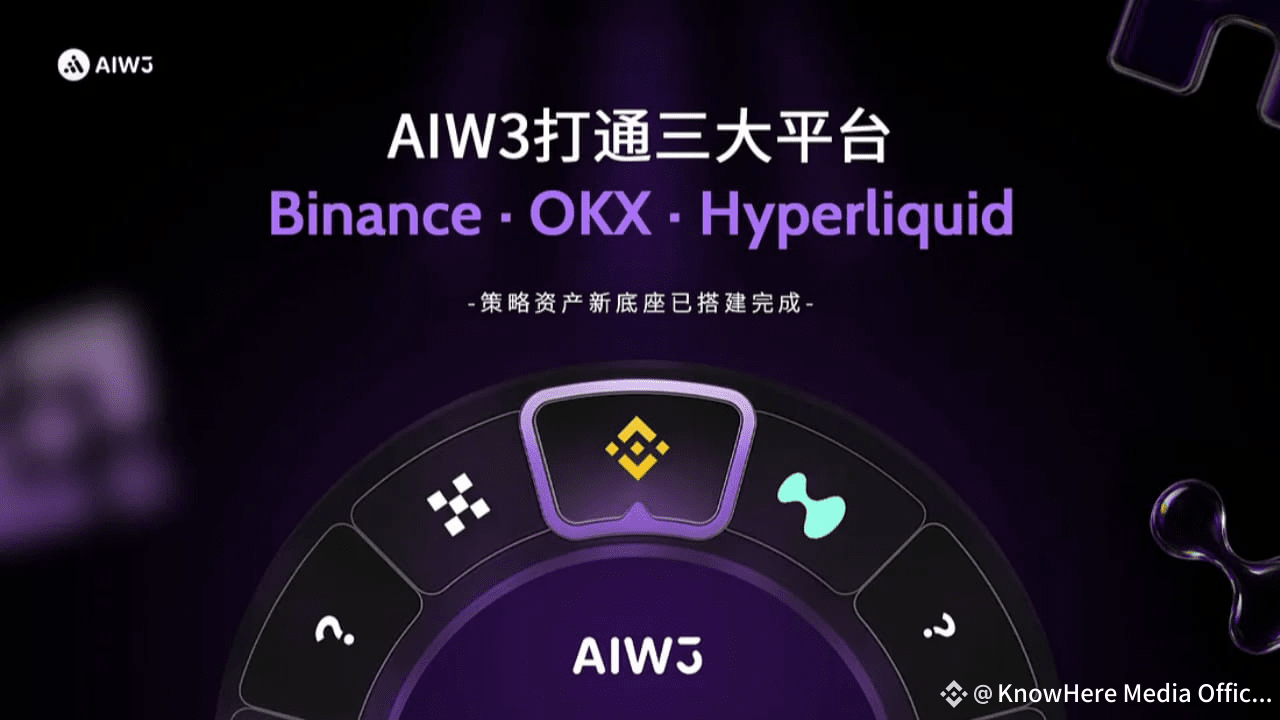
Currently, the centralized real trading channels of Binance and OKX are connected with Hyperliquid's on-chain smart contract channels. Strategies can be placed in real order books with one click and execution instructions are automatically distributed based on user subscription volume. The platform on which the strategy is placed, the frequency of execution, and whether to pursue low slippage and high transaction rates can all be customized.
Verification & Revenue Layer
Every real trading execution will be recorded, marked, and reflected in public indicators such as the strategy's Sharpe ratio, drawdown rate, subscription numbers, historical profit and loss, etc. The profit behavior of subscribed users will automatically settle the income of strategy providers, forming a true 'trading is monetization' profit-sharing closed loop.
These three layers constitute the main link of strategy assets' 'issuance, execution, profit', and the key to connecting this chain lies in our construction of a liquidity cooperative structure that connects CEXs and on-chain execution environments.
III. A strategy is not a model; it is a 'liquidity execution unit' mounted on the market.
The most common mistake made by traditional strategy designers is overestimating the complexity of logic and underestimating the infrastructure of execution.
A strategy with a high Sharpe ratio, if it cannot stably run in real markets, cannot match counterpart transactions, and cannot solidify profit and loss feedback into on-chain credit data, is essentially just 'looking clever', but can never enter the market.
The true credit of strategy assets comes from both ends:
Which markets are upstream mounted on? Can it match high-quality liquidity?
If the strategy is placed on the Binance deep market, you can obtain high-frequency feedback with low slippage and immediate execution; if deployed on Hyperliquid, you can achieve on-chain transparent settlement and non-custodial execution control.
Is there a profit realization channel downstream? Can subscription calls and profit sharing be completed?
AIW3 provides a complete subscription profit-sharing system, ensuring that the profit and loss results of any caller will map to the strategy creator's income ledger, completing the mechanism of 'strategy as a source of income'.
On this basis, strategy creators are no longer just 'authors', but 'node operators' of the order execution network. Strategies are not written, but placed, run, and used. The credit of the strategy is not in tweets or charts, but in the real order book, in the on-chain settlement path, and in whether you can be continuously called by others.
IV. AIW3 connects not only platforms but also the system foundation of strategy assets.
The current integration of the three major platforms (Binance, OKX, Hyperliquid) essentially completes the closed-loop path of strategy assets from 'designable' to 'deployable' to 'verifiable' — from blueprint to on-chain, from signal to order, from personal use to others' subscription.
The changes it brings are not just a few 'deployment buttons' added to the interface, but a complete transformation of the lifecycle structure of strategies as 'derivatives of trading behavior':
Users can choose to deploy strategies in the order books of centralized CEXs or in on-chain automatic execution environments;
Strategy creators can manage the logic of multi-platform order placement uniformly and receive unified profit sharing;
The system provides a full set of risk indicators such as Sharpe and execution visualization data, forming a public credit system;
The entire platform has the deployment flexibility and system efficiency of 'multi-platform execution + single account calling'.
We are not building a strategy community, but constructing a 'production, operation, and liquidity coordination network for strategy assets'. Each trader can leave verified strategy records in this system, form a real credit history, and publish their logic as callable on-chain asset modules.
V. In conclusion: The new phase of strategy assets belongs to systems that can operate, be placed, and afford.
When we talk about 'strategy assetization', we are essentially looking for a method that allows trading logic to have a lifecycle closed loop: it must be able to be published, executed, access real market liquidity, provide feedback on profit results, and be used collaboratively with others. Any missing link will cause strategy assets to degenerate into a simulation game.
Today, AIW3 has built a truly operational foundation for strategy assets through the centralized deep order books provided by Binance and OKX, the on-chain Builder Code execution environment of Hyperliquid, and its own strategy encapsulation and profit-sharing engine.
It is not an executor of a certain strategy, nor an agency interface of a certain platform, but a set of infrastructure networks that can transform trading behaviors into verifiable, callable, and profitable assets. Every trader, every set of logic, and every execution path can ultimately become a 'liquid information asset node'.
This means that future strategy platforms will no longer compete on UI or backtesting reports, but on who has higher quality liquidity coordination capabilities, a more complete execution history system, and a more sustainable subscription profit-sharing structure. The three major platform integrations completed by AIW3 provide dual guarantees of 'operable + receivable' execution and liquidity for this new cycle.
The moment when a strategy truly becomes an asset is not when you finish writing it, but when it is called, placed, verified in the real market, and jointly brings profits for you and others.
You are not running a strategy alone; you are an 'execution unit' and 'value node' in a strategy network. What we are building is to turn every path between you and the market into a callable value interface.
Platform Entry
Website : https://aiw3.ai/
X : https://x.com/AIW3_ai
Docs : https://aiw3.ai/docs
Telegram community: https://t.me/AIW3_ai