
Date February 28, 2026
Author fabianocsaraujo1925
Featured Assets$BTC $ETH $ADA $XRP
🌊 Introduction
The Crypto Ocean and Its Inhabitants
In the vast ocean of the cryptocurrency market, there are small fish (retail investors), medium fish (the "dolphins"), and of course, the feared whales🐳🐳. But who are these giants that, with a simple tail movement, can create waves that drown or elevate the market?
A crypto whale🐳 is any entity, individual, company, investment fund, or even government; that holds a sufficiently large amount of a cryptocurrency to influence its price with a single transaction. For Bitcoin, for example, the limit is usually 1,000 BTC or more. For altcoins, it can be any wallet that holds more than 1% of the circulating supply.
But let's go beyond the basics. In this article, we will dive deep into the latest data from 2025-2026 to reveal who these giants are, where they concentrate, and how you can monitor them.
📊 Who Are the Biggest Whales in the Market?
1. Corporate Whales
Where Institutional Money Swims
Public companies that have adopted Bitcoin as treasury reserve are perhaps the most famous and monitored whales.
Strategy Inc (formerly MicroStrategy): The number 1 corporate whale. Under the leadership of Michael Saylor, the company has accumulated over 200,000 BTC over the years. Every buying or selling move (although they only buy) is closely monitored by millions of traders.
Bitcoin Miners: Companies like Marathon Digital (MARA) and Riot Platforms (RIOT) are also significant whales, accumulating the BTC they mine on their balance sheets.
2. Governments: The Whale No One Expected
Did you know that one of the largest holders of Bitcoin in the world is the United States government? Through seizures of illegal operations like Silk Road and the Bitfinex hack, the U.S. government has accumulated an estimated 328,372 BTC [text revision of previous analysis]. This stock, valued at over $20 billion, makes Uncle Sam a sleeping whale — but one that could wake up at any moment.
3. The Exchanges: The Whales that Hold Other People's Money
The wallets of exchanges like Binance and Coinbase are among the largest in the world, but with a crucial difference: they represent the funds of millions of users, not decisions of a single entity. Still, when these whales move (internal transfers, cold storage migrations), the market interprets it as a signal.
4. The Original Whale: Satoshi Nakamoto
The anonymous creator of Bitcoin mined about 1.1 million BTC in the early days of the network. These coins have never been moved, making Satoshi the definitive "sleeping whale." If these BTC ever wake up, the market will tremble.
5. The Early Believers: The Winklevoss Twins and Others
Individuals who got in early, like the Winklevoss twins, who bought a massive amount of Bitcoin after the deal with Facebook, also feature on the list of the first known whales.
📍 Where Do Whales Live? The Habitat of Giants
On-chain data from CryptoQuant reveals that whales have a preferred habitat: Binance.
Absolute leader in whale activity: Binance not only leads in large transaction volume but also in the number of individual whale transactions. There are over 56 million whale transactions, compared to ~16 million of its closest competitor, HTX Global.
Why does this matter? This concentration gives Binance unmatched liquidity. For a trader, this means tighter spreads and the ability to execute large orders with minimal impact on price. Thus, Binance's order book is one of the most accurate thermometers of institutional sentiment.
In addition to exchanges, whales also inhabit cold storage wallets for long periods, a behavior known as "silent accumulation." This is what we recently saw with XRP and Cardano.
🎣 How Whales Influence the Market (In Practice)
1. Creating Traps with Derivatives
A classic example recently occurred with XRP. The asset formed a head and shoulders top pattern that projected a 20% drop. Open interest spiked, and funding rates became strongly negative (a sign that many traders were short).
What happened? Instead of falling, XRP reversed and rose by 6%. The whales, who had accumulated 150 million XRP (around $200 million) during the panic, absorbed the supply and turned the breakdown into a trap for bears.
Moral of the story: When open interest rises and funding becomes very negative, pay attention. It may be a trap set by the sharks.
2. Silent Accumulation During Market Weakness
While the price of Cardano (ADA) fell more than 71% in six months (from $0.90 to $0.26), whales were buying. Data from Santiment shows that large holders (wallets with 100,000 to 100 million ADA) accumulated 819 million tokens during this period, equivalent to $213.9 million.
They now control nearly 70% of the circulating supply of ADA. This does not mean that the price will rise tomorrow, but it shows that confidence behind the scenes has not diminished — and that the available supply for trading is becoming increasingly scarce.
3. Behavior in Corrections: Market "Anchor"
During the October/November correction of 2025, a specific group of whales accumulated 36,000 BTC in 14 days, helping to soften the declines during negative macro events. Conversely, in deeper declines (below $100,000), whales with more than 1,000 BTC took profits — not out of panic, but as a tactical move.
4. The Science Study: Whales Are "Receivers," Not "Transmitters" of Shocks
A recent academic study published in ScienceDirect revealed a surprising truth: contrary to popular perception, whales are net receivers of shocks, while small investors ("minnows") and mid-sized investors ("dolphins") are the transmitters.
What does this mean? Small investors react more to market shocks and hedge expectations (fear), while whales move in a more strategic and less emotional manner. They do not cause panic; they surf the wave created by it.
📱 How to Track Whales (And Use It to Your Advantage)
The transparency of blockchain allows anyone to monitor whales. Here are the main tools and what to observe:
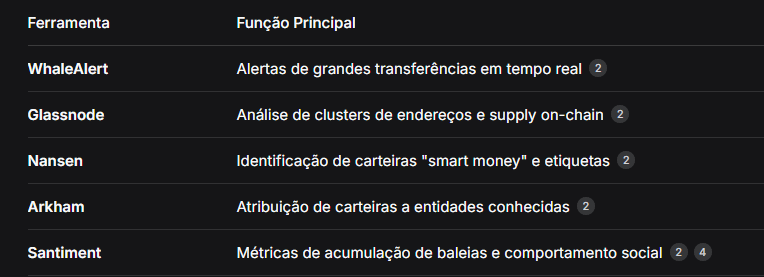
The signals you should monitor:
Whales sending crypto to exchanges: May indicate preparation for sale (bearish pressure).
Whales withdrawing crypto from exchanges (to cold storage): Classic sign of accumulation and long-term vision (bullish).
Dormant wallets that suddenly wake up: May precede large movements.
Increase in the number of wallets with 100+ BTC: In 2025, this group grew by 0.47% in a few weeks, adding about 91 new whales. It is a sign that capital is concentrating in strong hands.
🧠 Conclusion: What Whales Reveal About the Market
Whales are neither villains nor saviors — they are rational participants operating on a different scale than ours. Monitoring them will not give you the exact answer of when to buy or sell, but it will offer you valuable context about where capital is flowing.
The most important message from the 2025-2026 data is: whales accumulate in fear and distribute in euphoria. While retail sold ADA during a 71% drop, whales bought. While leveraged traders bet against XRP, whales absorbed the supply.
In the end, understanding whales is understanding that the market is cyclical and that the biggest profits go to those who have the patience and capital to swim against the current.
And you, do you already monitor whales or prefer to swim in the dark?