

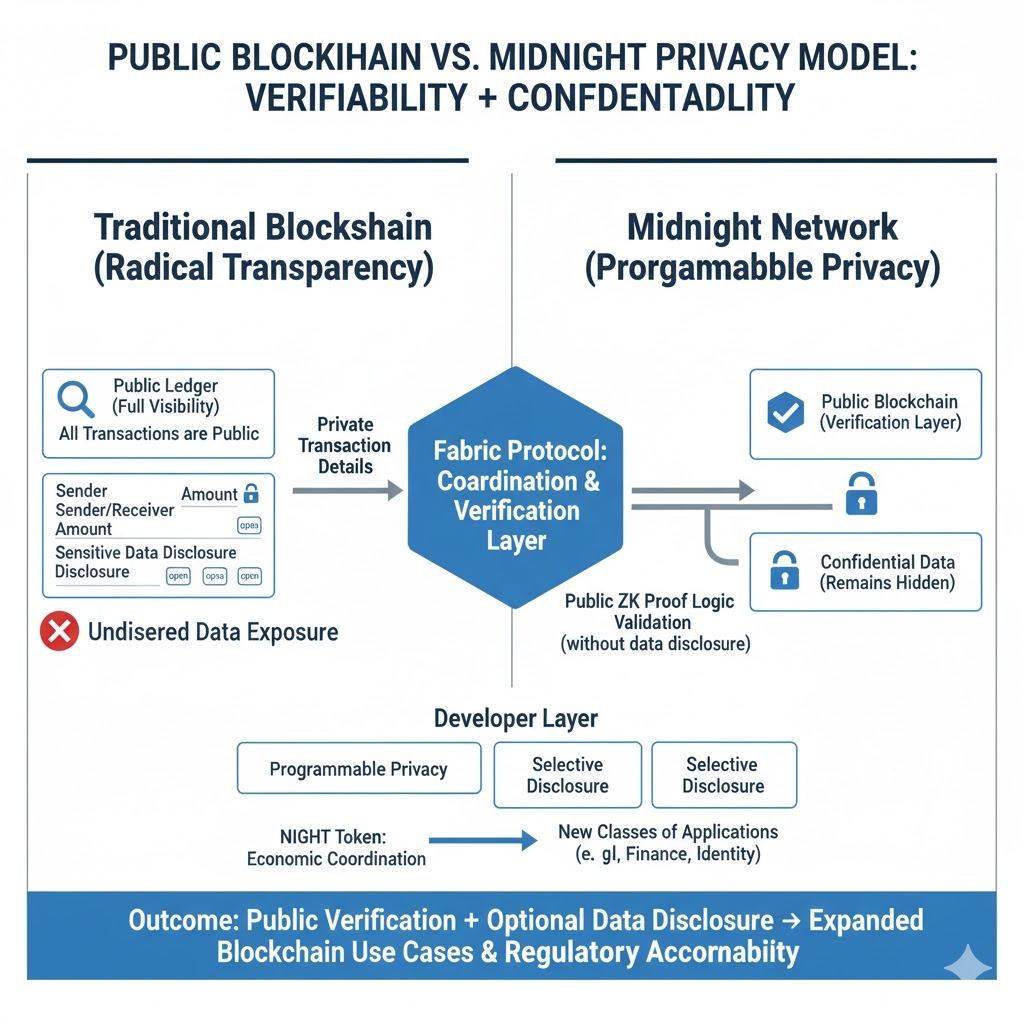
Over the years I’ve noticed that one of the most persistent structural tensions in crypto isn’t about technology, it’s about visibility. Public blockchains were designed for radical transparency, yet many real world financial systems rely on controlled privacy. As institutions explore blockchain infrastructure, the question increasingly becomes whether networks can preserve verifiability without exposing every piece of data.
That question is what first made me curious about the @MidnightNetwork . Rather than framing privacy as an ideological goal, the design appears to approach it as an infrastructure problem. The interesting part is that the network seems built around a simple premise: privacy systems will only scale if they can coexist with regulatory accountability.
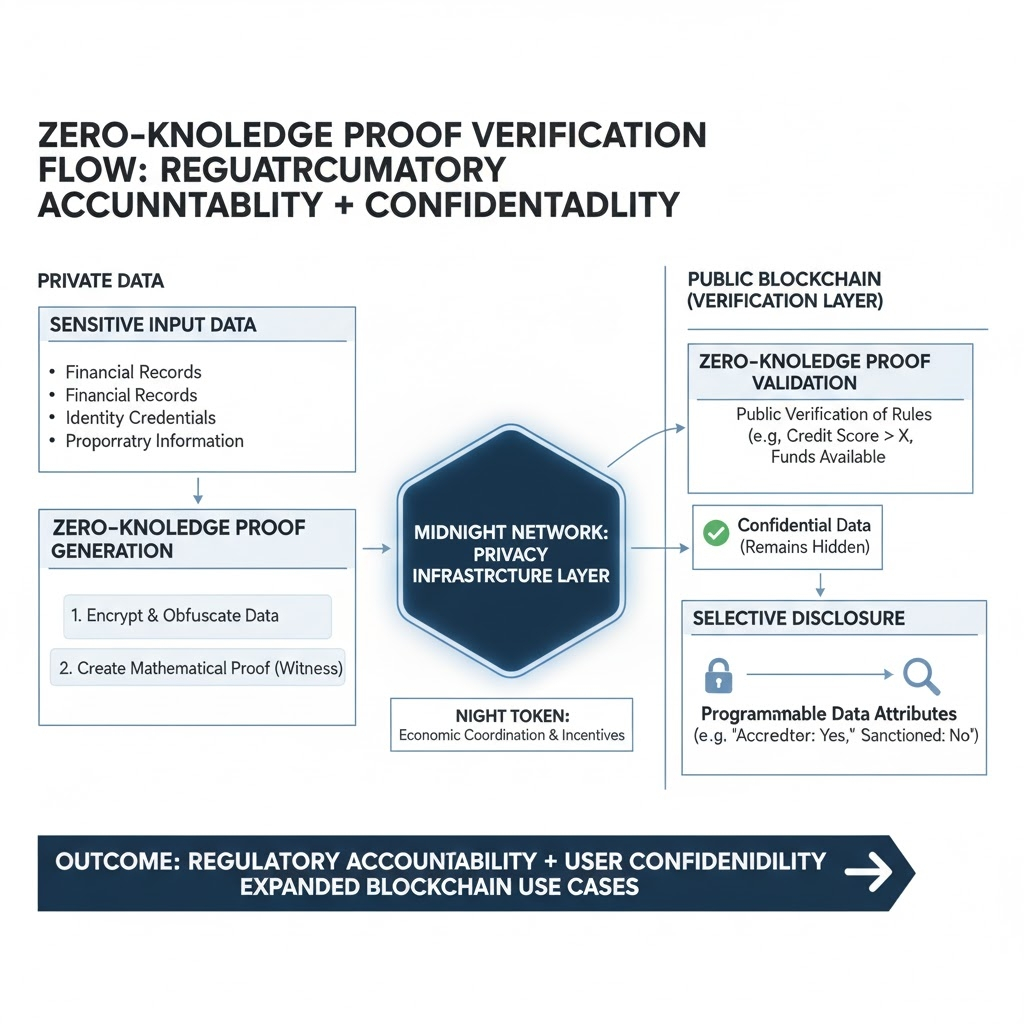
The technical foundation behind this idea relies on Zero Knowledge Proofs. This provides a way for individuals to show that a transaction meets specific requirements without having to divulge any of the private information associated with that transaction, the nature of which I believe is a shift in focus from data being hidden to being proven correct
From an architectural standpoint, it fosters the division of verification from the identification of all users. The network is able to confirm that every transaction adheres to the protocol rules while still allowing privately felt confidentiality between the parties to those transactions. This new architecture allows for a preservation of the public blockchain's trust model, combined with greater flexibility in terms of data visibility
Where this becomes particularly important is at the developer layer. Privacy infrastructure only becomes meaningful when it is programmable, allowing applications to define which information remains confidential and which elements can be selectively revealed. Additionally, systems that support this type of programmable privacy will generally allow for the development of completely new classes of applications, particularly where confidentiality is required by the nature of the business or industry.
The economic coordination layer is based on the #night Token, which can be characterised as providing multiple functions, including enabling transactions, facilitating the participation of validators, and aligning incentives among participants in the network. What I tend to watch closely is whether the economic model encourages long term participation rather than short term activity.
Early signals around privacy focused infrastructure often appear in predictable ways: developer experimentation, early stage tooling, and conversations around institutional use cases. These signals are useful, but they rarely provide clear answers about long term adoption. In my experience, the real test of infrastructure is whether applications eventually emerge that cannot function without it.
That may ultimately be the most interesting question around networks like Midnight. If programmable privacy becomes a foundational requirement for certain types of decentralized applications, then systems designed around selective disclosure could become quietly essential. Crypto markets often move quickly around narratives, but infrastructure tends to reveal its importance slowly, usually through the behavior of developers building on top of it.
#BTC #ETH #Write2Earn #TRUMP $COS $BANANAS31
