

I think Midnight can help identity applications become more practical, and this is perhaps one of the most notable use cases of this project.
The reason is quite simple. Identity on the blockchain sounds very reasonable, but upon closer inspection, it always has a rather annoying contradiction. On one hand, the system needs to know who you are, or at least needs to know what qualifications you have to participate in a certain service.
On the other hand, if everything is public or forces users to submit their entire personal data, then what is called identity on-chain can easily become a data leak machine on a larger scale than Web2.
In my view, this is why many identity stories in Web3 sound good, but when put to real use, they start to reveal too much friction.
Midnight is trying to wedge itself into that bottleneck.
The point I find noteworthy is that they do not see identity as 'putting all records on the chain and then trying to protect it'. They are going in a much different direction: proving a truth about identity without exposing the entire identity.
This is where selective disclosure starts to make real sense.
It may sound like a technical detail, but if you think about it, this is a significant difference. In real life, most identity systems do not actually need to know everything about you. They just need to know a few very specific things.
An app needs to know if you are over 18, but does not need to know your exact birthdate, home address, and document number.
An employer needs to know whether your qualifications are real, not your entire accompanying personal data.
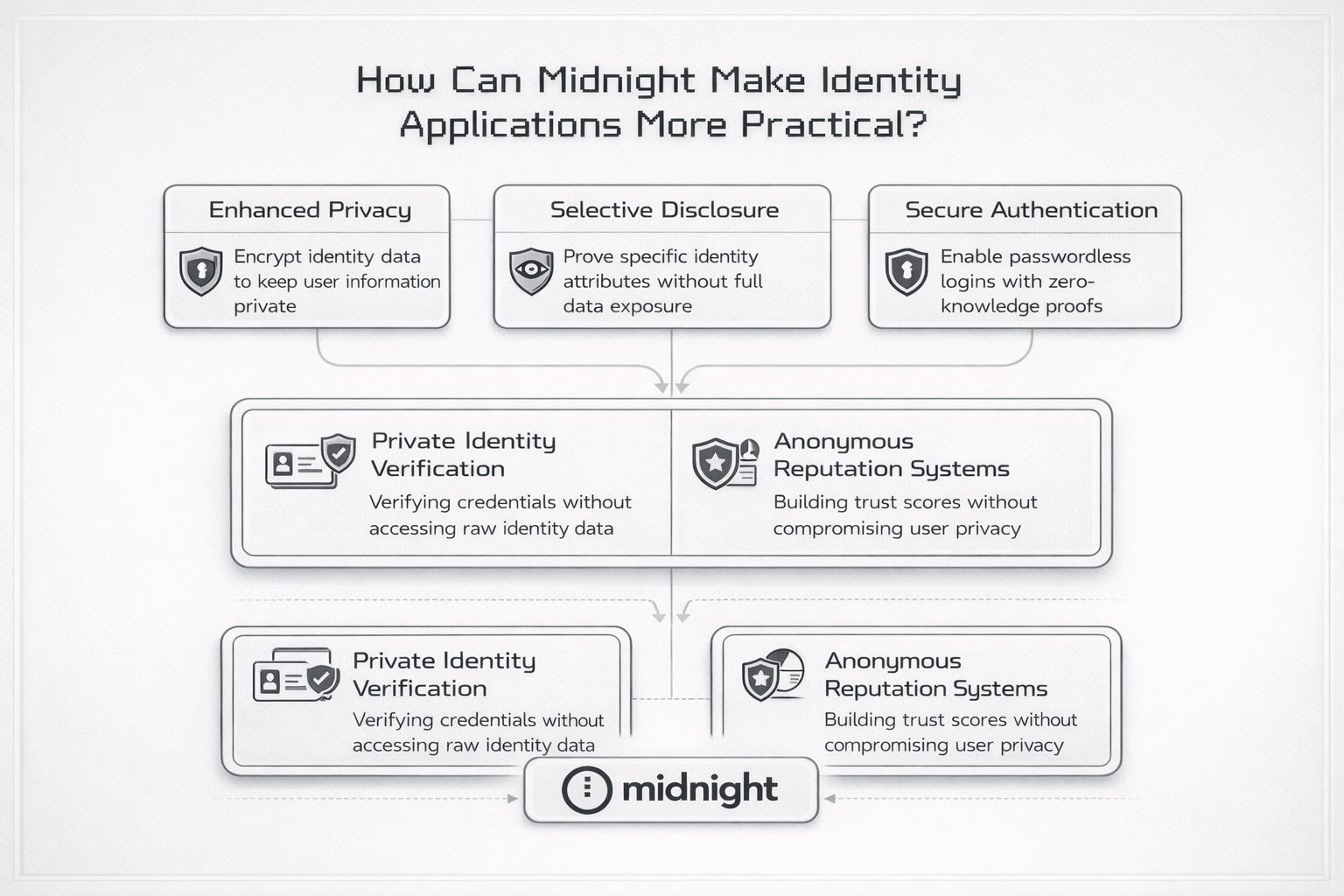
A financial platform may need to know if you meet certain credit conditions, but it does not necessarily need to see your entire financial situation.
In my view, this is when Midnight makes the identity story more realistic.
Instead of forcing users to publicly disclose all their data just to prove a small point, Midnight is moving in the direction of allowing users to only prove the necessary parts.
If this model operates as their thesis suggests, then identity on the blockchain will seem less like a problem of 'exchanging privacy for verification' and closer to a system where users can still be verified without being overly exposed.
I think this is why ZK proofs become important in this story, but not in a way that end users must understand what ZK is to see the value.
The real value lies in the fact that data can be kept on the private side, while what goes out is just proof that a certain condition is true.
This changes the nature of identity applications quite a bit. Because instead of storing and transmitting the entire set of sensitive data over the network, the system only needs to handle the proof part.
For me, there is a significant difference between identity as a usable product and identity as a beautiful idea on paper.
Another point that makes me see Midnight aligning with the identity use case is that they do not treat privacy as just an exterior layer.
Here, privacy is what makes identity less absurd.
Because to put it bluntly, many previous identity models in Web3 face a familiar problem: the more they try to increase verification, the easier it is for users to feel like they are being closely monitored.
This is especially frustrating in contexts like membership, voting, credential verification, or KYC. You want the system to know you are qualified, but you do not want your entire interaction history or personal data to be tightly linked to the chain in a way that anyone can scrutinize.
Midnight is trying to address exactly that.
A person can prove they are a valid member of a community without disclosing their full identity.
A person can participate in voting without turning all their activities into public data.
An application can check credentials or KYC without having to gather a whole warehouse of sensitive user information into one centralized point.
In my view, this is why Midnight can make identity apps more realistic not just for users, but for the organizations behind them as well.
For businesses or platforms, identity is not just about verifying users. It is also about compliance, risk management, and legal accountability.
If an identity system forces platforms to hold too much sensitive data, then that platform also has to bear additional operational, legal, and attack risks.
But if the system allows them to only check the necessary parts without having to hold all the data, the entire model becomes much lighter.
This is where I find Midnight's thesis quite pragmatic. They are not just trying to protect the user. They are also trying to create a model so that identity applications do not have to choose between two equally unpleasant things: either weak privacy or overly complex operations.
Another point I find notable is that Midnight also thinks about developer adoption, and this is extremely important if we are talking about identity really entering products.
There are many technologies that are correct in principle but do not go far because it is too difficult for developers to build. Identity apps are even more sensitive because they lie at the intersection of UX, data, and compliance. If the stack is too difficult, most teams will not touch it.
Midnight is trying to lower that barrier with Compact.
For me, its significance does not lie in how modern this language sounds, but in how it helps developers approach privacy-preserving smart contracts in a more familiar way.
If developers can build identity logic without delving too deeply into cryptography right from the start, the chances of having a real product will be much higher.
This is a small detail, but I think it is very important. Identity does not become a real market just because of technology alone. It only becomes a real market when there are enough builders turning that technology into usable apps.
Of course, I do not think that selective disclosure and ZK alone are enough to conclude everything is done.
Identity is one of the hardest areas because it always encounters edge cases. There are cases that require many layers of verification. There are legal requirements that vary by region. There are users who do not care about what technology they are using; they only care about whether the experience is simple.
And there is also a very real question: do organizations, DEXs, or platforms out there really want to integrate this type of identity, or do they still choose the familiar way that is less private?
In my view, this is the real test of Midnight.
But if we only consider the orientation layer, I think they are asking the right questions. Identity on the blockchain will not be more practical just by gathering more data or pushing more credentials onto the chain.
It only becomes more realistic when users can prove themselves without having to disclose too much, and when applications can verify without having to turn themselves into a repository of sensitive data.
Midnight is trying to stand right at that point.
So if you ask me if Midnight can help identity applications become more realistic, the answer is yes.
Not because they are making identity 'stronger' in a superficial sense, but because they are trying to properly fix the core contradiction of digital identity: how to ensure that the system knows enough, but not too much.
If they can pull off a real app, real integration, and real usage in this direction, then this will not just be a privacy story anymore. It will be a real step forward for identity in Web3 to become less idealized and closer to how the world can use it in real life.
@MidnightNetwork $NIGHT #night