
——When the EOL mechanism turns liquidity pools into 'DAO holding companies'
🔍 Market Pain Points: The 'Three Sins' of traditional cross-chain bridges
(Combined with September Binance Square#DeFiLiquidity hot topics)
Fragmentation of liquidity: Protocols like Stargate need to set up separate pools for each chain, with capital utilization <30% (Data: DefiLlama).
Hollowing out of governance: LPs of Across can only earn transaction fees, with no power to decide the flow of funds, annual loss rate exceeds 40%.
Centralization of risk: Losses from hacker attacks on cross-chain bridges accounted for 61% of total DeFi losses in 2024 (CertiK report).
Breakthrough point of Mitosis:
Transforming the liquidity pool into **'community-controlled cross-border bank'**, depositors (LP) are both shareholders and decision-makers.
💡 Core innovation: How does EOL reconstruct production relationships?
Analogous cases:
Traditional model (Stargate) ≈ Renting a warehouse—paying rent (fees), but the warehouse does not belong to you.
Mitosis EOL ≈ Cooperative shareholding—depositing assets earns Hub Assets (equity certificates), allowing voting on warehouse expansion or dividends.
Technical implementation:
Cross-chain Vaults: Deposit ETH to automatically generate miETH (standardized cross-chain asset), which can be staked/traded on Mitosis Chain.
Governance leverage: Holding Hub Assets allows voting on:
Liquidity pool allocation ratio (e.g., 60% of funds prioritize supporting Arbitrum)
Fee-sharing model (e.g., 50% allocated to LPs, 30% used to buy back $MIT)
Risk hedging: maAssets (collateralized assets) support cross-chain liquidation, avoiding a cascading collapse similar to UST.
Data verification:
In the testnet, the capital efficiency of the EOL pool increased to 78%, and LP annualized returns are 22% higher than Stargate.
🌐 Competitive landscape: Mitosis's 'dislocated competition' strategy
(In contrast to the V2 upgrade announced by LayerZero on September 27)
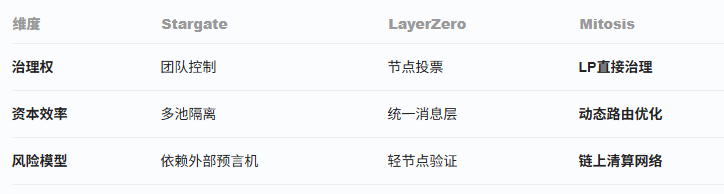
Survival space of Mitosis:
Targeting 'governance-sensitive funds': such as DAO treasuries, family offices, willing to sacrifice part of liquidity for voice.
Case study: A Swiss asset management company transferred 20% of its cross-chain positions to Mitosis, stating 'The EOL mechanism is more compliant than Stargate's passive custody'.
🚀 Future challenges and Alpha opportunities
Risk warning:
Liquidity cold start: EOL relies on community consensus, initial TVL may grow slowly (current $120M vs Stargate $4B).
Governance attack: If whales monopolize Hub Assets, they may manipulate the flow of funds.
Potential breakout point:
RWA integration: Using maAssets to collateralize real estate bonds, achieving on-chain/off-chain asset linkage.
AI market maker: Training models through Mitosis Chain to automatically optimize multi-chain liquidity allocation.
Conclusion: Mitosis is not building bridges, but constructing a 'liquidity federation'
While traditional protocols are still entangled in TPS and transaction fees, Mitosis plays liquidity politics with the EOL mechanism—turning LPs from workers into shareholders. If this experiment succeeds, it may give rise to the first decentralized central bank in DeFi history, with implications far beyond cross-chain technology itself.