
Recently,
A token called ASTER has become popular in the cryptocurrency space.
just completed the token issuance,
and the price rose several times within just a few days,
triggering discussions among many communities and investors.
but I observed a very interesting phenomenon:
The Google Trends search heat for ASTER actually peaked before the price soared.
This made me start thinking about a question:
"Is Aster driven by price or is price driven by emotions?"
This article aims to start from the case of ASTER,
exploring the relationship between search heat and price,
and what we can learn from it.
[What is ASTER? Why did it become popular?]
ASTER is the native token of a decentralized perpetual contract trading platform,
focusing on multi-chain trading and generating yield from collateral asset models,
and propose an innovative trading mining mechanism.
Its predecessor was APX, which recently completed a brand overhaul.
the team has received investment support from well-known institutions such as Binance Labs,
former Binance CEO Zhao Changpeng (CZ) has also been reported to have hinted at support,
the market's expectations increased significantly.
After ASTER officially launched on 9/17,
the coin price surged rapidly, attracting significant attention.
[How do search volume and price change?]
I entered "Aster" on Google Trends to observe the changes in search heat, and found a key point:
The Google Trends search peak appeared on September 20
The highest price point for ASTER appeared on September 24
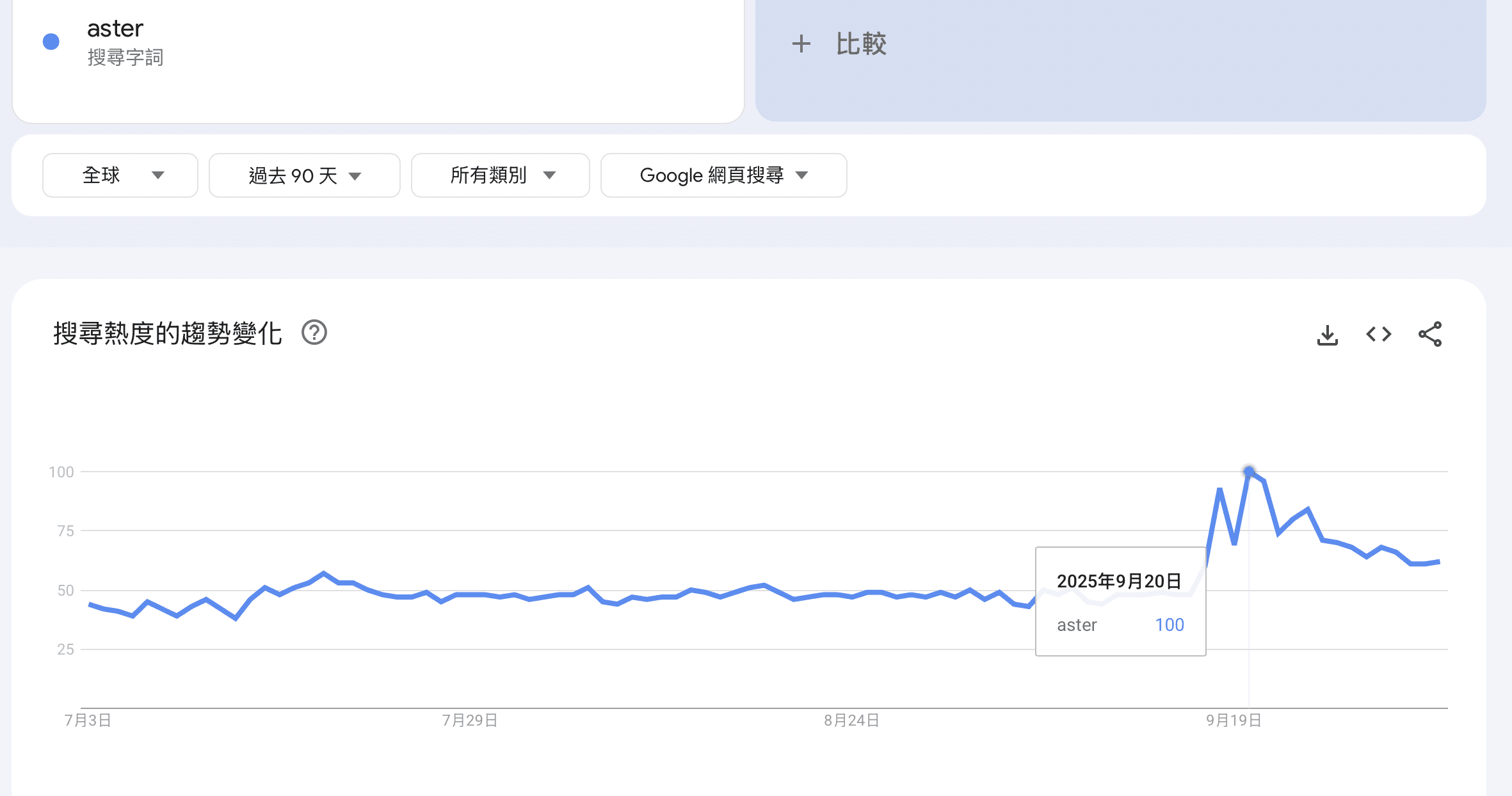
In other words, three days before the price peaks,
the search heat had already "reached its peak."
we might all wonder,
should be when the price has risen to its highest point,
which attracts everyone's attention,
which further drives up search volume.
But actually, it's not the case.
in the case of Aster,
Search heat reached its peak first,
the coin price then rises,
This also indicates that certain events are driving the coin price.
[What happened with Aster?]
Aster officially launched on 9/17.
It is also the time when exchanges gradually opened for trading,
Therefore, on this day, the first wave of search volume will be raised.
However, many new coins decline after this wave ends,
search volume will start to decline,
but Aster has not decreased but rather increased,
it turns out that on 9/18, Binance's former founder CZ posted congratulating Aster: https://x.com/cz_binance/status/1968358873556992120
under the media's rush to report and heated discussions in the community,
Search volume further increases,
while also driving up the coin price.
Aster's search volume peaked on 9/21,
and the price fell after peaking on 9/24.
This process actually aligns very well with the common "emotional-driven cycle" in the cryptocurrency space:
from search → curiosity → entry → driving up price → triggering more attention → price peak appears.
[Can search volume be used as a leading indicator?]
The case of ASTER gives us an important reminder:
In the cryptocurrency space, emotional heat (like search volume) often reacts to prices earlier.
and this pattern of heating up market sentiment is a common characteristic of many new coins exploding in a short time.
In other words, if you can pay attention when the search heat just starts to rise, you might discover opportunities a step earlier.
You don't need to wait until the price has risen by 100% to start researching what this coin is. Through things like:
Google Trends (to check changes in search heat)
Keyword monitoring on Reddit / X (Twitter)
These can all serve as clues for you to discover hot coins early.
and through observing heat changes, to determine the timing of entry and exit.
However, it is still necessary to remind about the risks.
Even if search volume surges,
under the overall poor market conditions,
which may lead to results that do not meet expectations,
Therefore, we must not take search volume as the only indicator.
[Disclaimer]
This content is for informational sharing and educational purposes only, and does not constitute any form of investment advice, trading recommendation, or financial planning guidance. Investment involves risks; please assess carefully according to your own situation and consult a professional financial advisor before making decisions. The author and this platform are not responsible for any losses caused by the use of this information.