
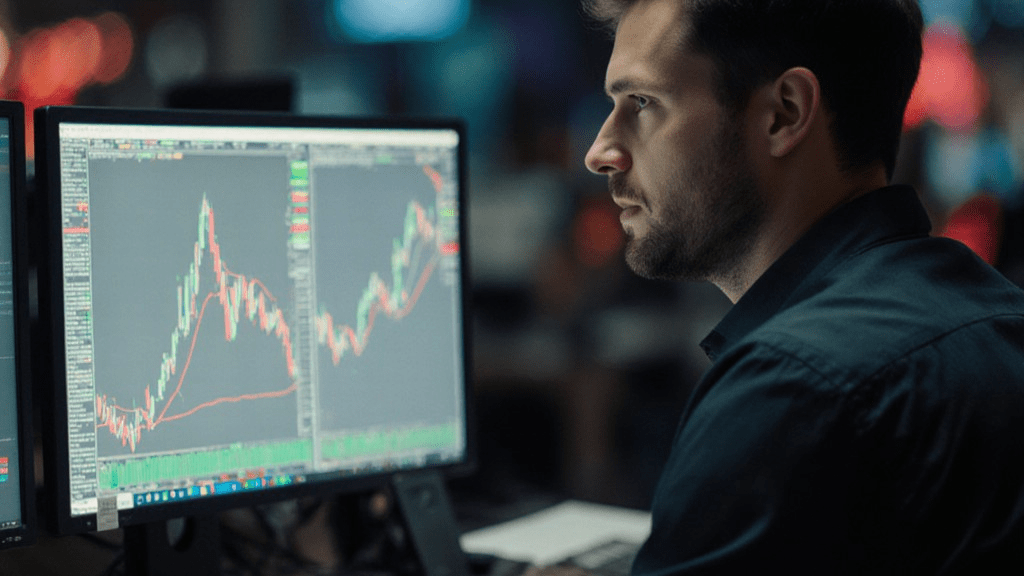

Intuition does not work for trading. Rules do.
It doesn't matter how sharp you think your instinct is; if you rely on gut feelings or that 'sense' that the market is going to move in a certain direction, you are playing a dangerous game. The reason? Markets are not a casino (although they may seem like one to many). Money flows from impatient hands to patient hands, from those without a plan to those with a clear strategy.
The ruthless logic of the market
Behind every market movement, there is something that governs it: liquidity. This liquidity mostly comes from a huge group of operators who have no idea what they are doing. For every hundred traders who enter the market, there is one who knows how to transfer that liquidity to their portfolio. What we're saying here is brutal but true: trading is not about frantically chasing money, but about planning.
Trading is strategy, method, probabilities. It is applied mathematics and statistics, not magic or superstition. If you've ever wondered why your trades didn't work out, it might be time to admit that you don't have a system. Or worse, that you have one, but you don't follow it.
Does intelligence help in trading? Maybe not as much as you think.
One of the great lessons you'll learn on this journey is this: IQ has no direct relationship with returns. In fact, knowing too much can work against you. Why? Because excessive analysis can paralyze you.
Information overload can make you doubt just when you should act. And this brings me to one of the most relevant quotes from Warren Buffett and Charlie Munger, the geniuses behind Berkshire Hathaway:
“Eating mistakes is essential, as long as the correct ones outweigh the incorrect ones.”
In other words, mistakes are inevitable, but if you don't learn from them, you're finished. THAT'S IT.
Lessons from the electric fence (yes, the metaphor is literal)
Will Rogers, quoted by Munger several times, said:
“There are three types of people: those who learn by reading, those who learn by observing, and those who have to pee on the electric fence by themselves.”
I was in the third group. I needed to learn through blows and electric shocks, figuratively speaking. I discovered that trading experience is not learned from a book or by watching others trade. It is learned by losing money and, most importantly, understanding why you lost it. Because if there's one thing that's true in the world of trading, it's this: the market will not spare you. It will take everything from you before giving you something (if it ever gives you anything).
Mistake as opportunity
For months, I felt stuck. I made the same mistakes over and over again. I sabotaged myself just when all the conditions to enter a trade were aligned. I overanalyzed. I looked for excuses not to enter. And when I saw the market moving in the right direction, I reacted impulsively (later) and entered trades where the conditions were not met. Result: months of total inconsistency.
It was then that I established the first trading rule for myself, quoting Warren Buffett:
“DON'T BE CONSISTENTLY STUPID.”
Rules, management, and the importance of time in the market.
The problem wasn't the market. It was my execution. I realized that I needed a system that included three fundamental pillars (this clearly has a development that I've been shaping with my mentor):
Clear rules that must be followed before entering a trade.
Calculated risk management before each trade.
Time in the market: experience cannot be bought or learned in a course. It can only be gained by trading.
The ignorance of market dynamics.
Another big mistake I made was underestimating market dynamics. I thought that just reading candles and basic patterns was all I needed. What ingenuity. If it were that simple, institutions wouldn't spend millions on advanced software or teams of data analysts.
This reminded me of Jesse Livermore, the legendary American trader from the early 20th century. Livermore did not make decisions based on gut feelings. He studied the flow of orders, the volume, and understood the psychology of the markets.
One of the techniques he used to gain an advantage was the meticulous reading of buy and sell orders that came through the tickers, which were the devices that transmitted real-time information about stock transactions.
I didn't trust my instinct; I trusted the data. And here I was, along with many like me, trading with x20-x50 leverage because I "felt" that #BTC was about to drop or rise. Now I laugh at myself. Livermore became a millionaire in 1900 with analysis and strategy, and I intended to do the same in 2025 with intuition and blind faith. Ridiculous, right?
It's all about balance
Trading is a balancing act. It's not about punishing yourself for trading on intuition, but also not ignoring your mistakes. One of the most valuable recommendations you will receive as a trader is this: keep a diary of your trades.
Note why you entered, why you exited, and what happened afterward. This habit will transform your trading style. But there's something more important than a diary: the temperamental advantage.
Successful traders are not mathematical geniuses. They are people with enough composure not to be knocked down by mistakes. They know that losses are inevitable and that there is no way to avoid them. The only thing you can control is your system and your mind.
Conclusion: trading is not for everyone
The market is relentless. When I first heard this, I felt frustration boiling my blood. Was trading not for me? It won't be for you if you're not willing to accept losses, learn from your mistakes, and trade with a clear and defined system; it would be best to remain a passive investor.
Because, as Charlie Munger said:
“If you're not willing to see the market drop by 50% without panicking, you're not cut out to be a shareholder.”
Trading is not a guessing game or a matter of gut feelings. It is method, statistics, and logic (quoting my mentor* at the end, I'll leave you her username so you can look her up and verify for yourself what I wrote*). So, if you're starting, forget about intuition and set clear rules but above all, FOLLOW THEM.
After months of stumbling comes the most rational conclusion: what works in the markets is not your instinct; it's your ability to adapt, learn, and execute with discipline.
Remember: the market is your servant, not your master. But if you don't understand this, you will always be its slave.
Finally, I'm leaving you the user of X, IG, and other networks of the trader who taught me the hardest part: transforming my intuition into logic, faith into positive statistical advantage, strategy into system: mariellangsaez. Thank you simply.
It's time to read.
I love bitcoin