
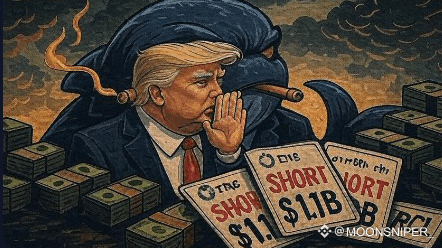
The 'whale' under the ENS name garrettjin.eth, who opened shorts on $1.1 billion and an Oracle failure
Here’s what really happened. Below will be broken down by the minute!!! The article is not small, I didn't want to miss anything. An interesting read…
On October 10, 2025, the cryptocurrency market experienced one of the most dramatic crashes in its history, which became the largest event by liquidation volume. Within a matter of hours, positions worth over 19 billion dollars were liquidated, and the total market capitalization shrank by hundreds of billions. This event not only wiped out huge sums from traders' balances, but also revealed deep structural problems in the industry. In this article, we will analyze the reasons, chronology, suspicions of manipulation, consequences, and prospects for recovery, based on data from reliable sources.
Reasons for the crash: Political trigger and structural vulnerabilities
The main catalyst for the crash was the unexpected announcement by U.S. President Donald Trump of 100% tariffs on imports from China, including critical software. This announcement, made via Truth Social, triggered panic in global markets, which spilled over into crypto, as traditional markets were closed for the weekend. The tariffs heightened fears of a trade war, especially given the crypto industry's dependence on Chinese supplies for mining equipment and technology.
However, the political factor was only a trigger. The underlying reasons lay in the accumulated leverage in the market. In the months leading up to this, hedge funds, retail traders, and market makers had built positions with borrowed funds, reaching levels of 50-200x. When prices started to fall, automatic margin calls triggered a cascade of liquidations. Additionally, technical failures played a role: there was an exploit in the margin trading system on Binance, leading to the freezing of stop orders and forced liquidations even of low-leverage positions.
Liquidity evaporated sharply due to the actions of market makers. For example, Wintermute, one of the largest liquidity providers on Binance, transferred 700 million dollars (including 200 million in BTC) to the exchange hours before the crash, which emptied order books and removed “support walls.” This created a vacuum where algorithms continued to sell in the absence of buyers.
Timeline of events: From the first drop to record liquidations
Events developed rapidly, mainly in the morning hours of October 10 (UTC+8):
• 5:00 AM: Bitcoin begins to decline from 119,000 dollars, trading volumes are normal.
• 5:20 AM: Acceleration of altcoin liquidations, volumes increase 10-fold — an attack on market maker positions.
• 5:43 AM: A dump of 60 million dollars in USDe on one exchange leads to a depeg to 0.6567 dollars. Oracles relying on spot prices from this venue instantaneously revalue collateral.
• 5:44 AM: Collapse of wBETH (down to 430 dollars) and BNSOL (down to 34.9 dollars). A 23-minute delay indicates a sequential attack.
• 6:30 AM: Total liquidations exceed 10 billion dollars, market makers completely exit, totaling 19.3 billion in liquidations.
Overall, 1.6 million traders were liquidated in one day, peaking at 7 billion dollars in one hour. Bitcoin fell from 122,000 to 101,000-105,000 dollars (a drop of 21%), Ethereum — by 18% to 3,500 dollars, altcoins — by up to 90% (for instance, SOL down 30%, SUI down 80%). Stablecoins depegged, exacerbating the panic.
Suspicions of a coordinated attack and insider trading
On-chain data analysis indicates not a random panic sell-off, but a possible coordinated manipulation of oracles. The attack exploited a known vulnerability: Binance announced updates to the oracles for USDe, wBETH, and BNSOL on October 6, creating a “window” until October 14. A dump of 60 million dollars on one venue distorted prices that the oracles used to assess collateral, amplifying the damage by 322 times.
The key suspicious element is the “whale” under the ENS name garrettjin.eth, which opened shorts worth 1.1 billion dollars, including 735 million in BTC. This whale sold over 35,000 BTC for ETH in August-September and earned over 80 million in 24 hours during the crash. Connections with a research firm and a former exchange head (Huobi, BitForex) hint at insider trading. Analysts like @eyeonchains note that the depegs were isolated to one exchange, which is inconsistent with an organic crash.
On X (formerly Twitter), users discuss insider trading related to Trump: shorts were opened hours before the announcement, with profits up to 200 million dollars for individual whales. Some posts mention the suicide of a Ukrainian influencer due to losses, highlighting the human factor.
Consequences: Financial losses and lessons for the market
The crash wiped out 660 billion dollars from market capitalization (from 4.3 trillion to 3.64 trillion), affecting 96% of futures traders. Largest liquidations: 5.39 billion on BTC, 4.44 billion on ETH. Altcoins were hit harder due to low liquidity and speculative nature.
Systemic vulnerabilities exposed: dependence on centralized oracles, fragility of stablecoins, lack of circuit breakers (like in traditional markets). Exchange insurance funds became overwhelmed, and auto-deleveraging only intensified the decline. This event is compared to the crashes of COVID-2020 (1.2 billion) and FTX-2022 (1.6 billion), but it is 12-16 times larger.
On X, shock predominates: posts about “capitulation” before the rally, lessons on stop-losses and avoiding over-leverage. Some see it as an opportunity to buy at the bottom.
Recovery and outlook: From “black swan” to new growth?
By October 13, the market rebounded: Bitcoin above 114,000 dollars, market capitalization — 3.67 trillion. The fear index is at lows (31), RSI oversold (33) — signals for buying. Experts like Pentoshi call this the “top-3 flash crash of all time” and predict BTC growth to 130,000 by the end of the month if it holds above 110,000.
Long-term lessons: the need for diversification, improvement of oracles (multi-source, time-weighted), and increasing infrastructure capacity by 100 times. The industry is moving to mainstream, with institutional portfolios reaching 24% in tokenized assets by 2030, but such crashes underscore the risks. Political volatility (tariffs, Fed) remains a factor, but cleansing from leverage could trigger sustainable growth.
In conclusion, the crash on October 10 is not the end, but a “detox” for the market. For traders, it’s a reminder: DYOR, manage risks, and remember that in crypto, minutes can decide everything.
#BinanceSquareFamily #BinanceNews
#CryptoApocalypse #BitcoinDunyamiz #Oracle

