

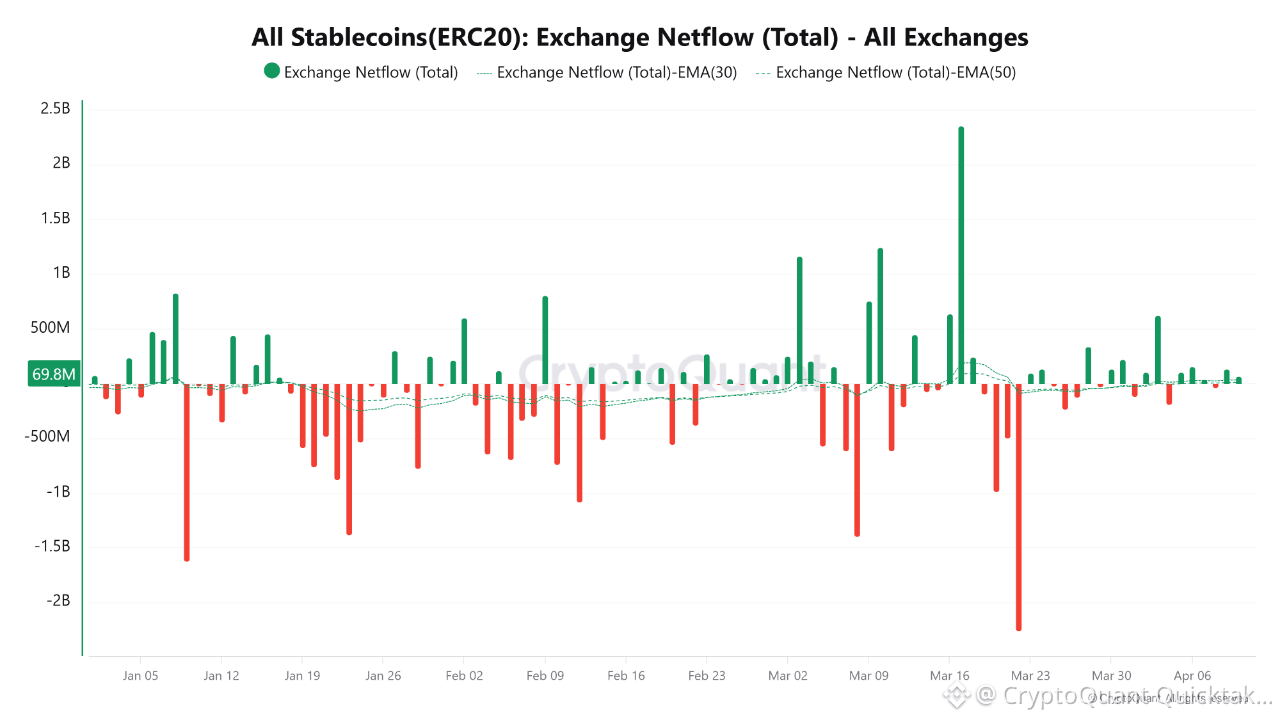
The chart shows very strong inflows in mid March, followed immediately by sharp outflows, which is notable. Currently, netflow appears slightly positive and more balanced compared to March. This indicates that available liquidity for buyers is increasing. Since stablecoins are directly used to purchase BTC, ETH, and altcoins, these inflows represent potential buying power.
If investors are moving funds to exchanges instead of keeping them in banks or cold wallets, it means they are preparing to take positions. This typically occurs either in anticipation of buying the dip or positioning ahead of expected news. Usually, whales and institutions first send stablecoins to exchanges, then often open short positions, triggering a market drop. After realizing profits, they switch to spot buying at lower levels. Tracking whale behavior has historically been profitable. However, this expectation is based on past patterns and is not guaranteed. Therefore, monitoring inflows and outflows remains crucial.
If inflows increase while prices are declining as we see now it suggests that capital is entering for dip buying, and smart money may be accumulating. Binance is the primary hub for institutional and whale activity, making stablecoin inflows to Binance particularly important to watch.
Recently, the presence of small but consistent positive netflows along with sideways EMA trends indicates liquidity accumulation. In the short term, this can lead to increased volatility and raises the probability of a bullish fake breakout.
Stablecoin inflows typically move first into BTC, then ETH, and finally into altcoins. Therefore, this data could be an early signal of an altcoin season. However, it does not start immediately it is a process and currently in its earliest phase. The beginning of a full altcoin season may take months, and it is generally more appropriate to expect it after a major market bottom has formed.
Written by PelinayPA