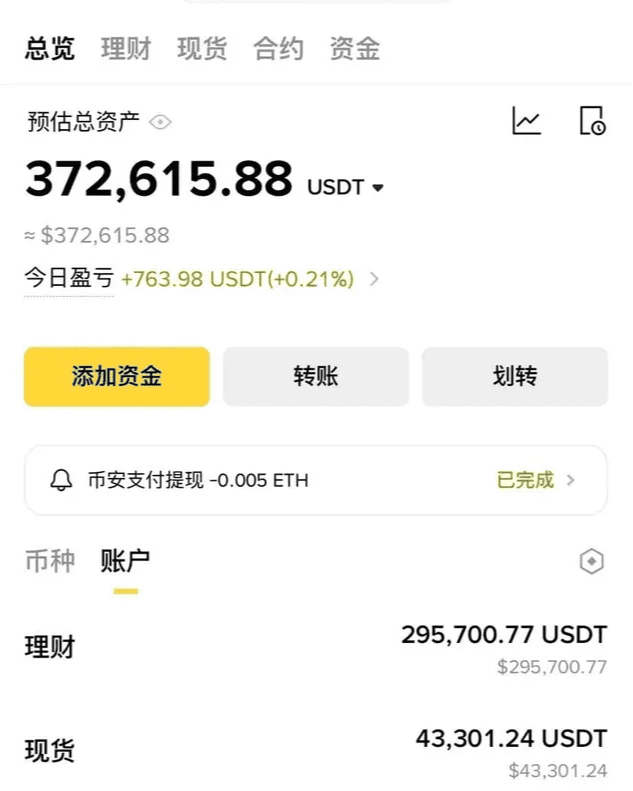
People often ask, 'Is spot trading more profitable than futures trading?' The truth is: for most people, spot trading does not earn more, but the probability of being able to keep what has been earned and not lose the principal is much higher. Futures trading appears to generate quicker returns, but it often leads to losing both previous earnings and the principal, while spot trading steadily accumulates considerable profits over time.
First, there is a significant difference in the baseline safety of the principal. After buying spot assets, even if the market drops severely, as long as you don’t sell, the quantity of assets you hold won’t change; at most, there will be unrealized losses on the books.
Just like during the low market conditions of the past two years, many people's spot holdings dropped by 40%, but when the market warmed up, most of them rebounded. The principal will never disappear out of thin air. However, contracts carry leverage; for example, using 10,000 to open 5 times leverage is equivalent to leveraging a position of 50,000. If the direction reverses by 20%, the 10,000 principal will directly be liquidated.
Let's look at the impact of mindset on operations. When the contract leverage is fully utilized, emotions also amplify: earning a little makes one fear a pullback, rushing to take profits and missing out on big market movements; losing a little leads to stubbornly holding on, thinking 'it will definitely rebound,' only to end up in liquidation. However, the fluctuations in spot trading are not that extreme. For example, my friend uses a strategy of 'buying to average down after an 8% drop, taking profit after a 12% rise.' Even if it drops 5% in the short term, there's no need to panic; it won't liquidate as long as the trend isn't broken. Just wait for the pullback to end, and there's no need to anxiously watch the market every day.
There's also a difference in profit logic. To make money with contracts, one must accurately guess the rhythm of each wave of ups and downs, calculate the leverage and stop-loss, and a single misstep can lead to losing everything. Furthermore, contracts have expiration dates; even if you correctly predict the long-term trend, short-term fluctuations may prevent you from holding out until delivery.
Spot trading relies on 'trend compound interest.' You don't have to guess correctly every time; if you capture two 30% market movements in a year, the principal can grow from 10,000 to 17,000. You don't have to race against time; as long as you hold onto the trend, the returns will naturally accumulate over time.
Ultimately, the premise of trading is 'to stay alive.' Contracts are like walking a tightrope; even if you walk smoothly at first, a stumble can lead to zero. Spot trading is like walking up stairs: it may be slow, but every step is steady.#加密市场回调 $ETH
How to plan funds, how to seize opportunities, and how to control rhythm—I can slowly explain it to you, helping you avoid years of detours. Sometimes, it just takes these few straightforward words.@加密薇姐