
The distribution of Bitcoin tokens hides secrets: 57% held by individuals, can it surpass the $30 trillion market capitalization of gold?
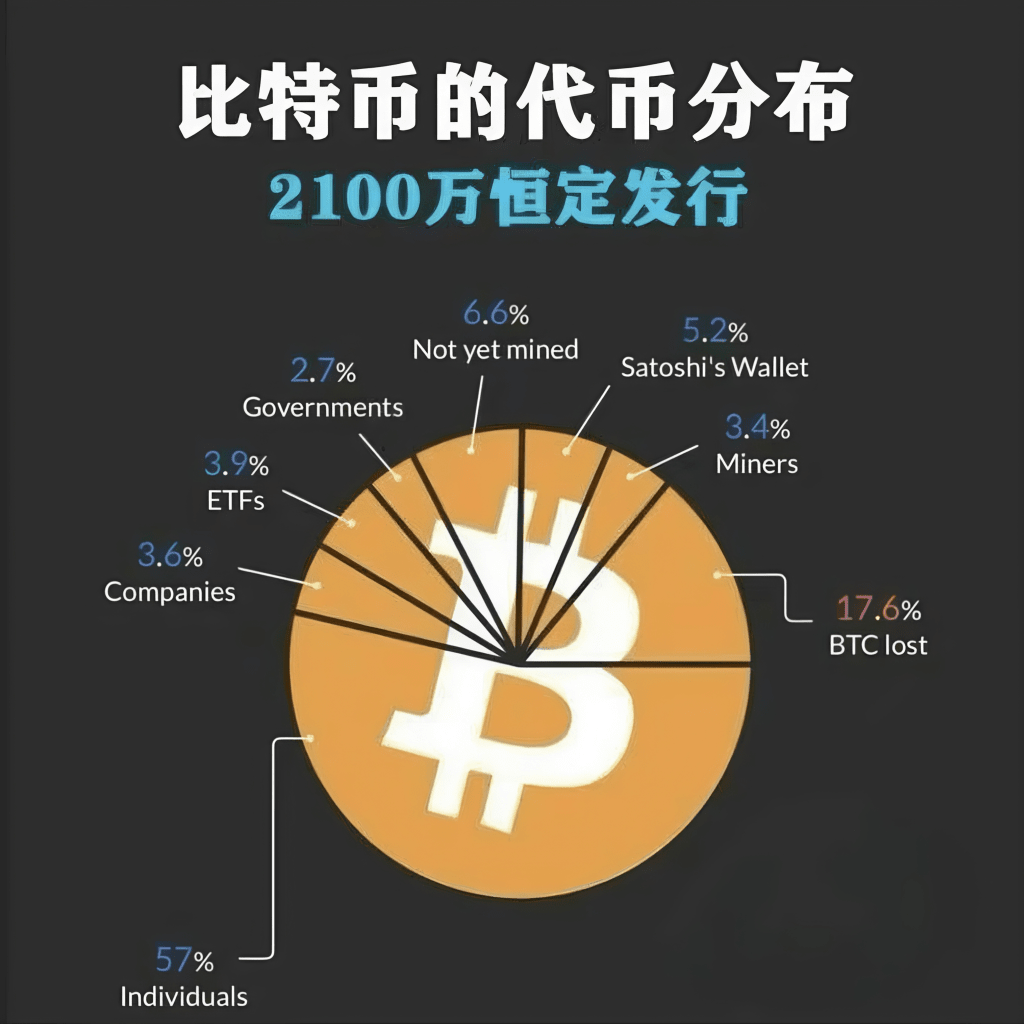
A set of the latest Bitcoin token distribution data is redefining the market's perception of this digital asset: 57% held by individuals, 17.6% permanently lost, 6.6% not yet mined, and the remaining shares are dispersed among Satoshi's wallet, spot ETFs, companies, miners, and governments. This highly decentralized holding structure supports the claim that 'Bitcoin is the most decentralized product' and has sparked heated discussions about 'can it surpass gold to become the highest valued asset globally.'
Token distribution breakdown: the core strength of decentralization
The decentralized characteristics of Bitcoin are vividly reflected in its holding structure.
- Individual holders dominate absolutely: 57% of tokens are held by global individual investors, among which 74% of holders hold less than 0.01 BTC. This 'retail-oriented' distribution pattern means that no single individual or a few individuals can dominate market direction.
- The supply side of 'permanently locked': 17.6% of lost tokens and 5.2% of Satoshi's dormant wallet tokens (about 1.096 million, which have not transacted since 2010) together account for over 22%. This portion of supply has almost permanently exited circulation, further reducing the risk of concentrated selling.
- Institutions and public sectors hold diversified positions: the holdings of spot ETFs (3.9%), listed companies (3.6%), miners (3.4%), and governments (2.7%) do not exceed 4%, and there is also a diversified distribution within institutions—only the US spot ETFs have multiple institutions like BlackRock participating, with total holdings exceeding 1.19 million.
This distribution contrasts sharply with traditional assets. Taking gold as an example, its reserves and trading are highly concentrated among national central banks and large financial institutions, whereas Bitcoin's 'balanced allocation' from individuals to institutions is the core manifestation of its decentralization attribute.
Benchmarking gold: the market cap gap between $2 trillion and $30 trillion
Despite the significant advantages of decentralization, the market cap gap between Bitcoin and gold remains substantial. As of October 2025, the market cap of gold has soared to $30.42 trillion, while the market cap of Bitcoin is only about $2.17 trillion, less than 1/14th of gold. The differences in the value logic of the two also determine that the path to surpassing will be full of challenges.
The core advantage of gold lies in its millennia-long consensus and stability: as a 'non-productive' asset, it has consistently maintained its safe-haven value amidst geopolitical turmoil, with a single-month increase of 13% in 2025, and its price stability far exceeds that of Bitcoin. While Bitcoin is referred to as 'digital gold', its increase in 2025 was only 16%, and it is still subject to regulatory policies and technological iterations, leading to price volatility that is much higher than that of gold.
However, Bitcoin's supply rigidity is forming a competitive advantage: a fixed upper limit of 21 million tokens and a mining mechanism that halves every year means that the 6.6% of tokens yet to be mined will gradually enter the market, and institutional purchases have already formed a 'supply squeeze'—the annual purchase volume of global ETPs and listed companies reaches 944,000, far exceeding the daily output of miners. This supply-demand imbalance may become a long-term driving force for its market cap growth.
Can decentralization support 'market cap ascension'?
The decentralized structure of Bitcoin indeed provides unique support for its value endorsement: tens of thousands of nodes worldwide maintain the ledger together, open-source protocols reject single control, and decentralized holdings reduce manipulation risks. These characteristics have led to increasing recognition in the digital economy era.
However, to surpass gold, three major bottlenecks must be overcome: first, the range of consensus; the 'globally accepted value' of gold has persisted for thousands of years while Bitcoin still needs to overcome barriers of geography, age, and cognition; second, regulatory certainty; countries' policy attitudes toward cryptocurrencies have yet to unify, which may restrict its large-scale application; third, liquidity and stability; further reduction of volatility is needed to meet the long-term allocation needs of institutions and ordinary investors.
From the perspective of token distribution, Bitcoin has built a decentralized 'skeleton', but the 'flesh' needed for market cap ascension—deeper consensus and mature ecology—still require time to cultivate. When the scale of 21.7 trillion grows to 30 trillion, decentralization may be the most solid foundation, but it is by no means the only answer. This competition between 'digital gold' and 'physical gold' has just begun to enter deeper waters.
#XAUUSD trading records #Forex trading insights #Precious metals market analysis #Daily trading review #Investment and financial management skills Bitcoin liquidation experience #coinglass liquidation stories #Investment risks and reflections #Mid-life career setbacks #Dramatic life reversals #The essence of money #Individual investors #web3 #The essence of wealth #The power of capital #Red ant quantification #Bitcoin #Quantitative trading #Macroeconomics #Investment finance #Blockchain #Investment#爆仓了