

Key Takeaways
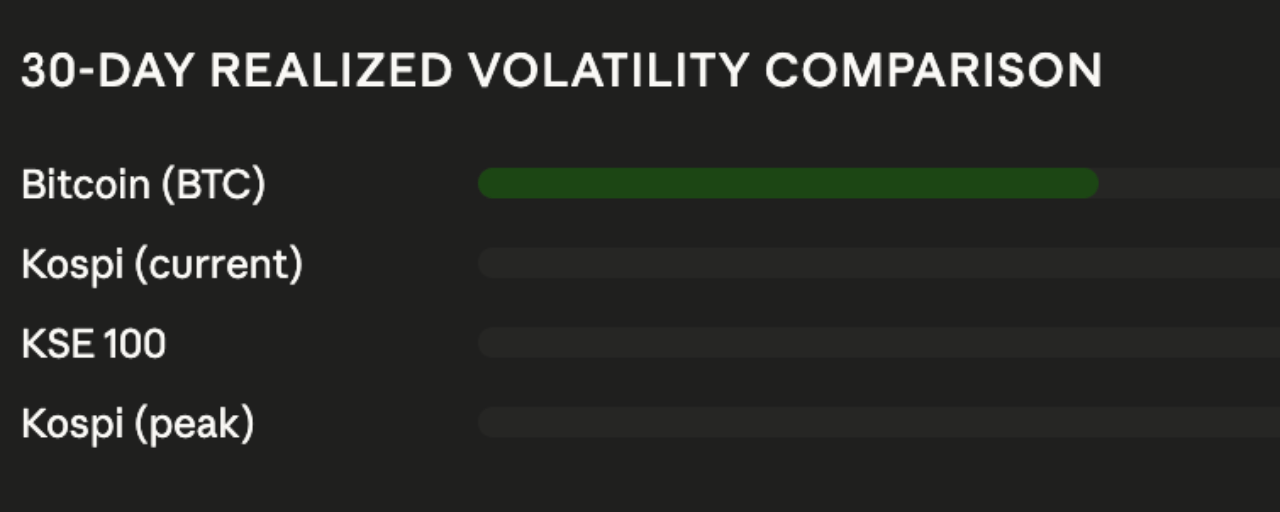
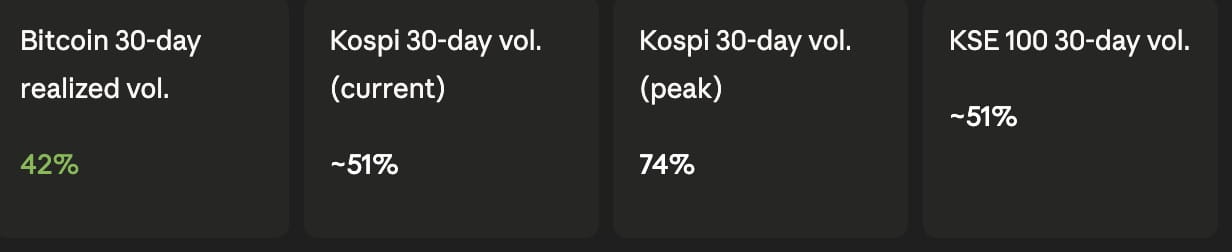
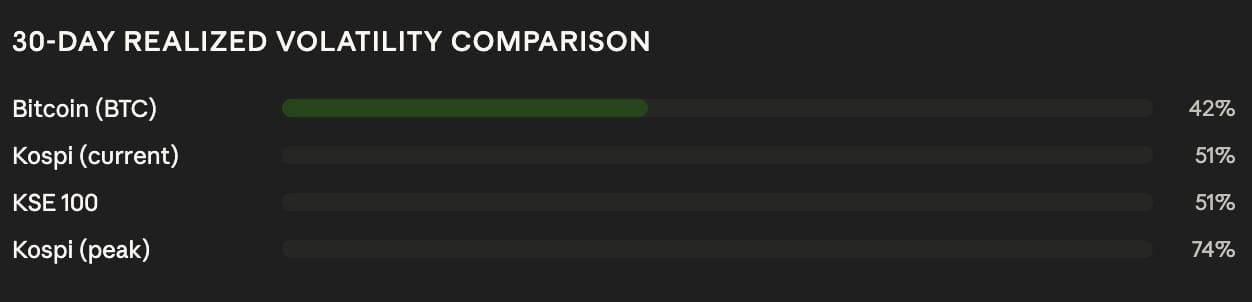
Bitcoin's 30-day realized volatility has fallen to 42%, below South Korea's Kospi at 51% and Pakistan's KSE 100 at 51%
The Iran conflict's energy shock hit oil-dependent economies like South Korea and Pakistan harder than Bitcoin, which held a relatively narrow $65,000–$75,000 range
Spot ETF inflows since January 2024 have structurally dampened Bitcoin's price swings by bringing more institutional, risk-managed capital into the asset
A ceasefire expiry on Wednesday represents the next major test for both crypto and equity markets
Bitcoin has long carried the reputation of crypto's most volatile major asset -- an instrument capable of doubling or halving within months. That narrative is being quietly rewritten.
For the first time in recent memory, Bitcoin's 30-day realized volatility has dropped to 42%, falling below South Korea's benchmark Kospi index and Pakistan's KSE 100, both sitting at 51%. The development marks a meaningful statistical inversion: two of the world's more turbulent equity markets are now swinging harder than the asset class historically synonymous with extreme price moves.
Why Equity Markets Are Moving More Than Bitcoin
The divergence is not coincidental. The Iran conflict has delivered an acute energy shock to oil-dependent economies, with South Korea and Pakistan -- both heavily reliant on imported crude -- absorbing the geopolitical disruption through their equity markets. Bitcoin, by contrast, held a relatively contained range of $65,000–$75,000 through the same period, insulated from the direct economic transmission channels that hammered energy-import-dependent stock markets.
Institutional Capital Has Changed Bitcoin's Structure
The more significant driver of Bitcoin's declining volatility may be structural rather than situational. The launch and rapid growth of US spot Bitcoin ETFs since January 2024 have brought a fundamentally different class of capital into the asset -- institutional investors operating with risk management frameworks, position limits, and longer time horizons than the retail-dominated trading that historically amplified Bitcoin's price swings in both directions.
Sustained ETF inflows have effectively added a layer of price stabilization, with institutional buyers providing a more consistent demand floor and reducing the outsized impact of retail-driven sentiment swings that previously defined Bitcoin's volatility profile.
What Comes Next
The ceasefire between warring parties is set to expire Wednesday, making the coming days a critical test for the volatility divergence thesis. A breakdown in peace talks could reignite energy price shocks and equity market turbulence in oil-dependent economies, while simultaneously testing whether Bitcoin's newfound relative stability holds under renewed geopolitical stress -- or whether the asset reverts to its historically elevated volatility in a risk-off environment.
If Bitcoin maintains lower realized volatility than major equity benchmarks through a ceasefire expiry event, the case for a structural reclassification of Bitcoin's risk profile becomes considerably harder to dismiss.