


Source: Talking About Li
Today (10.30), the market news is quite lively; on one hand, the Federal Reserve continues to announce a rate cut of 25 basis points (bringing the federal funds target rate down to 3.75%-4%), and on the other hand, there are US-China trade talks.
We have discussed the issue of interest rate cuts and the end of QT in our previous articles. This interest rate cut is a 'done deal,' and although it is favorable, the market has largely already priced it in. However, based on Powell's speech, it seems that FOMC members currently have some disagreements regarding the interest rate cut in December, which may be one of the reasons for market volatility.
In addition, many investors may also be worried that the Sino-US trade negotiations will lead to new uncertainties, which to some extent further obscures the expected effect of interest rate cuts.
1. Trump expressed satisfaction
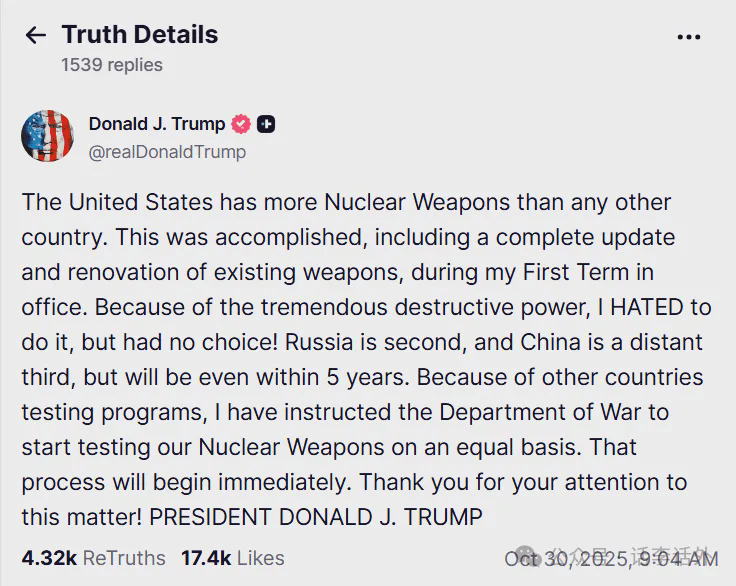
Today, before the trade meeting, Trump posted on his TruthSocial that he has instructed relevant departments to 'immediately' begin nuclear weapons testing. As shown in the figure below.
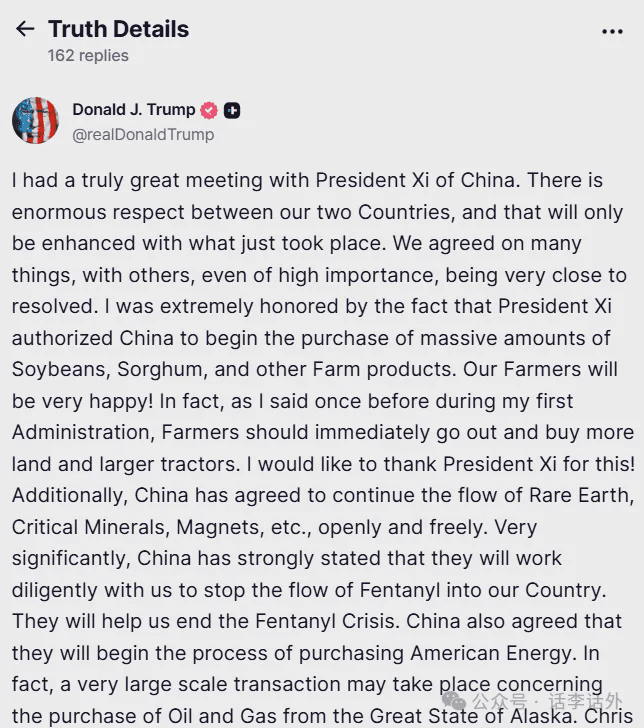
After the meeting, Trump quickly announced that the United States and China have reached a consensus on many issues. As shown in the figure below.
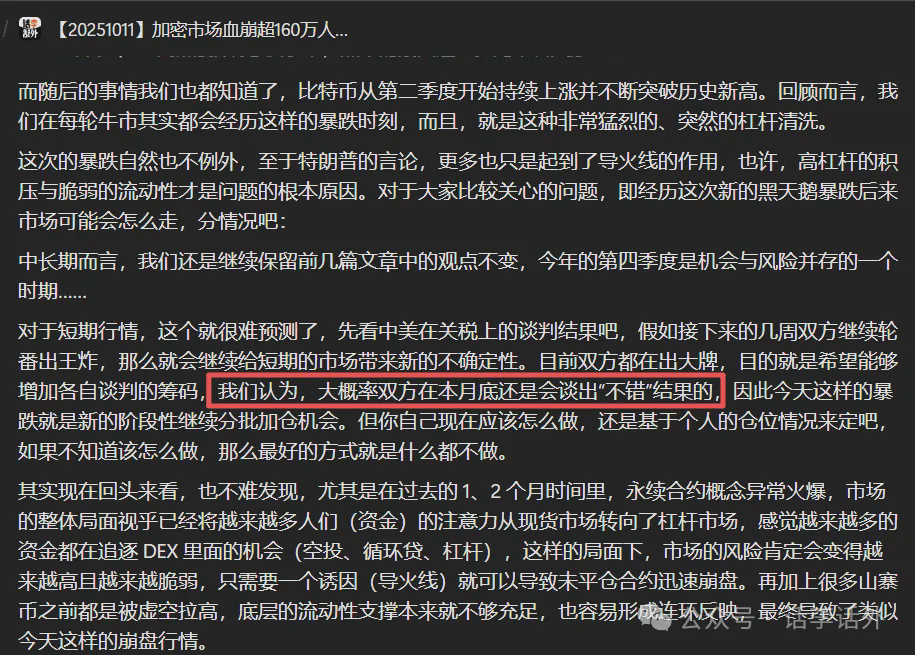
Regarding the negotiation results at the end of this month, we actually discussed this in our previous articles: it is highly likely that a 'good' result will be reached by the end of this month. As shown in the figure below.
Of course, this kind of diplomatic easing is more of a positive for market sentiment, but it does not represent a positive for the funds. Funds may not immediately enter the market unless both sides officially announce or sign a clearer agreement or plan. Only substantial implementations can stimulate the funds; otherwise, in the short term, funds will definitely remain cautious. Even speculation will first flow into more mature US stock markets rather than the higher-risk crypto market.
On a macro level, the Fed's policies and the Sino-US negotiations are affecting market expectations, but as individual investors, we should pay more attention to how to better adjust our investment mentality and trading strategies.
2. Let's continue discussing the investment mentality
The Fed has also continued to cut interest rates as expected, and Trump has boasted about having reached many 'wonderful' agreements with China. Logically, the market should be satisfied, but why isn't Bitcoin rising today?
If the rise and fall of the market could be predicted so easily, there probably wouldn’t be any poor people in this market.
In recent articles, we have discussed many macro aspects. Although the overall macroeconomic trend has not changed significantly, short-term market fluctuations still catch many by surprise. I remember discussing similar issues in earlier series of articles; the market is more a behavior based on expectations. The key to understanding market behavior is not only to understand what is happening now but also to understand what the market's previous expectations were.
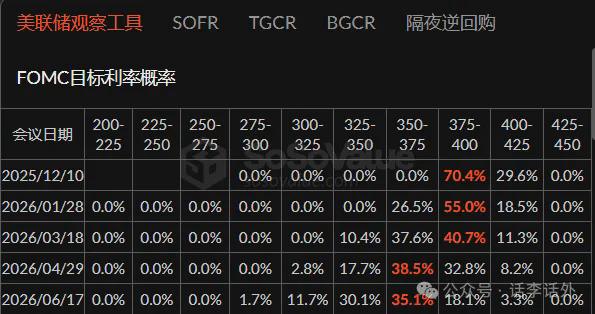
The Federal Reserve's interest rate cut of 25 basis points in October has been anticipated. The market initially expected the Fed to cut rates again in December, but Powell's remarks have put the December rate cut expectation back into question. This brings uncertainty to the short-term market. From the Fed's observation tool, we can also see that, a few days ago in the article (October 22), when I took a screenshot, the expected probability of a rate cut in December was 97.4%, but after today's Fed press conference, this probability has now dropped to 70.4%. As shown in the figure below.
Additionally, many people interpreted Powell's speech today as a hawkish stance, but we believe that based on the content of Powell's speech today, it does not seem to be a shift in position. Instead, it is more of a reminder to the market (investors) that the Fed will continue at its own pace, meaning it will still determine the frequency of interest rate cuts based on the trajectory of US economic data, rather than taking aggressive easing measures as the market or Trump hopes.
Originally, people believed that the Fed's easing policy would continue as expected, but now Powell's latest answer is ambiguous. In this situation, the short-term sentiment will definitely be affected. It would be good enough if Bitcoin doesn't fall (sideways or slight corrections would be more reasonable), how can one still think it will rise immediately?
Moreover, from the perspective of funds, not rising or falling is not necessarily a bad thing. Looking at the short-term dimension, it may more likely be a temporary cautious choice for risk management. Here, we still maintain our previous article's viewpoint: Bitcoin may have another rebound opportunity before the end of the year (or in the first quarter of next year).
In short, short-term prices are unpredictable, but if you are a long-term investor, patience is still the core element of position management.
I remember when I first started writing my public account, I thought of a lot of advice to give to new friends entering the circle. In the end, I summarized it into eight words: protect your capital, don't touch what you don't understand. Later, these eight words often appeared in the articles, and those who have been paying attention for a long time should not be unfamiliar with them.
Some people compare investment in this field to gambling, while others compare it to a game. But whether it's gambling or a game, if we want to achieve some results in a field, it's best to find a game that suits our specific advantages (niche track), meaning you should focus only on those games that you can repeatedly learn and study, rather than blindly following others' actions or so-called news hotspots.
In a field that seems easy to get rich, playing a game that doesn't suit you is the main cause of most tragedies. Over the years, I have seen too many people who, through frequent trading or leveraging, not only lost all their capital but also wasted their best time, until they gradually disappeared from the market as the game rapidly evolved.
In the past two years, I've noticed that more and more people are lamenting how difficult it has become to make money in this field. I believe this is also an inevitable law of the development of things, as more participants enter the market, including more professionals (including institutions), and various knowledge continues to accumulate and spread. People need to keep learning. When something starts to become relatively competitive, some so-called advantages will gradually weaken, and the market overall will start to become a winner-takes-all situation, which is definitely not friendly for ordinary retail investors.
Many people always attribute their inability to seize opportunities to the market itself, to mishearing someone's recommendation, or directly to their own bad luck. However, we should reflect on ourselves as well. In this market, there are many participants, and even those who are smarter and more capable than you may not be able to seize every opportunity. So why should you be able to? Opportunities are sometimes not about seizing them but about waiting or ambushing in advance. When an opportunity appears in front of the public, it is often also when smart traders begin to prepare to withdraw in batches.
Not to mention, for example, from June 2022 to June 2023, Bitcoin fluctuated around $20,000. If at that time you still believed in the next bull market, then that period was a good dollar-cost averaging buying (forward ambush) range. But from the feedback in the comments of our historical articles, it seems that many people did not buy back then. Similarly, now that Bitcoin has risen to 110,000, with an increase of more than 5 times, the theoretical stage risk is obviously increasing, which should also be the time for you to withdraw in batches. However, I find that some people not only do not consider withdrawing but instead buy in at high prices, hoping to sell at the peak of 150,000, because some KOL told them Bitcoin will rise to 150,000 this year.
Of course, I also believe that Bitcoin will definitely rise to 150,000 someday, or even higher. In other words, even if you buy Bitcoin at a high price now and hold it for the long term, you can definitely ensure that you will make money. The probability is that it will be a guaranteed investment, but the core issue here is: how much risk are you willing to take, including time risk, financial leverage risk, etc.
From 110,000 to 150,000, there is about 36% room for increase, but you also need to consider whether you are prepared for the possibility of being trapped until 2028. If a new phase of bear market starts next year, do you still have enough idle funds to continue participating in the market?
In fact, whether it is Bitcoin with limited increase or altcoins that have the potential to rise dozens or hundreds of times, apart from some exceptions, all other projects (tokens) do not have any issues from an investment/speculation perspective; they can be participated in. The key problem lies in: many people have a significant cognitive bias regarding their risk preferences and the uncertainties of the market.
Only when you can handle the relationship between risk preference and market uncertainty well can you determine whether a person can make money in the market. Those who want to avoid risk, don't want to spend time and energy researching, and still want to earn excess returns easily will ultimately either lose all their capital or incur losses themselves.
The herd mentality is a strong emotional manifestation on the current internet. However, this mentality has both advantages and disadvantages. If you can handle it well, it can help you quickly extract and replicate others' successful experiences into your strategy. For example, many methods mentioned in our 2024 e-book (Blockchain Methodology) can be optimized or adapted. But if not handled well, it may lead to your anxiety or even failure. Everyone's situation is different, and their understanding and preference for risk are also different. Especially in trading operations, we should formulate strategies based on our actual situation instead of mindlessly repeating and copying.
Taking Bitcoin as an example, in previous articles, I shared that from 2022 to 2024, we still have 70% of our second round of dollar-cost averaging Bitcoin that hasn't been sold. However, since our previously customized Plan A has basically been achieved, we don't have to sell this batch of BTC; we can hold it for another five to ten years without any issue. We are no longer concerned about whether Bitcoin will rise to 150,000 this year.
In summary, if you don't want to lose too badly, then don't be too depressed when the market is at a low, and don't be too complacent when the market is at a peak. Balance the relationship between opportunities and risks, always maintain respect for the market, always customize a phased exit plan that suits yourself, and always leave operational space for the unknown future (retain cash liquidity). This is the core of how we can make money in this field for a long time.
3. At the end of the article, let's briefly discuss x402
A few days ago, I noticed that many partners in the group were discussing this x402, but the level of discussion has obviously not been as high as it was a few days ago.
Due to personal energy issues, I haven't closely studied the x402 protocol and related projects in the past few days; I just took a quick glance. In fact, for any new concept, as long as the direction is simple and clear enough, it doesn't seem difficult to drive the price up. For example, 'initiated by Coinbase', 'participated by many well-known institutions', 'future of AI payments'... These phrases make it easy for people to associate and naturally attract followers.
On October 23, the first token based on the x402 protocol, PING, was born on Base. The birth and surge of this coin directly made the x402 concept quickly popular. Soon, projects like PAYAI also started to attract more and more people's attention and wallets through rapid price increases.
Many people may have missed previous inscription opportunities, so when x402 exploded, they hoped to seize this new opportunity. However, based on the current performance of some related tokens, it seems that after a few days, some partners have quietly found themselves stuck at the mountain top.
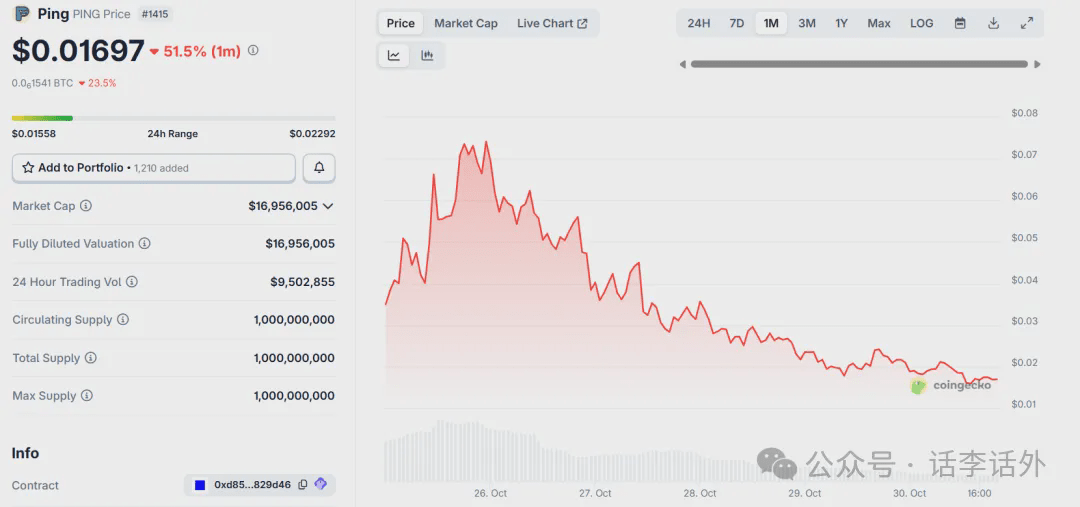
As for whether the x402 protocol is really the so-called future of AI payments, I can't say for sure right now, but if you started out just speculating on the related tokens as MemeCoin, then there shouldn't be any long-term fantasies; otherwise, the one who ultimately gets hurt will still be yourself.
A good concept does not necessarily have sustained good price performance; it also needs time for development and validation. Take Bitcoin as an example; the concept is good enough, claiming to be digital gold, but it still faces huge volatility, let alone those new concepts that have just emerged for a few months.
Of course, if you really have high hopes for the future imagination space of x402 and believe it is the future of AI payments, then there is no need to rush at this moment; you will still have many opportunities in the future. What you need to do now is add it to your research list and maintain DYOR.
In summary, whether investing based on macro policies, aiming to seize short-term hotspots for speculation, or betting on certain on-chain projects hoping for a transformation from bicycles to villas, gambling has its way of playing, speculation has its way of playing, and investment has its way of playing... It all depends on how you want to play, how you can play, how you should play, and how you ought to play. Ultimately, all these behavioral decisions are a result of individual risk management and cognitive boundaries.