
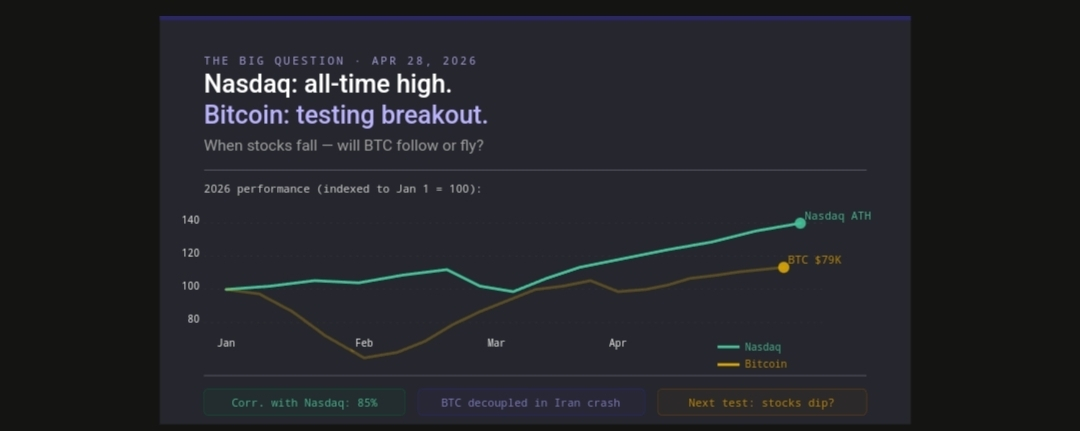
The Nasdaq Composite just printed a new all-time high this week. The S&P 500 is back above 7,000. US tech stocks — after one of their worst Q1s in years — have fully recovered.
Bitcoin is at $79,000. Testing the $80K level for the fourth time.
On the surface, these two things seem like they're telling the same story: risk appetite is back, markets are up, everything is fine. But underneath, there's a question that more sophisticated traders are actively wrestling with right now.
Bitcoin now testing a major breakout at $79,000 as it challenges the upper boundary of its main October descending channel. The big question now is whether cryptos will decouple from equities in the event of a stock market downturn — a factor that could determine if Bitcoin and its peers are truly poised to return to record highs.
Bitcoin's correlation with the Nasdaq has been approximately 85% through most of 2026. In plain terms: when tech stocks go up, BTC goes up. When tech stocks go down, BTC goes down. This has been the dominant market regime for the past 18 months, interrupted only briefly during the sharpest Iran crisis moments — when BTC actually held value while stocks sold off.
That brief decoupling is the data point bulls point to. During the worst days of the Iran oil shock, the Nasdaq dropped 6–8% while Bitcoin's drawdown was significantly smaller. The White House shooting produced a BTC rally while stocks were flat. These are early signals that BTC's safe-haven behavior is emerging — but they're not yet consistent enough to call it a regime change.
So far, cryptocurrencies have maintained a strong correlation with the Nasdaq. However, while the tech index has reclaimed its all-time highs, Bitcoin is now testing a major breakout. This presents a critical test: in the event of a stock market correction, will Bitcoin hold as a safe-haven asset, or will it reprice as another risk asset?
Here's the honest framework for thinking about this. Bitcoin behaves as a risk asset during liquidity-driven selloffs — when everything gets sold to raise cash (2022, March 2020). It behaves as a safe haven during confidence-driven selloffs — when people are fleeing specific risks like currency debasement, geopolitical instability, or banking system stress (SVB March 2023, Iran Q1 2026).
The type of selloff determines Bitcoin's behavior. If the next equity drawdown is driven by Fed hawkishness or valuation concerns — BTC likely falls with stocks. If it's driven by a geopolitical shock or dollar weakness — BTC likely holds or rises.
Given that the dominant macro risks right now are Iran (geopolitical) and dollar debasement (inflation) rather than Fed overtightening — the conditions actually favor BTC acting as a hedge rather than a risk asset in the next selloff. But this is a thesis, not a certainty.
The real-world test is coming. Whether BTC passes it will determine the next chapter of its identity in global markets.