Scalability has always been Ethereum’s paradox — the network that pioneered decentralized computation also carries the weight of its own success. As adoption grew, so did congestion, gas fees, and latency. The challenge wasn’t a lack of innovation, but a lack of scalable efficiency. That’s where zkRollups emerged as Ethereum’s most promising evolution — and Linea, a zkEVM developed by ConsenSys, has taken that promise and turned it into a functioning, developer-friendly ecosystem built for reliability, precision, and long-term sustainability.
Linea’s approach to zkRollups isn’t just about faster transactions; it’s about reengineering how computation, security, and user experience can coexist at scale. Efficiency here doesn’t mean cutting corners — it means optimizing proof generation, data compression, and execution flow so that Ethereum’s security model remains intact while transaction costs drop to fractions of a cent.
WHAT ZKROLLUPS ACTUALLY SOLVE
To understand the importance of zkRollup efficiency in Linea’s design, it’s crucial to grasp what zkRollups are built to fix. Ethereum’s Layer 1 processes every transaction individually, storing vast amounts of redundant data across thousands of nodes. This guarantees decentralization but limits throughput to a few dozen transactions per second.
zkRollups — short for zero-knowledge rollups — solve this by batching thousands of transactions off-chain and submitting only a compact cryptographic proof back to Ethereum. This proof, known as a zkProof, mathematically verifies that all bundled transactions were valid. The key innovation is that Ethereum doesn’t need to re-execute them — it only needs to verify the proof, a process exponentially faster and cheaper.
The result: a system where Ethereum maintains full trustlessness while delegating the heavy lifting of computation elsewhere. But the challenge lies in how efficiently this system operates — how fast proofs can be generated, how small they can be made, and how easily they can integrate into existing Ethereum logic.
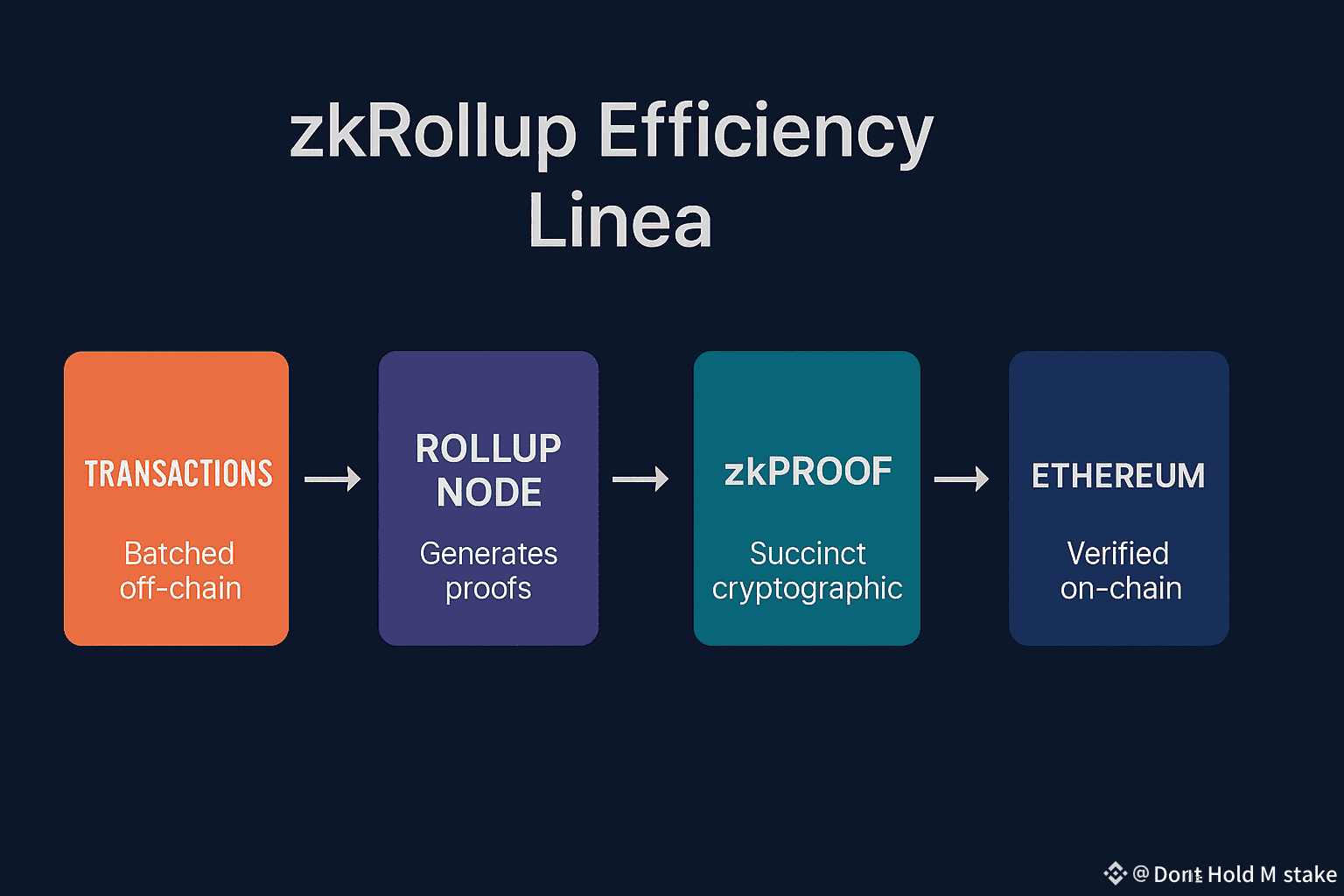
LINEA’S ARCHITECTURE – BUILT FOR EFFICIENCY AT SCALE
Linea was designed from the ground up to maximize zkRollup efficiency without compromising developer usability. Its architecture integrates three core principles: proof optimization, EVM equivalence, and data accessibility.
1. Proof Optimization
Linea’s proving system compresses massive batches of transaction data into succinct zkProofs that can be verified on Ethereum in seconds. Unlike earlier rollups that required large computational overhead, Linea’s circuits are optimized for speed, enabling faster proof generation even under heavy network activity. This reduces settlement delays and minimizes cost volatility.
2. EVM Equivalence
Many zkRollups face a trade-off between efficiency and compatibility. They offer impressive throughput but require developers to rewrite or recompile smart contracts. Linea eliminates that friction through EVM equivalence, meaning every Solidity contract, every tool — from MetaMask to Hardhat — works natively on Linea. Developers don’t have to think about cryptography; they just deploy and scale.
3. Data Accessibility
Linea ensures that the data associated with every batch remains transparent and retrievable. This not only preserves Ethereum’s ethos of verifiability but also enhances developer trust. Efficient zkRollups aren’t just about cheaper execution — they’re about preserving the auditability of every transaction without bloating the network.
WHY EFFICIENCY MATTERS MORE THAN EVER
In the early days of Layer 2, the focus was on reducing gas fees. But as Web3 matures, the definition of efficiency is evolving. For Linea, efficiency is multidimensional — it’s about speed, cost, composability, and energy use.
Speed: Faster proof cycles mean quicker transaction finality, giving dApps the responsiveness users expect from Web2.
Cost: More efficient computation directly lowers fees, making microtransactions, gaming, and high-frequency DeFi viable.
Composability: Efficient architecture enables smooth interoperability between Linea and other zk-based networks via shared proof standards.
Sustainability: Compact proofs consume fewer computational resources, making zkRollups one of the most energy-efficient scaling solutions available.
In other words, efficiency determines whether zkRollups remain theoretical or become infrastructure-grade technology.
ZKROLLUP PERFORMANCE AS A NETWORK FLYWHEEL
Linea’s ecosystem thrives because zkRollup efficiency creates a self-reinforcing loop of growth. Lower fees attract developers, more applications attract users, and higher transaction volume further amortizes costs — which, in turn, makes the network even more efficient.
This feedback loop mirrors the evolution of the Internet itself: as bandwidth costs dropped, new applications like video streaming and social media emerged. Similarly, as zkRollup efficiency improves, entirely new classes of Web3 applications — real-time gaming, decentralized social networks, and on-chain AI — become economically feasible.
ETHEREUM ALIGNMENT AS A DESIGN CHOICE
Unlike many Layer 2s that seek independence from Ethereum, Linea embraces Ethereum’s consensus and security model. Every zkProof submitted to Ethereum reinforces its base layer — effectively reusing trust rather than rebuilding it. This approach has two major advantages:
1. Sustainability: Linea’s architecture doesn’t fragment liquidity or security. It scales Ethereum’s ecosystem as a whole, not just its own chain.
2. Longevity: By staying fully aligned with Ethereum’s evolution — including future upgrades like EIP-4844 (proto-danksharding) — Linea ensures that its efficiency compounds over time as Ethereum itself becomes more scalable.
THE USER IMPACT – INVISIBLE COMPLEXITY, VISIBLE SPEED
For users, the result of zkRollup efficiency is deceptively simple: transactions that feel instant and cost almost nothing. But beneath that experience lies a complex orchestration of cryptographic compression, zero-knowledge verification, and decentralized data management.
Linea’s design ensures that users don’t need to understand the underlying math — they just experience smooth performance. The goal is not just to make blockchain faster, but to make it feel effortless.
In practice, this means:
Stablecoin transfers in seconds.
NFT minting at negligible cost.
DeFi transactions that finalize faster than a webpage refresh.
Linea’s infrastructure makes all of this possible while still preserving Ethereum-grade security.
HOW DEVELOPERS BENEFIT FROM ZKROLLUP EFFICIENCY
For developers, zkRollup efficiency means shorter feedback loops and predictable costs. Linea’s zkEVM equivalence ensures seamless migration of existing contracts, while its gas model optimizes resource allocation dynamically — reducing congestion even at peak usage.
This allows builders to focus on product innovation rather than infrastructure maintenance. Whether it’s building payment rails, liquidity markets, or data-driven dApps, Linea’s high-throughput environment provides a stable foundation that rewards creativity.
Moreover, as zk proof systems continue to advance, Linea’s modular design means it can adopt faster proving algorithms or integrate off-chain computation layers without disrupting existing deployments — a rare advantage in the fast-moving L2 landscape.
THE FUTURE OF SCALING: EFFICIENCY AS A PUBLIC GOOD
Linea’s vision aligns with a broader principle in Web3 — scaling should benefit everyone, not just early adopters. Efficiency isn’t a competitive edge; it’s a shared responsibility that enhances the usability of the entire Ethereum ecosystem.
By optimizing zkRollup performance, Linea reduces barriers for entry-level users, institutions, and developers alike. Its infrastructure lowers transaction costs, supports composable apps, and strengthens Ethereum’s global footprint. In doing so, Linea transforms scalability from a privilege into a public utility.
CONCLUSION – EFFICIENCY AS THE FOUNDATION OF TRUST
The success of any blockchain network ultimately depends on one thing: how much trust it can provide with how little friction. For Linea, zkRollup efficiency is the mechanism that makes that possible. It is the silent architecture behind seamless UX, the invisible engine powering composability, and the guarantee that security and scalability no longer need to be opposites.
Linea doesn’t chase hype; it engineers endurance. Its zkRollup system is not an add-on — it’s the core philosophy of how the network operates: verifying everything, trusting nothing, and scaling without compromise.
As the industry moves beyond speculation into infrastructure, Linea’s efficiency-first design will define what reliability looks like in the next generation of Ethereum scaling. Because in the end, efficiency is not just a metric — it’s the new form of trust.
Linea isn’t racing for speed. It’s building for permanence — a blockchain that runs fast today and still runs flawlessly decades from now.
Follow me to learn more about the projects that truly create real value in today’s market — explained from the perspective of regular users, in the simplest and most relatable way!