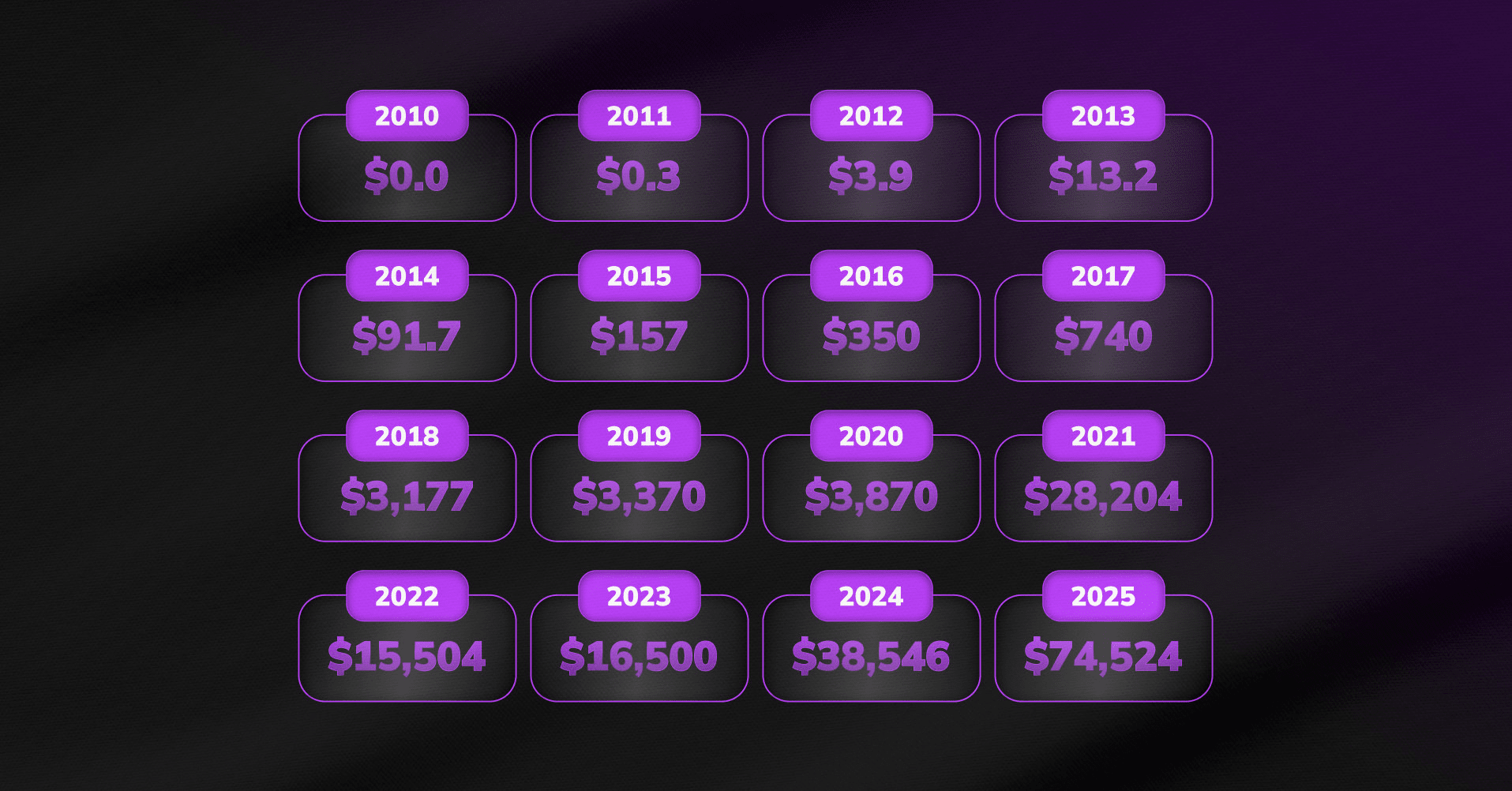
Bitcoin still holds the title as the largest digital asset in the world. Its value continues to increase in the long term, although it still has high volatility that can drive its price down sharply in certain periods.
The growth of Bitcoin since its emergence has indeed been extraordinary compared to traditional assets. For example, the price of gold has only increased by about 497% since 2009, from Rp384,000 to Rp2,296,000. In comparison, Bitcoin has skyrocketed by over 201.999.900% from its initial price of US$0.05 to currently around US$101,000.
Even more extreme, Bitcoin briefly broke US$126,000, which means an increase of 251,999,900% since it was first introduced by Satoshi Nakamoto.
Price Decline Footprint: From Crypto Winter to Global Economic Turmoil
Although the long-term trend is upward, Bitcoin is not immune to market pressures. One of the darkest moments occurred during the crypto winter of 2022. The combination of high inflation in the United States and the Federal Reserve’s aggressive interest rate hikes caused global investors to shy away from risky assets, including crypto.
As a result, Bitcoin closed much lower compared to 2021, plummeting from US$28,204 to US$15,504.
This year, several economic catalysts have once again put pressure. The tariff policy of more than 100% imposed by U.S. President Donald Trump on China since April has caused Bitcoin to drop drastically to US$74,254, before finally managing to rebound above US$100,000.
Nevertheless, the recovery did not last long. In recent days, Bitcoin has weakened again and has dropped more than 16% in a month, despite just setting a new all-time high the previous month.
Are We Heading Towards a New Crypto Winter?
Concerns about a repeat of the crypto winter naturally arise when Bitcoin moves down again. However, Bitwise's Chief Investment Officer (CIO), Matt Hougan, believes this situation does not point towards a crypto winter like in 2022.
He emphasizes that this price correction more reflects a phase of retail investor fatigue, not an early signal of a major collapse. According to him, the market still has strong fundamentals, and the current pressure is more short-term in nature.
Conclusion: Bitcoin Can Drop, But the Overall Trend Remains Intact
Bitcoin is indeed in a weakening phase, and it is possible to experience further decline. However, in the context of its long history, movements like this are not new. As long as the fundamental factors do not change drastically, Bitcoin still has strong potential in the long term.
The question is no longer whether Bitcoin can drop, but whether investors are ready to face the volatility that characterizes this asset.