
The story of Bitcoin isn’t just about being a digital currency. It’s a tale of a system where trust isn’t placed in a bank, company, or government, but rather in mathematics, computing power, and the rules of the network.
Paying over the Internet was possible before, but the issue was always a trusted third party in the mix — a bank, payment processor, or financial institution. When you send money online, you’re not actually transferring funds directly to that person. There’s a system in between that verifies the payment is legit, that there’s a balance available, and that the same money isn't spent twice.
This is where Bitcoin's biggest question begins:
If there's no bank in between, how will the network confirm that someone isn't spending the same Bitcoin twice?
This problem is referred to as the double-spending problem.
Imagine a person has 1 BTC. They try to send the same BTC to a merchant and at the same time to another person. In a traditional banking system, the bank checks if the first payment is valid and rejects the second. But in Bitcoin, there is no central bank. So who makes the decision?
Here enters Bitcoin's genius design: Proof-of-Work and the Longest Chain.
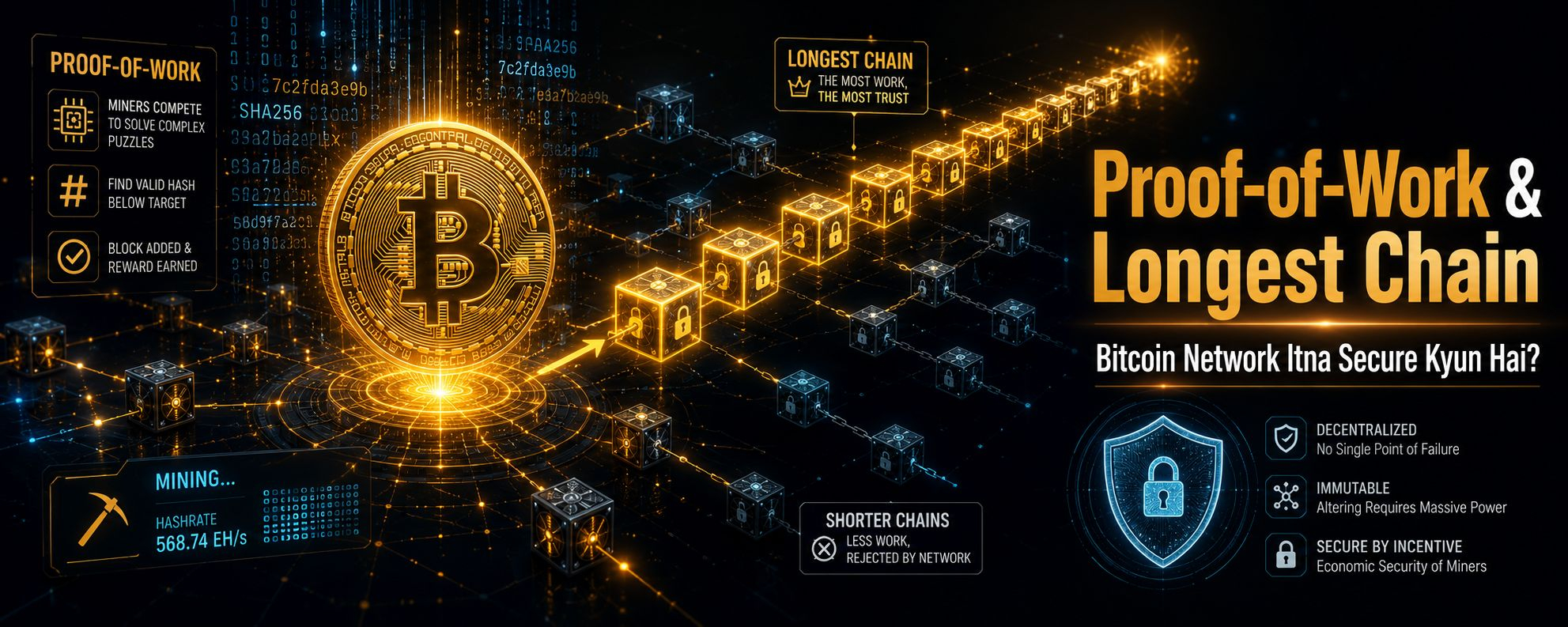
Transactions in the Bitcoin network are collected in blocks. Miners verify these blocks and provide proof to the network that they have done real computational work. This proof isn’t a simple claim; it requires heavy calculation from the miner. This process is known as Proof-of-Work.
Proof-of-Work simply means:
You'll need to provide a mathematical proof of work to add a block to the network.
This work is done through computer power. Miners find a valid hash that satisfies the Bitcoin network's difficulty rules. It’s like guesswork, but extremely hard. Miners try numbers repeatedly until they get a valid result. Once they achieve that, the other nodes in the network can easily verify that the proof is correct.
The beauty here is:
Creating a block is difficult, but verifying it is easy.
This is why no attacker can easily create a fake history. If someone wants to change an old transaction, they can't just change one block; they have to redo the Proof-of-Work for all the blocks that follow. And while they're doing that, honest miners will keep pushing the real chain forward.
Now let's talk about the Longest Chain.
In the Bitcoin network, nodes consider the chain with the most accumulated Proof-of-Work to be valid. This is commonly called the longest chain, but technically it means the chain with the most computational work invested.
This chain serves as a historical record for the network. Which transaction occurred first, which came later, what was confirmed in which block — all of this is stored in the chain.
If two miners find different valid blocks at the same time, a temporary split can occur. Some nodes see one block, while others see a different block. However, the network doesn’t stop. Miners continue mining on one branch. The branch that adds the next block first becomes longer, and the network accepts it as the main history.
In this way, Bitcoin reaches consensus without a central judge.
Now understand the main point of security.
Bitcoin remains secure as long as honest miners collectively control more computing power than the attackers. If honest nodes hold the majority of the power, they will create blocks faster than attackers. Even if attackers try to create a fake chain, the honest chain will always stay ahead.
This is why attacking Bitcoin is extremely expensive and difficult. An attacker needs massive computing power to change the network's history. Just to reverse one transaction, they must win a race against the honest network. And the more confirmations a transaction receives, the more difficult the attack becomes.
For example, when a transaction is included in a block, it receives 1 confirmation. After that, each new block adds an extra layer of security to that transaction. 2 confirmations, 3 confirmations, 6 confirmations — each layer increases the cost and difficulty for an attacker.
That's why the concept of confirmations is important in Bitcoin. Small payments might be fine with fewer confirmations, but for large transactions, users usually wait for more confirmations.
Bitcoin's Proof-of-Work system is based on a simple but powerful idea:
The truth of the network is the one where the most real-world energy and computation have been invested.
Here, trust is not in words, but in work. Any node can join or leave the network, and later come back to check the longest Proof-of-Work chain to understand what happened during their absence. The network doesn’t require central permission.
I think this is the strongest part of Bitcoin. It doesn't just create digital money; it creates a trustless system where thousands of independent nodes can agree on the same truth.
In banks, trust is placed in institutions. In Bitcoin, trust is based on rules.
Proof-of-Work provides economic incentives for miners to behave honestly. If a miner mines a valid block, they receive a reward. If they cheat, create an invalid block, or push fake history, the network rejects their work. This means wasted energy and zero reward.
This is what game theory makes Bitcoin stronger. Being honest is profitable; being dishonest is costly.
The Longest Chain is Bitcoin's memory system. Proof-of-Work protects that memory. And nodes independently verify that memory.
This was Satoshi Nakamoto's vision: an electronic cash system where two parties can transact directly, without a trusted third party. Proof-of-Work and the Longest Chain made this vision practical.
Even today, the foundation of Bitcoin's security remains the same. Market prices will fluctuate, narratives will change, but Bitcoin's base design still sends a powerful message:
Don't trust. Verify.
The real strength of Bitcoin is hidden not just in the price chart, but in its decentralized security model. Proof-of-Work is its engine, the Longest Chain is its history, and honest nodes are its backbone.
Not financial advice — this article is for educational purposes.
#bitcoin #BTC #Bitcoinblockchain #BTCblockchain $BTC