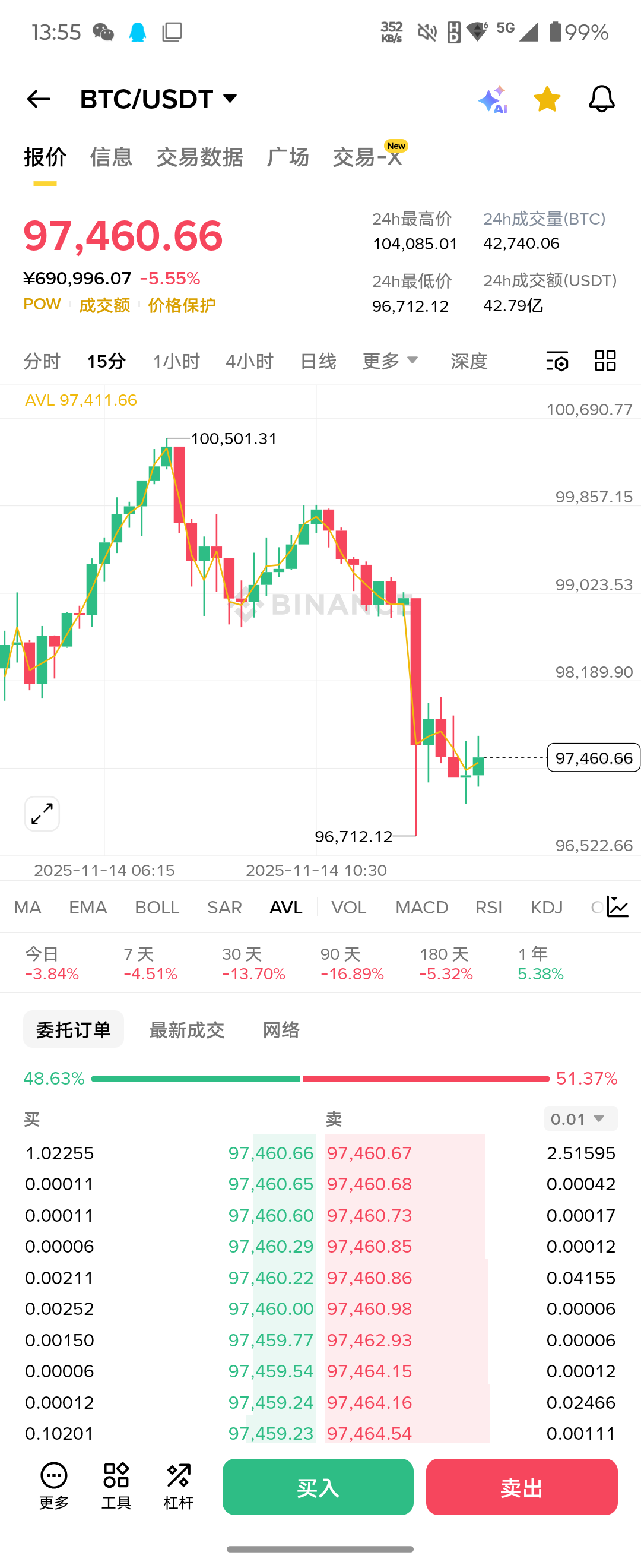
> Once viewed as an unstoppable Bitcoin bull market, it is now facing the most severe test since the beginning of this year.
After three consecutive days of sharp declines, Bitcoin further broke through the key psychological level of $100,000 on Friday (November 14), briefly dropping to around $97,600, marking its lowest level since May 8.
This largest global cryptocurrency has fallen about 22% from its historical high of $126,273 set on October 6, with **approximately $450 billion in market value evaporated** during this period.
In stark contrast to the downturn in the crypto market, traditional safe-haven assets like gold and silver have continued to strengthen. This divergence reflects that investors' preference for traditional safe-haven assets is increasing amid rising macroeconomic uncertainty.
---
## 01 Large-scale Sell-off by Long-term Holders
All along, long-term holders of Bitcoin (LTHs) have been seen as the most steadfast force in the market, typically holding coins for over 155 days and often able to withstand the impact of price fluctuations.
However, according to on-chain data released by CryptoQuant on November 14, these long-term holders have **sold approximately 815,000 Bitcoins in the past 30 days**.
This is the highest selling level since January 2024, and these so-called "big hands" are selling Bitcoin at the largest scale this year.
CryptoQuant analysts pointed out: "In the face of declining demand, long-term holders are actively selling, putting heavy pressure on prices."
Analysts, including Will Clemente, co-founder of Reflexivity Research, found that **the selling pressure is not concentrated in a specific group**, but is widely distributed among holders of 6 months, 18 months, 3 years, and even 7 years.
The phenomenon of long-term holders from different age groups selling simultaneously is extremely rare.
## 02 U.S. Investors Lead the Sell-off
Data shows that U.S. investors played a key role in this sell-off. XWIN Research diagnosed based on the persistently negative "Coinbase Premium Index":
"The U.S.-centered structural pressure" is driving prices down.
A negative index means that U.S. investors are selling Bitcoin at prices below the global market price.
According to on-chain data from XWIN Research, the trading price of Bitcoin on Coinbase is lower than on other global exchanges, showing that selling pressure in the U.S. investment market is much greater than buying pressure in Asia or Europe.
The market repeatedly exhibits this pattern: **Bitcoin rises during Asian daytime but sharply reverses during the U.S. trading session in the evening**.
## 03 Deteriorating Macroeconomic Environment
The macroeconomic environment is equally unfavorable for risk assets like Bitcoin. Although the U.S. government shutdown has officially ended, the market did not respond with the expected 'risk appetite'.
On the contrary, the market views this development as an event of "good news fully priced in is bad news."
More importantly, **the expectations for Federal Reserve interest rate cuts are rapidly cooling down**. According to the CME FedWatch tool, traders currently price the probability of a Fed rate cut in December at 51%, down from 69% a week ago.
Recent hawkish comments from several Federal Reserve officials have intensified this trend. Cleveland Fed President Loretta Mester stated that the Fed should maintain stable interest rates to continue applying pressure on inflation.
Mary Daly, President of the San Francisco Federal Reserve, believes it is still too early to determine whether the Federal Reserve should cut interest rates at the December meeting.
The prolonged U.S. government shutdown has also led to delays in the publication of key economic data. White House economic advisor Kevin Hassett confirmed that **the government will not release the unemployment rate data for October**.
This leaves the Federal Reserve lacking complete data references when making decisions at the December meeting, and it is likely to maintain interest rates unchanged as a result.
## 04 Leverage Liquidation and Derivatives Market Pressure
The inherent structural problems in the crypto market are also significant factors in this plunge. Bitcoin's latest correction reflects the market's continued difficulty stabilizing after experiencing the largest single-day liquidation event in history on October 10.
On that day, more than $20 billion in leveraged positions were forcibly liquidated.
XWIN Research Japan pointed out: "The 12th is the day with the largest daily clearing peak in the past 10 days, indicating that the market is overly biased towards leveraged positions."
When major support levels are lost, **a series of forced liquidations are triggered, accelerating the price decline**.
The derivatives market is also showing signs of tension. Coinbase's Deribit data shows a surge in demand for put options below $100,000, especially in the range of $90,000 to $95,000, indicating a rise in market risk aversion.
## 05 Weakening Institutional Interest
Institutional investors, who were once key drivers of Bitcoin's rise, are also withdrawing their investments. In the past month, the **selling scale of spot Bitcoin ETFs has reached approximately $2.8 billion**.
Markus Thielen, CEO of 10X Research and former portfolio manager at Millennium Management LLC, pointed out:
If the upward momentum of the coin price further stagnates, there could be billions of dollars in outflows before the December Federal Reserve meeting.
According to SoSoValue data, on November 13 alone, there was nearly $897 million in outflows from Bitcoin ETFs listed in the U.S.
At the same time, global listed companies only added 14,400 Bitcoins in October, the lowest monthly increase of the year.
The cooling of institutional demand has severely impacted the Bitcoin market, as they have been one of the key pillars of Bitcoin's rise this year.
## 06 Market Outlook and Support Levels
Analysts are largely cautious about the future trajectory of Bitcoin. 10X Research noted in a report to clients: "**The bear market atmosphere has already permeated**—Bitcoin and most crypto-related assets are deep in a bear market."
The institution has set the next key support level for Bitcoin at around $93,000.
Jake Ostrovskis, head of over-the-counter trading at Wintermute, pointed out: "Bitcoin is facing dual pressures from spot selling and corporate hedging, and traders are almost completely avoiding altcoins."
When the market narrative of cryptocurrencies weakens, their correlation with traditional risk assets increases, becoming a major driving force behind this decline.
However, some analysts believe that the crypto industry is facing significant regulatory tailwinds. If tech stocks rebound, Bitcoin may see a substantial rebound.
---
Crypto analysis firm 10X Research has announced that **Bitcoin and most crypto assets have officially entered a bear market**. They warn that if the upward momentum of the coin price further stagnates, there could be billions of dollars in outflows before the December Federal Reserve meeting.
Market participants are closely monitoring the $93,000 level, believing it to be Bitcoin's next key support level.
Moreover, the phenomenon of Bitcoin declining in sync with tech stocks raises concerns among investors that this is not just a problem in the cryptocurrency market, but a signal of deteriorating prospects for risk assets overall.
> Once seen as an unstoppable Bitcoin bull market, it now faces the most severe test since the beginning of the year.
After three consecutive days of sharp declines, Bitcoin further fell below the key psychological threshold of $100,000 today, Friday (November 14), briefly dropping to around $96,700, the lowest level since May 8.
This largest global cryptocurrency has fallen about 22% from its historical high of $126,273 set on October 6, **with a market value evaporating by approximately $450 billion**.
In stark contrast to the decline in the crypto market, traditional safe-haven assets like gold and silver continue to strengthen. This divergence reflects an increasing preference for traditional safe-haven assets among investors amid heightened macroeconomic uncertainty.
# 01 Large-scale Sell-off by Long-term Holders
All along, long-term holders of Bitcoin (LTHs) have been seen as the most steadfast force in the market, typically holding coins for over 155 days and often able to withstand the impact of price fluctuations.
However, according to on-chain data released by CryptoQuant on November 14, these long-term holders have **sold approximately 815,000 Bitcoins in the past 30 days**.
This is the highest selling level since January 2024, and these so-called "big hands" are selling Bitcoin at the largest scale this year.
CryptoQuant analysts pointed out: "In the face of declining demand, long-term holders are actively selling, putting heavy pressure on prices."
Analysts, including Will Clemente, co-founder of Reflexivity Research, found that **the selling pressure is not concentrated in a specific group**, but is widely distributed among holders of 6 months, 18 months, 3 years, and even 7 years.
The phenomenon of long-term holders from different age groups selling simultaneously is extremely rare.
## 02 U.S. Investors Lead the Sell-off
Data shows that U.S. investors played a key role in this sell-off. XWIN Research diagnosed based on the persistently negative "Coinbase Premium Index":
**The "U.S.-centered structural pressure"** is driving prices down.
A negative index means that U.S. investors are selling Bitcoin at prices below the global market price.
According to on-chain data from XWIN Research, the trading price of Bitcoin on Coinbase is lower than on other global exchanges, showing that selling pressure in the U.S. investment market is much greater than buying pressure in Asia or Europe.
The market repeatedly exhibits this pattern: **Bitcoin rises during Asian daytime but sharply reverses during the U.S. trading session in the evening**.
# 03 Deteriorating Macroeconomic Environment
The macroeconomic environment is equally unfavorable for risk assets like Bitcoin. Although the U.S. government shutdown has officially ended, the market did not respond with the expected 'risk appetite'.
On the contrary, the market views this development as an event of "good news fully priced in is bad news."
More importantly, **the expectations for Federal Reserve interest rate cuts are rapidly cooling down**. According to the CME FedWatch tool, traders currently price the probability of a Fed rate cut in December at 51%, down from 69% a week ago.
Recent hawkish comments from several Federal Reserve officials have intensified this trend. Cleveland Fed President Loretta Mester stated that the Fed should maintain stable interest rates to continue applying pressure on inflation.
Mary Daly, President of the San Francisco Federal Reserve, believes it is still too early to determine whether the Federal Reserve should cut interest rates at the December meeting.
The prolonged U.S. government shutdown has also led to delays in the publication of key economic data. White House economic advisor Kevin Hassett confirmed that **the government will not release the unemployment rate data for October**.
This leaves the Federal Reserve lacking complete data references when making decisions at the December meeting, and it is likely to maintain interest rates unchanged as a result.
# 04 Leverage Liquidation and Derivatives Market Pressure
The inherent structural problems in the crypto market are also significant factors in this plunge. Bitcoin's latest correction reflects the market's continued difficulty stabilizing after experiencing the largest single-day liquidation event in history on October 10.
On that day, more than $20 billion in leveraged positions were forcibly liquidated.
XWIN Research Japan pointed out: "The 12th is the day with the largest daily clearing peak in the past 10 days, indicating that the market is overly biased towards leveraged positions."
When major support levels are lost, **a series of forced liquidations are triggered, accelerating the price decline**.
The derivatives market is also showing signs of tension. Coinbase's Deribit data shows a surge in demand for put options below $100,000, especially in the range of $90,000 to $95,000, indicating a rise in market risk aversion.
# 05 Weakening Institutional Interest
Institutional investors, who were once key drivers of Bitcoin's rise, are also withdrawing their investments. In the past month, the **selling scale of spot Bitcoin ETFs has reached approximately $2.8 billion**.
Markus Thielen, CEO of 10X Research and former portfolio manager at Millennium Management LLC, pointed out:
If the upward momentum of the coin price further stagnates, there could be billions of dollars in outflows before the December Federal Reserve meeting.
According to SoSoValue data, on November 13 alone, there was nearly $897 million in outflows from Bitcoin ETFs listed in the U.S.
At the same time, global listed companies only added 14,400 Bitcoins in October, the lowest monthly increase of the year.
**The cooling of institutional demand** has severely impacted the Bitcoin market, as they have been one of the key pillars of Bitcoin's rise this year.
# 06 Market Outlook and Support Levels
Analysts are largely cautious about the future trajectory of Bitcoin. 10X Research noted in a report to clients: "**The bear market atmosphere has already permeated**—Bitcoin and most crypto-related assets are deep in a bear market."
The institution has set the next key support level for Bitcoin at around $93,000.
Jake Ostrovskis, head of over-the-counter trading at Wintermute, pointed out: "Bitcoin is facing dual pressures from spot selling and corporate hedging, and traders are almost completely avoiding altcoins."
When the market narrative of cryptocurrencies weakens, their correlation with traditional risk assets increases, becoming a major driving force behind this decline.
However, some analysts believe that the crypto industry is facing significant regulatory tailwinds. If tech stocks rebound, Bitcoin may see a substantial rebound.
Crypto analysis firm 10X Research has announced that **Bitcoin and most crypto assets have officially entered a bear market**. They warn that if the upward momentum of the coin price further stagnates, there could be billions of dollars in outflows before the December Federal Reserve meeting.
Market participants are closely monitoring the $93,000 level, believing it to be Bitcoin's next key support level.
Moreover, the phenomenon of Bitcoin declining in sync with tech stocks raises concerns among investors that this is not just a problem in the cryptocurrency market, but a signal of deteriorating prospects for risk assets overall.