
What exactly is a blockchain wallet?
The origin of wallets
Everyone knows that the "chain" in blockchain has a core role - the main chain currency. Taking Ethereum (ETH) as an example, its main chain currency is ETH. For a blockchain to operate normally, it relies on countless nodes verifying transactions together, and the people running these nodes can be understood as "miners". As we know, mining comes with rewards, and these rewards are directly deposited into the node's wallet when mined. However, the problem arises: if you want to use these rewards for transfers or other operations, the process is super complicated! You have to enter a bunch of code commands in the node's backend! The image below is a snapshot I took while setting up a private chain (today I'm sharing a picture, the image shows the command interface for creating a node wallet), so you can feel how strong that "technical feel" is.
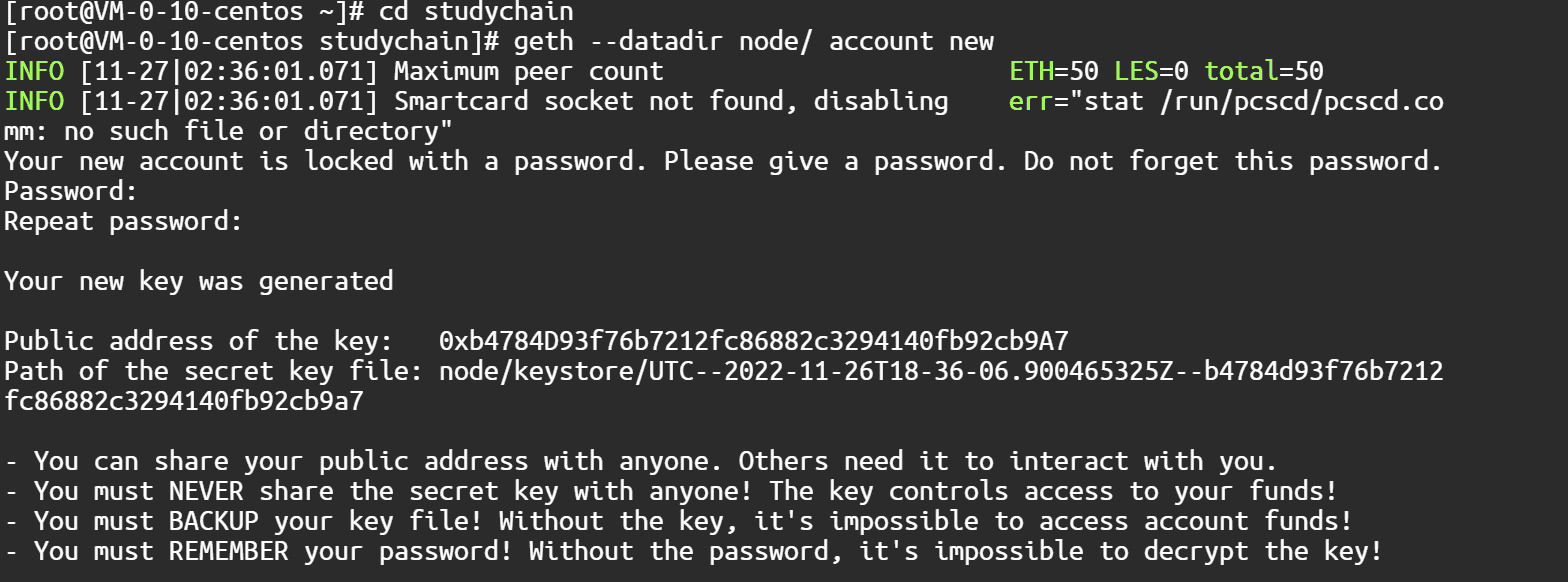
As Ethereum opened the door to programmable blockchains, the world of blockchain has become diverse and colorful. Besides main chain tokens (like ETH), developers can issue various tokens on-chain. These tokens are essentially programs running on the blockchain, technically called smart contracts. In addition to tokens, many DApps (decentralized applications) have emerged on-chain, such as decentralized exchanges like PancakeSwap under Binance. If you want to use these DApps, you also need a wallet to interact with them, after all, blockchain is decentralized, with no 'centralized institutions' to help you operate; everything relies on yourself!
Why do you need a wallet? Because running nodes is too troublesome! Imagine if everyone had to run a node to participate in blockchain, that would be unrealistic (of course, in the early days of BTC, that was the case; we old users should know that it was necessary to run a BTC node wallet on a computer, I can't find the image now, otherwise I would attach one for our newbies to see)! At this point, wallets emerged. They visualize complex operations and integrate them into an app or computer program. You just need to tap the screen to complete transfers, transactions, DApp signatures, etc. (for example, the dog-fighting games that everyone is interested in now must use wallets), without having to worry about typing command line codes!
Essentially, a wallet is a tool. Most universal wallets are compatible with multiple blockchain networks (also known as 'multi-chain support'), and I will explain this part in detail later. For us 'ordinary users' of blockchain, the main functions of a wallet are to store and transfer tokens and interact with DApps! (There are more things for developers to play with, but this article won't go that in-depth.)
Types of wallets
I just talked about what wallets are for. With the development of technology, the ecosystem on the blockchain is becoming more and more rich, and there are more things for everyone to play with. Traditional standard wallets can no longer meet the requirements, so various wallets have emerged. This article is written for beginners, so I will only discuss a few types that ordinary users often encounter and can use. (Whenever I format like this, someone says I am AI. Now AI is indeed convenient, but not everything should rely on AI; you need to have your own thinking ability. For me, AI just polishes some of my paragraphs!)
Software wallets: Software wallets are applications that run on mobile phones or computers, such as MetaMask or Trust Wallet. They are like digital wallet apps, always online, making it convenient for you to transfer, trade, or use DApps. The advantages are simplicity and suitability for beginners and small transactions; the disadvantages are that being online makes them easy targets for hackers, so don’t store too much money; safety first!
Hardware wallets: Hardware wallets are physical devices that serve as wallets. Some are similar to USB drives, while others resemble mobile phones. They are generally suitable for large holders and those who pursue extreme security; the operations can be cumbersome, and I won’t go into too much detail here, as hardware wallets are typically cold wallets.
Cold wallets: Cold wallets are wallets that are not connected to the internet. Most hardware wallets are a type of cold wallet, and paper wallets (writing the private key on paper, with additional conditions) also count. Its core is 'offline', meaning hackers cannot attack remotely, making the security level the highest. Suitable for long-term holders (HODLers).
Hot wallets: Hot wallets are wallets that are connected to the internet; most software wallets fall under this category. The advantages are convenience; the disadvantages are higher risks, as they can easily be compromised by phishing websites or viruses that steal private keys.
Multi-signature wallets: Multi-signature wallets require multiple private keys to authorize transactions. For example, you and a friend each hold a 'key', and both must be used to unlock. The advantages are security, preventing mistakes or theft by a single person; the disadvantages are complex operations, suitable for teams. (But, for example, 3-of-5 means 3 signatures out of 5; if three of them collude, they can take the money, which would be disastrous!)
Custodial wallets: Custodial wallets are wallets managed by a third party (such as an exchange). You deposit money into it, and the private key is held by the platform, akin to 'bank deposits'. Your Binance deposit address is theoretically your custodial wallet entrusted to Binance. (Theoretically, it’s not entirely accurate, but it's fine for beginners to understand this way.)
Non-custodial wallets: Non-custodial wallets are those where you control the private keys; the aforementioned software and hardware wallets are generally non-custodial wallets.
MPC wallets: Also known as keyless wallets, they use encryption algorithms to split and back up your private keys. For example, Binance's built-in wallet is an MPC wallet that splits the private key into one part for you, one for Binance, and one for the cloud.
Built-in wallet of the exchange (this type is named by me): this essentially does not count as a type of wallet, it just integrates the software wallet into the exchange app, somewhat like a mini-program from a certain app.
The 'pits' that beginners encounter when using wallets.
Let's write about the pitfalls in Q&A mode.
What type of wallet should beginners use?
If you ask me, if you don't need a wallet, and are just a pure contract or spot trader, then don't use one for now. As long as the amount is not particularly large (a few million dollars), keeping it on a leading exchange like Binance is very safe. However, if you have a wallet need, for example, you are a dog-fighting player, then those dog-fighting platforms will provide you with 'good service'. If you are a yield farmer, then you need to learn more because there is also a plug-in wallet that I haven't mentioned yet, haha (for most beginners, using the built-in wallet of the exchange is enough; understand the rest clearly before proceeding).
What should be noted when creating a wallet?
Do not screenshot the mnemonic phrase page, do not screenshot, do not screenshot, do not copy the private key, do not copy, do not copy, nothing else (basic knowledge should be learned, do not create a TRON wallet to receive BSC tokens, haha).
What should be noted when using a wallet?
Do not click on unknown links or scan unknown QR codes for authorization, as you may receive some inexplicable tokens. If authorization is needed during selling or other operations, also pay extra attention (phishing!). It's recommended to frequently change wallets; in the absence of other requirements and conditions, use a wallet a few times and then discard it, just create a new one. This is not troublesome!
I've heard of 'fake wallets' how can I avoid them?
As long as you download and install it through their official website or official platform, don’t install it from some random links; this matter is unrelated to you!
What should I do if I lost money using the wallet?
In most cases (from my experience with beginners), it’s usually because they transferred to the wrong chain. At this point, switching chains will show you that your money hasn’t been lost; it’s just on another chain. However, the prerequisite is that the chains must be of the same series, such as all Ethereum-based, and the addresses must indeed be correct. I’m just using this as an example; there are many actual scenarios of lost tokens, and falling for phishing also counts! #加密市场回调


