

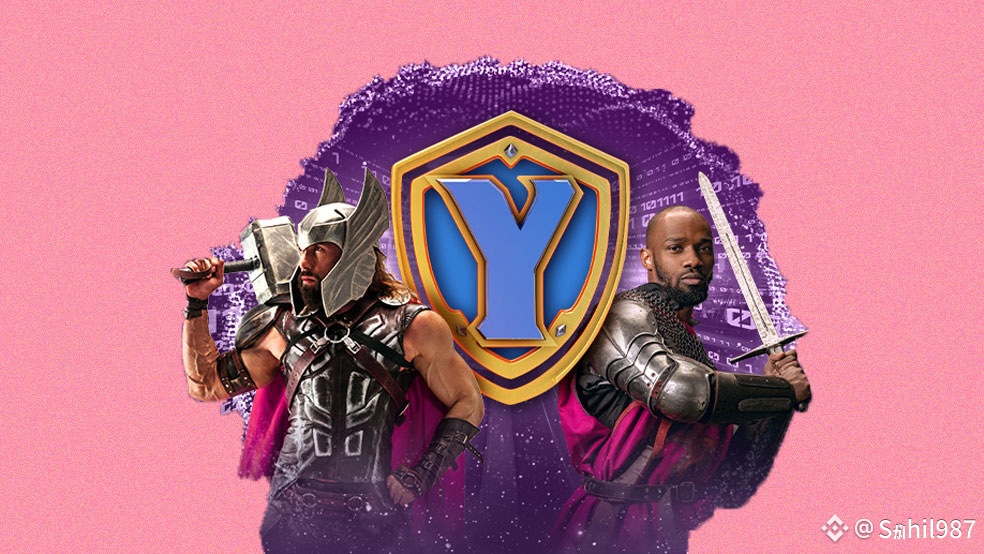
@Yield Guild Games There’s a moment in every ecosystem when something subtle reshapes the entire terrain rarely loud, rarely dramatic, but unmistakably transformative. For web3 gaming, that moment feels like it’s happening right now inside the evolving universe of Yield Guild Games, and it’s happening through a doorway many didn’t realize they needed until it appeared. The doorway is YGG Play, and its arrival marks the point where scattered game worlds stop being lonely islands and start feeling like connected continents.
What makes this shift so compelling is that YGG didn’t force it. It didn’t flood the market with marketing noise or promise the impossible. It did something far more powerful: it reframed what it means to enter a web3 game. And it did so by leaning into what made YGG matter in the first place not hype, not speculation, but the recognition that players aren’t just an audience. They’re the ecosystem.
The story starts with a truth most players know all too well. Web3 games have heart, but they’ve lacked a home a place where discovery is natural instead of overwhelming, where new titles aren’t buried in noise, where progress feels connected instead of scattered. Every studio has been building in isolation, while players have been chasing trailers, discords, and whitepapers with no real guidance.
Then YGG Play arrives. Not as a launchpad in the conventional crypto sense, but as a guild hall a living hub, a central world where players gather before stepping into others. For a guild built on identity, community, and shared progression, it feels like the most natural evolution imaginable.
Inside this new hub, something becomes clear: YGG Play changes the way players move through games. The model isn’t “pick a game and hope it sticks.” It’s “explore at your pace through meaningful quests,” each one designed to help players understand a game’s soul before committing time or capital. That simple design choice shifts the entire narrative of onboarding. You’re not thrown into the deep end. You’re guided, rewarded, and treated like your time has value.
And that’s where quests matter. They are not chores, not empty checklists, not disguised tutorials. They’re how YGG Play turns exploration into progression. When you complete quests, you’re not just finishing tasks you’re earning pathways into new worlds. And some of those pathways lead directly to early access game tokens, the kind that normally require jumping through speculative hoops. Instead, YGG rewards curiosity. You play your way into opportunities, not gamble your way in.
This is where the system begins to feel alive, almost like a storytelling format layered over real economies. Every quest completed leads you deeper into a world, and every world explored expands your identity within the YGG ecosystem. You don’t just gather rewards you gather presence. And the more presence you have, the more the ecosystem recognizes you. That recognition becomes influence, and that influence becomes a force carried from one game to another. Suddenly, your identity is not tied to a single title. It’s part of the guild itself.
For a DAO like YieldGuildGames, this moment feels like a culmination. The early years were about vaults, SubDAOs, NFTs, staking, governance pieces of an ecosystem designed around participation. But participation without direction leaves players drifting. YGG Play provides direction. It gives the ecosystem a shape, a starting point, a progression path that makes sense whether you’re new to web3 or a veteran who’s lived through every cycle.
The interesting part is how this affects the games themselves. Developers aren’t launching into a vacuum anymore. They’re launching into a world where players already gather, where quests guide them directly into the gameplay loop, where tokens can be discovered through interaction rather than speculation. It’s onboarding as narrative. Distribution as gameplay. Engagement as culture.
And culture is where YGG has always stood apart. Guilds aren’t about yield; they’re about belonging. They’re about shared stories, shared progression, shared identity. But guilds had been missing something the connective tissue between games. Now, with YGG Play as the guild's central hub, the ecosystem finally behaves like a constellation instead of scattered stars. Each game is a world. YGG is the gravity that holds them in relation to one another.
This is why the arrival of the YGG Play Launchpad feels so pivotal. It’s not just a marketplace for new tokens it’s the start of a player journey that stretches across multiple games, each one connected by quests, discovery, and community. Tokens aren’t isolated assets; they’re milestones in a larger adventure. And YGG becomes more than a governance token it becomes the energy that keeps the constellation bright. Through staking, participation, and governance, players aren’t just visitors they’re contributors shaping the universe they play in.
As more games join YGG Play, the universe expands, but not chaotically. It expands with purpose. Every title is curated, every quest crafted, every token opportunity aligned with meaningful gameplay. The platform doesn’t funnel players into one dominant world it gives them many worlds, each worth visiting, each connected by the same guild spirit that defined YGG from the beginning.
This is the shift.
One guild. Many worlds.
A single journey that spans them all.
Web3 games finally have a place where players don’t get lost they get welcomed. Where discovery isn’t noise it’s narrative. Where tokens aren’t speculation they’re earned through experience. And where the guild is no longer just a network it’s home.

