
If your funds are within 500,000 and you want to quickly succeed in the cryptocurrency world through short-term trading, please read this post carefully. After reading, you will understand the essence of short-term trading!
Not choosing a finance major in college is a major regret in my life. Starting from my freshman year, I began to learn about stocks/finance/foreign exchange online. The alternating red and green screens filled my life with color and fascinated me. With infinite longing for the market, I naively opened an account in my sophomore year. Later, I slowly learned more about the cryptocurrency world, Bitcoin, and through an introduction from a classmate, I got to know more and more, feeling very interested and starting my investment career.
Like most friends who have recently entered the market, many become obsessed with technical indicators and continuously use coins for back-testing to find patterns. They are eager to enter low-priced coins or coins that have significantly corrected, believing their safety is higher. In fact, these perceptions about the market are completely wrong.
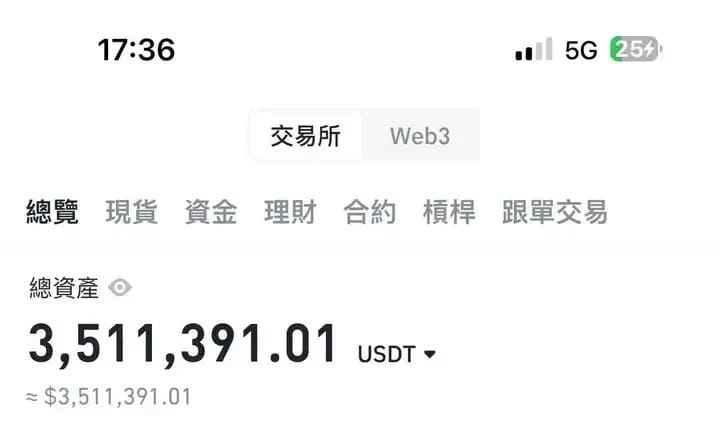
I later understood that if you want to quickly gain profits in the market, you must trade short-term. Combine medium and long-term compounding!
What summarizes is: Do not let the blood of profit cloud your judgment. You must know that the most difficult thing in the world is how to sustain profits. You must conduct serious reviews to determine whether it is luck or skill. A stable trading system that suits you is the way to sustainable profit.
There is a saying that impressed me: Ideology is something you must occupy; otherwise, others will occupy it.
Today, the trading mindset I share with you is the essence that has allowed me to stand firm in the market for a long time. If you study seriously, you will definitely gain a lot and your understanding of trading will undergo a tremendous change!
Sharing the application of ‘techniques’ in trading indicators.
Knowing is not difficult, but acting on it is not easy. For investment in the secondary market, everyone knows not to be greedy, nor to chase highs and kill lows, but how many can control their hands to achieve unity of knowledge and action? In the Tao Te Ching, Laozi mentions the way, law, and technique. The way refers to rules and natural laws, core concepts; the law refers to methods, principles, and systems; and technique refers to actions and operational methods. The combination of the way, law, and technique is regarded as an important principle and guideline for guiding people's lives and social development.
For the secondary market, we can also divide investment into the way, law, and technique, and all three are indispensable.
The way: represents investment philosophy and beliefs, that is, investment direction, goals, and values. It includes analysis of long-term market trends, macro conditions, and fundamentals.
Law: represents the rules and regulations of investment, including investment strategies, risk management, and asset allocation.
Technique: represents technical analysis, quantitative analysis, and trading psychology in investment.
Today's report will focus on the 'technique' in trading, aimed at sharing the application of technical indicators and technical analysis in practice. For the vast majority of people, there is no need to learn many biased technical indicators because they are all lagging and cannot directly yield profits. This report will share commonly used technical indicator methods to let more people understand the significance of technical analysis.
Note: The cryptocurrencies and indicators mentioned in this report do not constitute investment advice and are for learning purposes only. The mentioned investment advice and indicator methods do not apply to all cryptocurrencies and products. The risks in blockchain are significant, and you could lose all your principal. Please conduct your own research carefully.
The article mainly includes:
1. Explanation and application of MA and MACD indicators.
2. Explanation and application of Boll and RSI indicators.
3. Flag pattern consolidation variant.
4. Conclusion
1. MA moving average + indicator explanation and application.
The MA indicator, also known as Moving Average, calculates the average price within a certain number of periods. For example, MA5 represents the average price of the last five periods (including the current candle), whether at the minute level, hourly level, or daily level. The smaller the MA number, the more sensitive it is to fluctuations, thus focusing more on short-term fluctuations. Conversely, the larger the MA number, the slower the fluctuations, focusing on long-term fluctuations.
The MA numbers can be set according to user preferences. Here I share two common MA trading methods I use, namely the Vegas channel and the squeeze channel.
Vegas Channel
The Vegas channel, in its simplified explanation, uses the 144 and 169 moving averages to judge medium and long-term trends. This method is not suitable for time frames shorter than 15 minutes and is recommended for use in time frames of one hour or more.
Why use these two moving averages?
Upon careful observation, we can see that 144 and 169 are the squares of 12 and 13 respectively. This principle subtly implies Gann's square theory and the Fibonacci sequence. That is, the number 144 comes from Gann's square theory and the number 169 is the square of the Fibonacci number 13. Only by combining them can we achieve better application results in practical combat.
Example explanation:
Taking the four-hour trend of OP as an example, we find that when the 144-day moving average crosses above the 169-day moving average, a golden cross is formed (a golden cross indicates that the 144 moving average crosses above the 169 moving average), indicating a bullish trend in the medium to long term, and entry can be attempted. When the price reaches the top, the 144 moving average crosses below the 169 moving average, forming a dead cross (a dead cross indicates that the 144 moving average crosses below the 169 moving average), then it is time to observe and exit the market in the medium to long term.
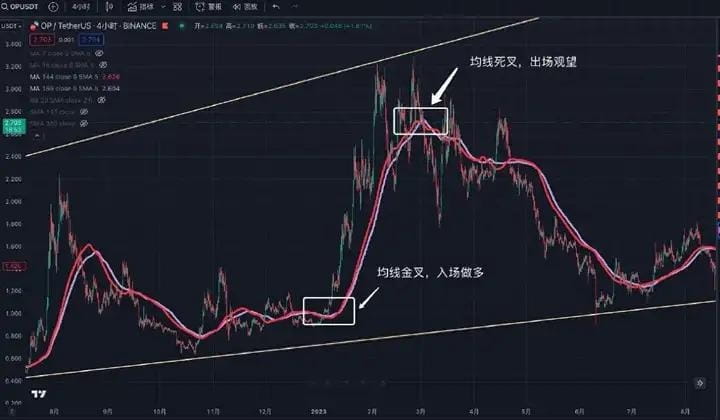
Then some may ask, isn’t your statement too absolute? How do you explain the back-and-forth golden and dead crosses of moving averages before sideways movement? You are just gambling!
Here is my suggestion: since the 144 and 169 moving averages cannot accurately determine short-term trends and have strong lagging effects, you can add the 7 and 14-day moving averages for auxiliary judgment of short-term trends. Let’s further amplify the trend of OP and assess medium to long-term changes using larger MA moving averages, then use smaller MA moving averages for secondary confirmation to achieve the highest certainty.
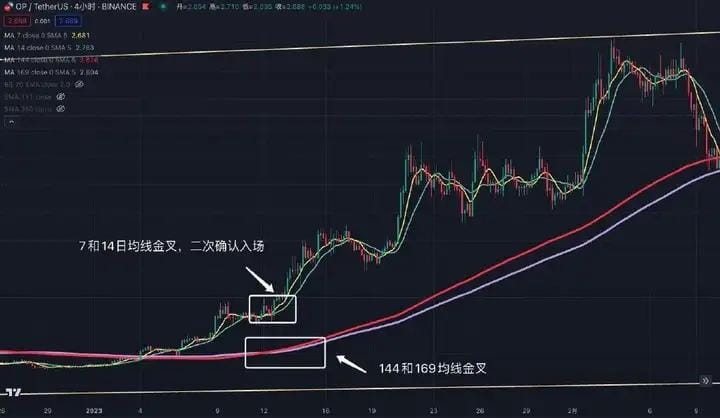
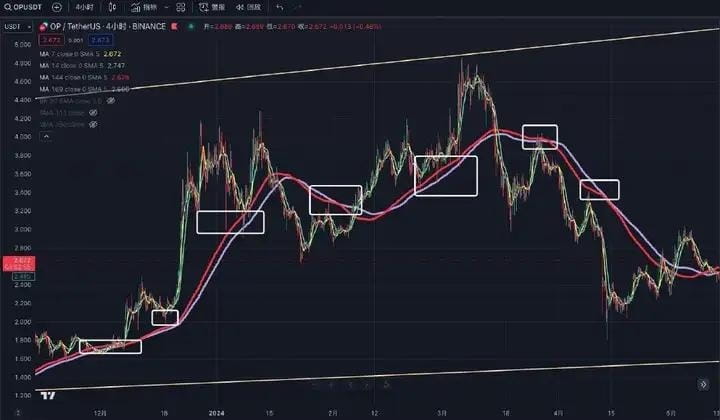
The Vegas channel is used to judge medium and long-term trends. Due to the lagging nature of the Vegas channel, it still needs to be combined with short-term moving averages for auxiliary verification. A strong market must see the 144 and 169 moving averages rise. If the price hovers near the 144 and 169 moving averages, it indicates a weaker short-term market, making it unsuitable for entry. Meanwhile, the 144 and 169 moving averages provide good support and resistance, suitable for ultra-short-term rebound operations.
Squeeze Channel
The squeeze channel mainly comes from the squeeze theorem in mathematical calculus. Its simplified explanation is that if a function is ‘squeezed’ by two other functions near a certain point, and these two functions have the same limit, then the limit of this function will also tend towards the same value.
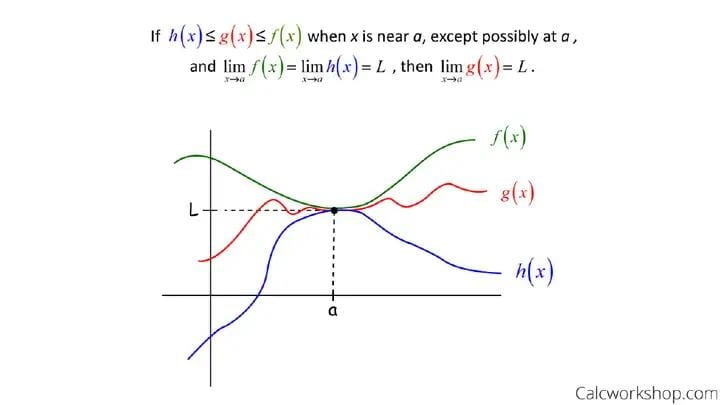
In secondary market trading, we can also use a similar squeeze theorem model. We can simplify it into two moving averages, namely the 111 and 350 moving averages. Due to the longer cycle of the 350 moving average, it is recommended for use in short-term trading.
Why these two moving averages?
Dividing 350 by 111 gives us a number that is closest to pi, which is 3.15, or we can say that dividing 350 by 3.14 gives us the closest number, which is 111.
Example explanation:
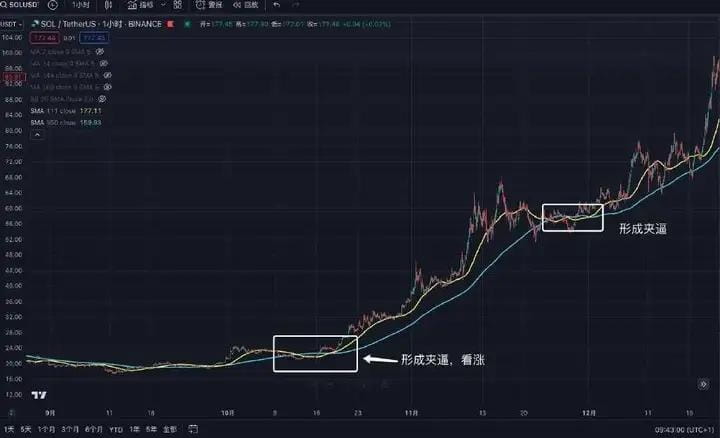
Taking the one-hour trend of TRB as an example, when the blue line (350) moving average is above, and the yellow line (111) moving average is below, forming a triangular shape, it indicates that the ‘squeeze’ has succeeded. After succeeding, the subsequent trend is bullish. However, it is important to note that for a correct ‘squeeze’ shape, the 111 moving average must cross above the 350 moving average. If only one side crosses, it does not stand.
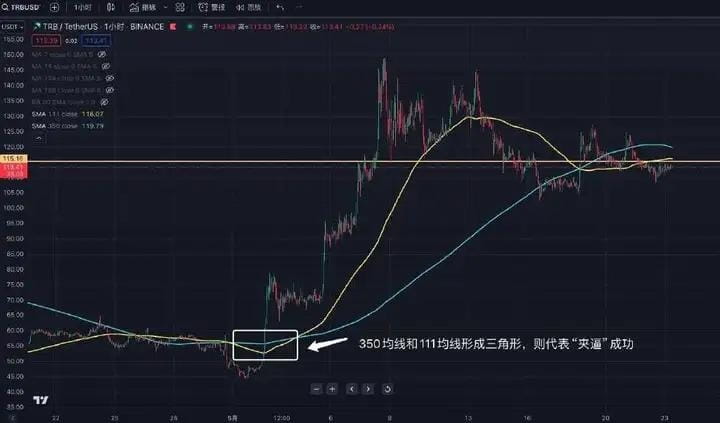
This channel is suitable for hourly and four-hour levels, although the accuracy is generally average. But once successful, the subsequent trend will be a super large-scale market. Therefore, when a squeeze pattern appears, we can pay more attention and focus. We can also use other technical indicators for auxiliary judgment.
MACD (Moving Average Convergence and Divergence)
MACD (Moving Average Convergence and Divergence) is the most commonly used technical indicator in trading, and its core is to analyze the changes in price momentum by comparing moving averages of different periods, thus providing buy and sell signals.
MACD is mainly divided into the zero line, MACD line, and signal line, and we mainly look at the three variations.
The three variations of MACD:
1. The crossing of the MACD line and the signal line:
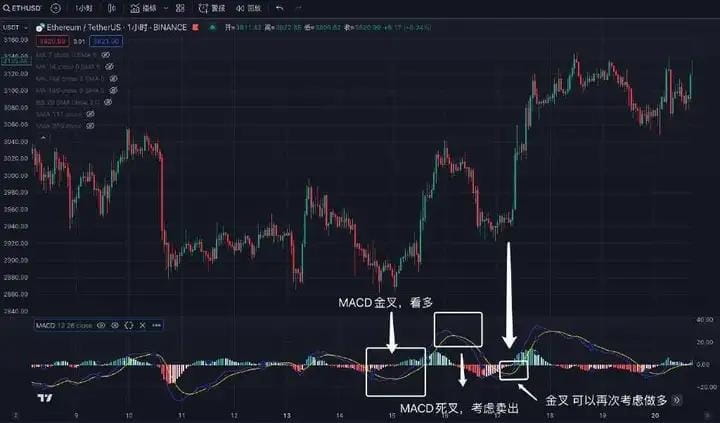
Buy signal: When the MACD line (blue) crosses the signal line (yellow) from below, it indicates that market momentum is turning positive, and buying long can be considered.
Sell signal: When the MACD line (blue) crosses the signal line (yellow) from above, it indicates that market momentum is turning negative, and selling can be considered.
2. The relationship between the MACD line and the zero line:
Above the zero line: When the MACD line is above the zero line, it indicates that the short-term average line is above the long-term average line, and the market is in an uptrend.
● Below the zero line: When the MACD line is below the zero line, it indicates that the short-term average line is below the long-term average line, and the market is in a downtrend.
3. Changes in bar charts:
● When the bar chart changes from negative to positive: When the bar chart changes from negative to positive, it indicates that the MACD line is above the signal line, and momentum is increasing, which is a buy signal. When the bar chart changes from positive to negative: When the bar chart changes from positive to negative, it indicates that the MACD line is below the signal line, and momentum is decreasing, which is a sell signal.
Taking the four-hour trend of ETH as an example, when the MACD line crosses the signal line, it indicates a bullish market. When the signal line crosses the MACD line, it indicates a bearish market. The MACD is applicable to any time frame, whether long-term or short-term, whether it’s a one-minute level or a weekly level, it is still applicable.
Advanced use of MACD and MA.
Besides the basic usage of MACD and MA, just knowing these is far from enough. Ultimately, these technical indicators can all be checked through public information, and many main forces and operators will deliberately create ‘fake trends’ to make you think you will miss out if you don't buy now.
In fact, it is just a trick to deceive you into getting on the bus.
How to prevent and identify these ‘fake trends’?
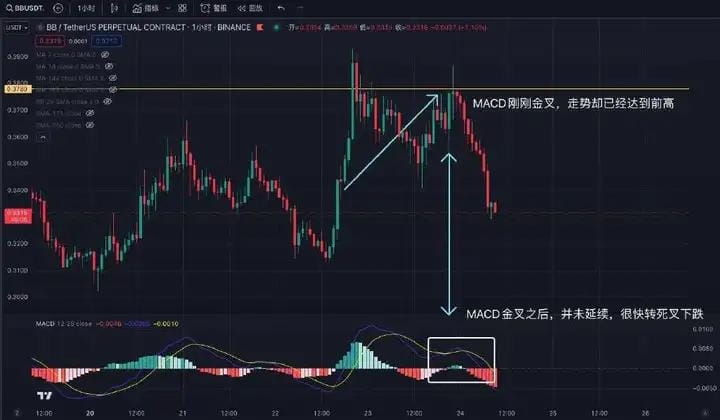
The price trend is mainly guided by the MACD golden cross to help novices enter the market. Taking the 15-minute trend of BB as an example, when the 15-minute trend breaks through a new high and then quickly drops, the MACD enters a dead cross, indicating the start of a correction. However, during the correction, the trend is rapidly recovering, even approaching the previous high. Yet, at this time, the MACD has only just started the golden cross. We can understand this trend as ‘having more in mind than the ability to act,’ meaning the price has rebounded to the previous high while the MACD just began the golden cross. In over 80% of cases, this trend will appear like this, showing strength but quickly weakening.
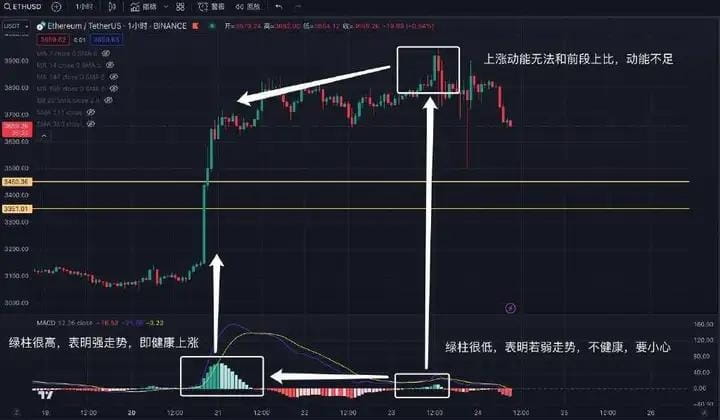
Next, let's take the one-hour trend of ETH as an example. When the MACD golden cross occurs, the green bars rise sharply, and the price follows suit. This kind of rise is a quality increase, indicating that entry can be followed. Then the price enters a sideways adjustment phase, and the MACD turns into a dead cross. After the adjustment, the MACD enters a state of obligation, but the focus on the increase and trend does not continue as before with the golden cross, but rather shows weakness in rising. This kind of ‘hanging by a thread’ state is very dangerous. Although the MACD golden cross occurs, the strength is not strong, and the longer this persistent state lasts, the more dangerous it becomes. When the price breaks through a new high while the MACD does not reach a new high, we call this a ‘top divergence,’ which is a strong sell signal. Similarly, when the price breaks through a new low while the MACD does not reach a new low, we call this a ‘bottom divergence,’ which is also a buy signal.
2. Explanation and application of BOLL and RSI indicators.
BOLL (Bollinger Bands)
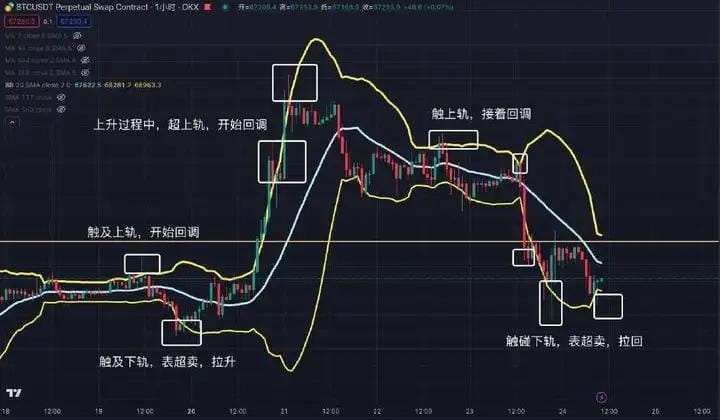
BOLL is a very simple and practical technical analysis indicator designed by American stock analyst John Bollinger based on the principle of standard deviation in statistics. I believe it is very useful in blockchain secondary trading. BOLL consists of three lines: upper track, middle track, and lower track. The upper, middle, and lower lines of the Bollinger Bands represent resistance and support levels. When the price reaches the upper track of the Bollinger Bands, it indicates resistance and may pull back. When it reaches the lower track of the Bollinger Bands, it may rise due to support. When the stock price rises above the upper track of the Bollinger Bands, it indicates overbought conditions and a higher possibility of a pullback. Conversely, when the stock price falls below the lower track of the Bollinger Bands, it indicates oversold conditions and a weaker market. When the price drops from the upper track to the middle track, the middle track plays a support role. If it breaks below the middle track, it becomes a resistance level. When the price rises from the lower track to the middle track, it also faces resistance. A breakthrough of the middle track and stabilization represents a shift from a resistance level to a support level.
Here are 10 golden basic principles of Bollinger Bands, which are very important:
1. When the price breaks out of the upper track, be wary of a pullback. 2. When the price breaks out of the lower track, be wary of a rebound. 3. Strong markets are generally above the middle track.
4. Weak market conditions always lie below the middle track. 5. The tightening of the upper and lower tracks hides sudden changes. 6. The larger the opening, the greater the market momentum.
7. The middle track guides the trend direction 8. The sudden narrowing of the channel indicates a reversal 9. The sudden opening of the channel indicates consolidation no longer.
10. The longer the channel narrows, the smaller the opening, the more significant and drastic the changes in the market will be.
Example explanation:
Taking the one-hour trend of BTC as an example, BOLL is mainly divided into three lines: upper track, middle track, and lower track. When the price exceeds the upper track, it represents overbought, and the probability of a correction is large. When the price drops below the lower track, it represents oversold, and the probability of a rebound is large.
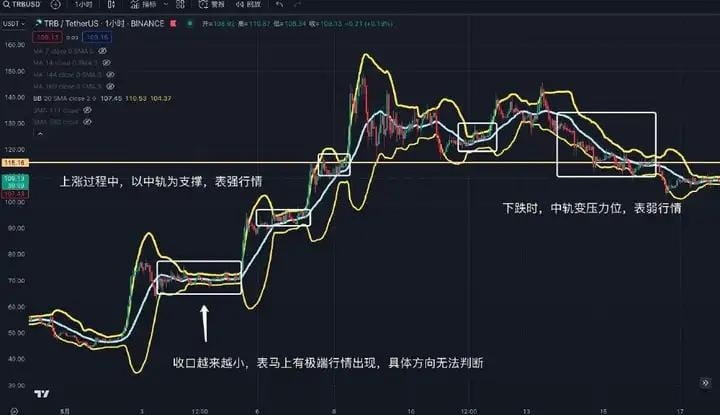
Next, let's take the one-hour trend of TRB as an example. When the BOLL band narrows, it indicates that extreme market conditions will occur. However, BOLL cannot accurately determine the specific direction and requires assistance from other indicators. The longer the narrowing time, the shorter the BOLL band, indicating that the future market will be more intense.
At the same time, in a strong upward market, BOLL will gradually rise along the middle track, while in a super strong market, BOLL will continue to rise above the upper track.
Conversely, in a weak market, BOLL will move down along the middle track, and at this time, the middle track shifts from a support position to a resistance position. In a super weak market, BOLL will continue to drop below the lower track.
RSI (Relative Strength Index)
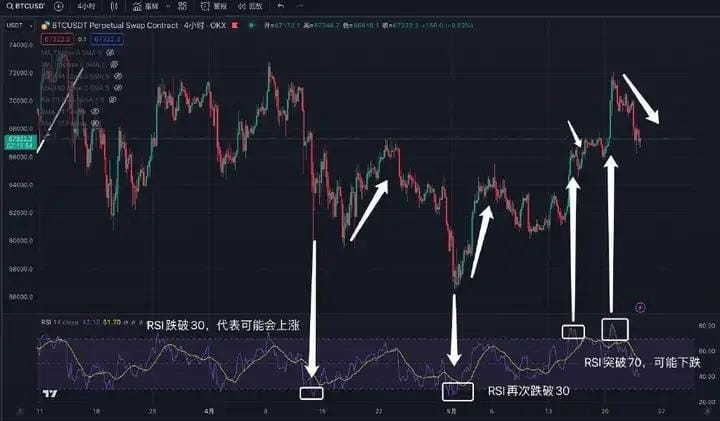
RSI (Relative Strength Index) works by calculating the magnitude of price changes to gauge the strength of market trends and thus predict trend continuation or reversal. The value of RSI fluctuates between 0 and 100, meaning that the price will not exceed this range. We can simplify this by saying that when the RSI reaches 70, it indicates overbought conditions with an increased risk of a pullback, and when it drops below 30, it indicates oversold conditions that may lead to a rise.
Example explanation:
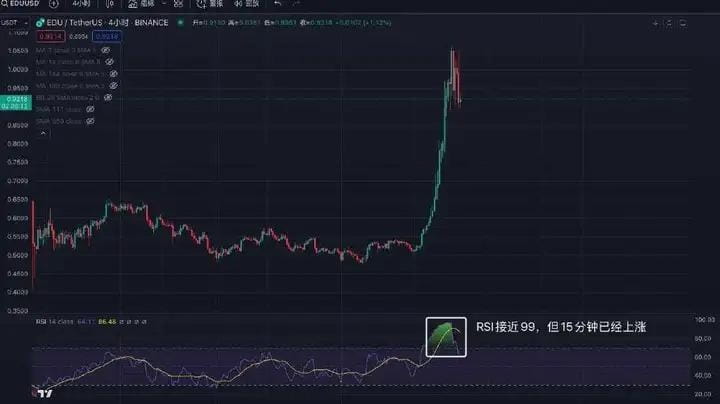
Taking the one-hour trend of BTC as an example, when the RSI drops below 30, it indicates a need for sideways movement and correction. However, this correction is not absolute and only indicates that the market trend is weak, thus cannot be used as a direct buying basis. Secondly, when the RSI breaks above 70, it indicates overbought conditions, which may carry a risk of correction. But this still cannot serve as a basis for buying or selling, it can only act as an auxiliary judgment. Note: In extreme situations, the RSI can reach 99 or above.
1. Therefore, do not use RSI as the primary basis for judgment.
Next, let's take the four-hour trend of EDU as an example. After the RSI breaks through 70, it continues to rise, and the RSI eventually reaches 99. Therefore, we cannot use the method of buying at 30 and selling at 70. We need to judge the nature of the stock/coin to see if it is low market value, meme-type coins, or high-control coins. Compared to blue-chip coins, the RSI judgment for other small coins may need to be raised to the range of 90 and 10, rather than 30 and 70. This requires personal judgment.
3. Flag pattern consolidation variant
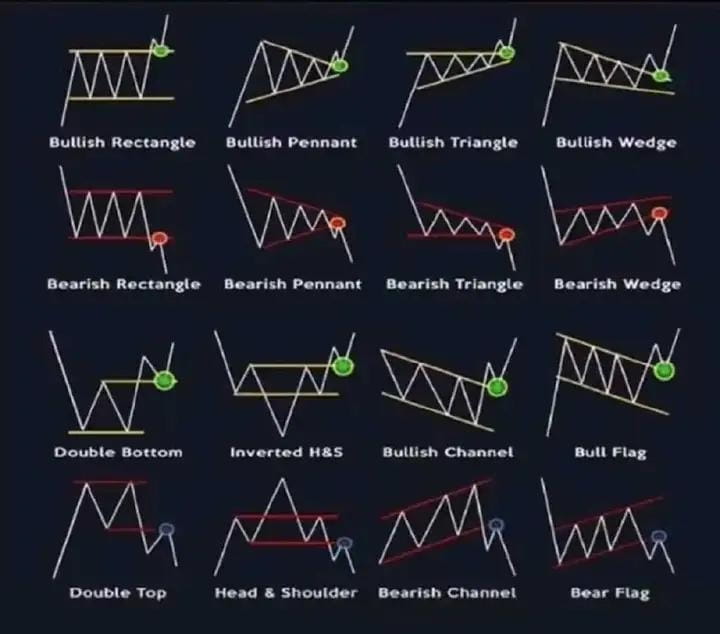
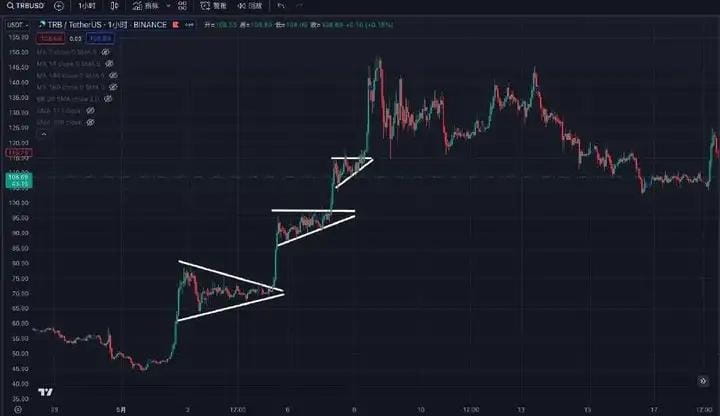
The flag pattern consolidation, also called triangular consolidation, is not judged by indicators but by the changes in the K-line trend. We can summarize it into 16 common basic change types. If you see a similar trend, you can buy in, and generally, the success rate is very high. The subsequent trend is bullish, but there are also failures. It is recommended to buy at the low point of the flag pattern. When the triangle area breaks upward, the breakout area becomes a support position, and when the price later falls, you can intervene near the support.
Example explanation:
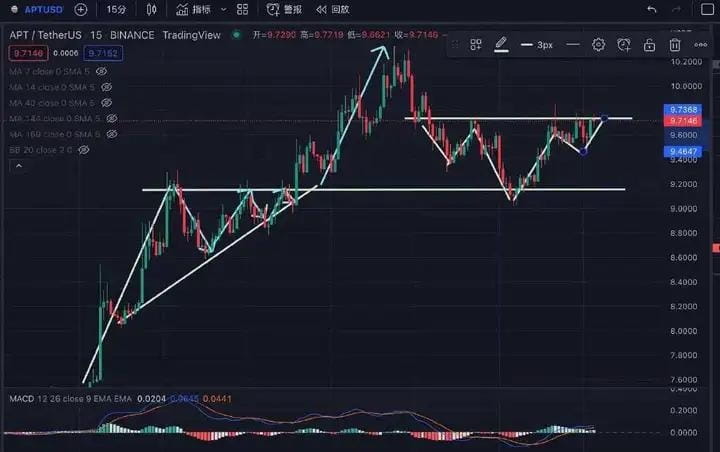
Taking the 15-minute trend of APT as an example, its trend perfectly replicates the third and tenth types of trends shown above. However, it should be noted that this is only a successful case, and many major forces and operators will deliberately create similar patterns to deceive you. We need to be cautious in distinguishing or stop loss in time.
Next, let’s take the one-hour trend of TRB as an example. We observed that TRB has applied the trend of a three-week flag pattern, achieving a threefold increase within a week. Thus, when we see similar trends in the market, we can draw them out for verification.
4. Conclusion
As it is said, in trading, the way, law, and technique are all indispensable. This report focuses solely on the ‘technique’ in the trading process. Simply learning and mastering the application of technical indicators is far from sufficient, as there are many pitfalls in the market. Moreover, every three months or so, the market trends and methods of pulling up or down will undergo significant updates, so it is necessary to continuously observe and summarize the subtle changes in the market.
People are alive, indicators are dead. The existence of technical indicators is to assist in making trading judgments after we have sufficient understanding and risk control. They cannot be used directly to profit, as all technical indicators lag and cannot achieve 100% accuracy. Only with sufficient understanding and risk control can they assist in investment; otherwise, it's just gambling.
At the same time, all technical indicators are not as simple as described in the report; each indicator has different variations and methodologies. If you study carefully, each indicator can be researched for years. Therefore, the article does not mention all variations. Additionally, each person's style is different, and the situations in which indicators are used also differ, requiring gradual adjustments according to your trading style.
Brother Yi continues to share 10 key points for trading profits, which most people do not tell him!

In the movie (Moneyball), the Oakland Athletics baseball team gathered players with various super strong abilities, thus leading to their final victory in the baseball game.
We often strive to help novice traders eliminate all distractions and focus on important goals. In our trading timeframe, how to obtain more profit opportunities and seize trends is the most important for us.
I have found that in most of my profitable trades, the following 10 factors are very beneficial. These conclusions are based on data rather than beliefs or personal opinions.
1. Expected success and failure probabilities
Your probability of success is the first step to helping you profit.
2. Average success rate
The higher your probability of success, the less you earn. Conversely, the lower the probability of success, the more you earn.
3. Risk and return ratio
Your goal should be low risk and high return, so that you can achieve more profits.
4. Entry signals in past situations
You must understand how entry signals have been in your timeframe in the past.
5. Exiting can also maximize profits
Using trailing stops and overbought or oversold indicators can help maximize profits.
6. Appropriate position size for opening trades.
Ensure that each loss does not exceed 1% of your total trading capital. Avoid large losses, as this is an important step towards profitability.
7. Always control your risk exposure within 3% of your principal.
Prevent rapid capital loss and the risk of liquidation. This is the first thing traders must do.
8. The frequency of entering trades is crucial.
When you really start trading, do you have enough trading guarantee systems in place? Are there too many signals that lower your probability of success or cause you to overtrade, resulting in excessive commission costs?
9. Consider the market trading volume.
Can the trading volume in the market achieve a lower bid-ask spread to prevent significant slippage? This is critical for the options market, over-the-counter trading market, or non-scalable trading systems.
10. Hold the best expectations and make the worst plans.
What is the maximum loss you can accept in trading funds? Can you also bear this loss emotionally and psychologically?
(Moneyball) movie plot
Billy Beane, who exhibited extraordinary baseball talent at a young age and was regarded as an all-around genius by scouts, declined a scholarship from Stanford University to join the major leagues. However, he never performed as expected and retired at 28. He then became a scout and later rose to the position of general manager.
Paul DePodesta, a graduate of Harvard University's economics department, differs from the subjective selection vision of ordinary scouts. He believes that objective data analysis is the way to go, but this is regarded as nonsense in the century-old philosophy of baseball.
Billy, who is eager to rebuild the team but lacks a strategy, encounters Paul, who has no opportunity to showcase his talents. Thus, the two join forces to create a team mostly made up of unknowns or discarded players, helping the Athletics achieve miracles. More importantly, this is named
The scientific management method of ‘Moneyball’ has changed the draft and trading strategies in the baseball world and has even been widely applied in other fields.

4 tips to guard trading account profits
Many want to know how to make money in the trading market. The ‘Trader Says’ public account has published a lot of articles on this topic, covering everything from trading strategies, capital management, to finding the best entry points.
However, just like a player, you need to be good at ‘offense’ and also need to be good at ‘defense.’ In trading, good ‘defense’ is more important than ‘offense.’ Next, let’s discuss how to ‘defend’ in trading and how to avoid drawdowns or losses with floating profits.
1. Wait with no positions, and do not trade blindly.
It needs to be remembered that the first thing you should do in trading is to avoid large losses in your account. This is 100% within your control. When there are no trading opportunities, do not enter the market blindly.
When there are no trading opportunities, the longer you stare at trading charts, the higher the probability of making mistakes and losses. A good trading opportunity should jump into your vision within 30 minutes of looking at the market.
Reemphasizing, if there are no good trading opportunities in the market, do not blindly trade. No matter how closely you watch the charts, it won’t help; the market will not move according to your expectations. Without good trading signals and lacking a decent trend to follow, just wait with no positions.
Additionally, you need to avoid choppy markets because choppy markets usually mean there are no clear trading opportunities. Clear trading opportunities typically arise in trending markets, often at a key price level (support/resistance), and not within choppy markets.
Market prices usually orient towards a certain price level. If the price of a certain variety you are observing has not yet reached a key level in the chart, it is best to wait with no positions and not to rush into trading.
A good trading opportunity is often easy to identify, while poor trading signals often lead to chaos, increasing the probability of losses.
The market will tell you the trends near key price levels. Therefore, before trading, be sure to think repeatedly and make calm judgments.
2. Do not let losses exceed your psychological threshold.
In any market trading, always remember one principle of capital management: never let your adventurous capital exceed your psychological threshold. Everyone, even myself, faces risks that exceed what their accounts can bear.
In trading, you must control your ‘risk amount.’ Regardless of whether to increase positions or not, the adventurous funds of each order being too much indicates greed. If you want to survive in the market, you must consider how much usable funds you have left in your account and control your risk. You must set a maximum risk amount for each trade, and only after you can achieve continuous profits can you make slight adjustments.
If your risk amount for each trade is $100, then do not change it for a certain period of time until your account shows stable growth before you can adjust. Additionally, you need to set your risk-reward ratio reasonably, ensuring that the average profit per order is greater than the risk amount. If your risk-reward ratio for each trade is not at least 1:1 or higher (i.e., the profit target must be greater than the stop loss), then that trade becomes meaningless.

3. Day trading often leads to overtrading.
Many traders lose money because they are too obsessed with day trading, and this temptation often leads to overtrading. Overtrading is very harmful and will ultimately lead to traders being kicked out by the market.
I believe that traders must adhere to low-frequency trading, meaning that the frequency of trading should be low rather than high. I have described this in detail in previous articles. You should let trades be undisturbed because each trade often takes longer than expected. The market usually goes farther than we imagine. If you want to earn more money in the market, the only way is to: remain patient and not interfere with the trading.
You should let your orders close on their own and not constantly modify your orders. Excessive intervention indicates that you lack confidence, causing emotional agitation and thus leading to overtrading. Therefore, you must remain patient and, once the orders are set, do not meddle with them.
Retail traders (like you and me) only have one real opportunity, which is to patiently wait for obvious trading opportunities and then enter the market.
Then, in the following days or weeks, continuously reduce your position sizes.
Entering and exiting multiple times within a day is a foolish behavior. It can make you frustrated, angry, or even break down. For most traders, day trading is not a wise choice; you can extend the holding period a bit, and during that time, your mindset will not be as agitated, and you will find that although the trading frequency has decreased, the profitability is improving.
4. Perfect and maintain the correct mindset.
The correct trading mindset is a neutral concept. Your mindset should not be influenced by any trade or position; you must completely disregard the wins and losses of trades. Once you start to care, you will become emotional, leading to trading errors, such as overtrading or risky trading.
A good trading mindset is to resist the temptation of various trading signals. One must overcome emotional influences, calmly face trading decisions, and rationally handle risk control and capital management.
Capital management is the greatest influence on your mindset. Therefore, controlling risk is key to maintaining a good mindset. You must control the risk amount of each trade, and once it reaches the limit, decisively close the position to prevent losses from becoming larger.
It is essential to understand that trading is a probabilistic game with wins and losses. If you place too much emphasis on winning or losing, this game will be very difficult for you. When you treat wins and losses objectively, you will discover that as long as you control the risk-reward ratio well, ensuring that the average profit per order is greater than the loss, you will ultimately profit.

In the cryptocurrency market, a day feels like three autumns. One must have talent to succeed in short-term trading!
A day without seeing the cryptocurrency market feels like three autumns. Yesterday I shouted that the bull market was coming, and today we are already halfway through the bull market. Recently, I have been reading a novel (The Night), and I wonder if any friends have read it. I really like this work by Catnip.
The novel by Catnip (The Night)
There is a saying that is very powerful:
There are those who slowly understand the way in the morning and know their fate in the evening, while there are also scholars who reach fate in the morning and break through the five realms in the evening!
Knowing destiny and the five realms is the highest realm of cultivation. Most people find it difficult to reach the realm of knowing destiny in their lifetime, and breaking through the five realms is even a transformation from human to divine, which only a few can achieve.
This book is quite profound and worth reading!
Why suddenly talk about this novel? Because I feel that our rise and fall in the cryptocurrency market is also a kind of cultivation that requires both the way and talent.
Today, the cryptocurrency market surged, and suddenly many experts appeared, claiming to have bought what coin at what price, which has doubled in the past few days.
I don’t know what it means to say these words.
Are you trying to show off your brilliance?
It seems that saying this now sounds a bit like a hindsight call; experts should have said it in advance!
Do you provide advice for netizens?
Only after it has risen so much, is that not leading others into a pit?
Looking at these messages will only increase worries, disrupt mindset, and be detrimental to investment. I generally do not look at them.
As for those who play with leverage, I have nothing much to say. Leverage can wipe you out with one wrong bet out of ten.
The cryptocurrency market itself has huge fluctuations. Adding ten times leverage is like gambling with your life.
If you believe you have a natural talent, then play short.
I don't consider myself an expert; I can only analyze steadily and buy in stages to earn some medium to long-term money.

Cryptocurrency gods are actually very similar to women.
The correct investment approach.
The correct strategy for trading coins should be to sit tight in a bear market and sell in a bull market.
In the past two months of the bear market, I worked hard to achieve this, so the losses over two months were compensated in one week of gains, and I even made some profit. The reason is that by deeply analyzing the merits and demerits of projects, I found potential projects and gradually built positions.
In the past period, I have analyzed EOS, BTM, GXS, DT, HT, etc. Except for HT, which has been weak with little increase, the others are all stars in the bear market and are extremely strong.
The correct investment approach in a bull market is to hold fully and sell at the right time.
Starting tomorrow, my research direction has also changed. I will no longer study hot projects, but rather analyze the trading volume and trends of projects to identify stage tops and prepare for selling.
There are no coins that only rise and not fall. Do not be blindly optimistic; even the strongest coins need a correction to confirm.
If you can't help but chase high, print this image out and stick it in front of your computer.

Unity of knowledge and action in trading
Unity of knowledge and action means that your thoughts and strategies must be consistent with your actions. This is indeed very difficult to achieve. I often like to use this phrase to describe the contradiction in trading: the struggle between thought and action.
If this can be maintained for a long time, it is a breakthrough. In fact, many people analyze the market trends correctly and their analyses are very accurate. However, why do the trades they make end up losing? This is because your actions do not align with your thinking.
Another situation is that when you cannot accurately gauge the market, and your subjective view is very uncertain, it is best not to place a trade. Why? It’s simple: when even you do not dare to believe, it is difficult to do well.
Many people start off by choosing to make a big bet or asking others how to operate.
This reminds me of a friend's saying: ‘To bet is a mistake, but not to bet is to miss out.’ This statement is indeed very reasonable, but I rebuffed him at the time. In this market, I would rather miss out than make a mistake. Therefore, it is best not to take a bet at this time—neither too much nor too little. In fact, many people cannot stop their hands. As long as the market is moving, they want to trade. This flaw is also widespread.
Therefore, the simple principle of ‘watch more and act less’ has eliminated a lot of people. If you keep trading, there are three types of people who really like you (people from exchanges, people from futures companies, your brokers). I believe that the more frequently an investor trades in this market, the shorter their lifespan will be, which is more harmful than beneficial to both sides.
The above also includes a situation where you ask others’ opinions to place an order when you are uncertain. First, it is important to understand that this order is not placed based on your subjective consciousness, but it is your own order. At this time, you might think, ‘Since everyone is doing this, there shouldn't be a problem with me doing the same.’ This can be a significant problem, as it is a world apart.
Why?
First, in others' consciousness, this order is generally planned; what to do if it goes wrong or how to take profits when it goes right. However, if you do not have a complete strategy in your own mind, when faced with unusual situations, you will panic and not know where to start.
Even if you are right, do you know how to take profits? In your subconscious, you may not have the concept of taking profits.
Only then will you understand the concept of when others close their positions. At this time, due to your own capital and position, your mindset differs from others. Therefore, the strategies you should adopt are quite different. Another problem traders often face is knowing their own views and still asking others how they see the market. This can lead to the following negative phenomena:
1. Your views and directions are generally the same as his.
2. The two people's thoughts are completely inconsistent.
The former is fine, as both can feel pleased (but it may also encourage their own greed). The latter is troublesome; for example, when someone else's analysis seems more accurate and comprehensive than your own, you will begin to doubt your own judgment, and at this point, your thoughts can become chaotic.
At this time, making a trade loses the overall perspective and becomes limited.
Therefore, I personally believe that discussing market trends is indeed necessary, but attention should be paid to the situation at hand. It is best to communicate more about mindset and discuss past mistakes rather than exchange views on how to look at future market trends, as I believe that discussing how to view future trends holds little significance. Who knows how future trends will be?
What we need to do is not to predict how accurate the market trends are, but to develop strategies for what to do when the market is against us. Making money when the market is favorable to us is a matter of course.
Therefore, if the strategy is well prepared, you do not need to be so anxious and mysterious about analyzing the market. I personally believe that predicting the market in a one-sided manner is inherently unrealistic behavior. #Cryptocurrency#
Three years in the industry, five years understanding it, ten years becoming a king.
Trading does not rely on becoming wealthy in one go, but on reasonable profits that can be sustained over the long term, providing a high probability of success.
To continuously acquire wealth.
Professionals create value, and details determine success or failure.
If you currently feel helpless or confused while trading in the cryptocurrency circle, I hope my sharing can provide you with some inspiration and help!
If you want to learn more profitable models, follow me and let’s discuss and exchange trading techniques and other unique strategies.
Power control trading method, strong stock operation method, recognize trends, know buy and sell points!


