
In 2025, financial privacy is becoming an increasing challenge. This is contributed to by both the development of analytical tools and new regulations. Many users have become interested in privacy coins. This is why Monero and Zcash have recently seen sharp increases.
📈 Why are privacy coins rising
In a world where every transfer can be observed, privacy coins are becoming critical infrastructure. Unlike Bitcoin, which is only pseudonymous, they can hide the sender, recipient, and amount of the transaction at the protocol level. In the era of AI capable of connecting all possible data, the only real protection for privacy remains privacy enforced mathematically.
The market speaks for itself: from January to November 2025, the market capitalization of the privacy coins sector increased by over 80%. This is a reaction to three independent processes:
growing blockchain analysis capabilities by governments and private companies, such as Chainalysis,
tightening regulations such as MiCA, requiring greater transparency,
increased demand for privacy coins in unstable countries (e.g., Argentina or Nigeria)
However, privacy coins are not all equal, so we will divide them into three basic groups.
🔒 Coins that are REALLY private
There is no room for half-measures here. Privacy is mandatory and cannot be turned off.
Monero (XMR) - the gold standard since 2014. Ring signatures, stealth addresses, and RingCT make your transaction indistinguishable from thousands of others. The anonset (the crowd of other users in which you hide) is huge. In 2025, Monero processes an average of 25-30 thousand transactions daily. Even with full access to the chain, it is impossible to extract specific transfers.
Pirate Chain (ARRR) - the most radical approach. 100% of transactions are encrypted using zk-SNARKs. The network is additionally secured by delayed Proof of Work on Litecoin and Komodo (greater resistance to 51% attacks). It hides everything, mathematically offering an even higher level of anonymity than Monero. On the other hand - a smaller number of users means a smaller anonset, and it is also harder to exchange it for another cryptocurrency.
🛡️ Privacy coins are relatively resilient
They are solid, but not indestructible due to architectural or scaling limitations.
Beldex (BDX) - a fork of Monero with an almost identical set of features. Unfortunately, the hashrate and number of transactions are an order of magnitude lower. The anonset is also smaller, but still at a fairly decent level. The network develops a whole ecosystem of privacy services.
Zano (ZANO) - an unusual hybrid PoS/PoW protocol. Unique Zarcanum mechanism - the first allowing to hide amounts in the Proof of Stake protocol. PoS metadata is a potential attack vector, but in practice, the protocol is still secure. Actively developed, experimenting with ways to use private smart contracts.
⚖️ Privacy in soft version
Here we have basic protection mechanisms available, but they can be circumvented or broken.
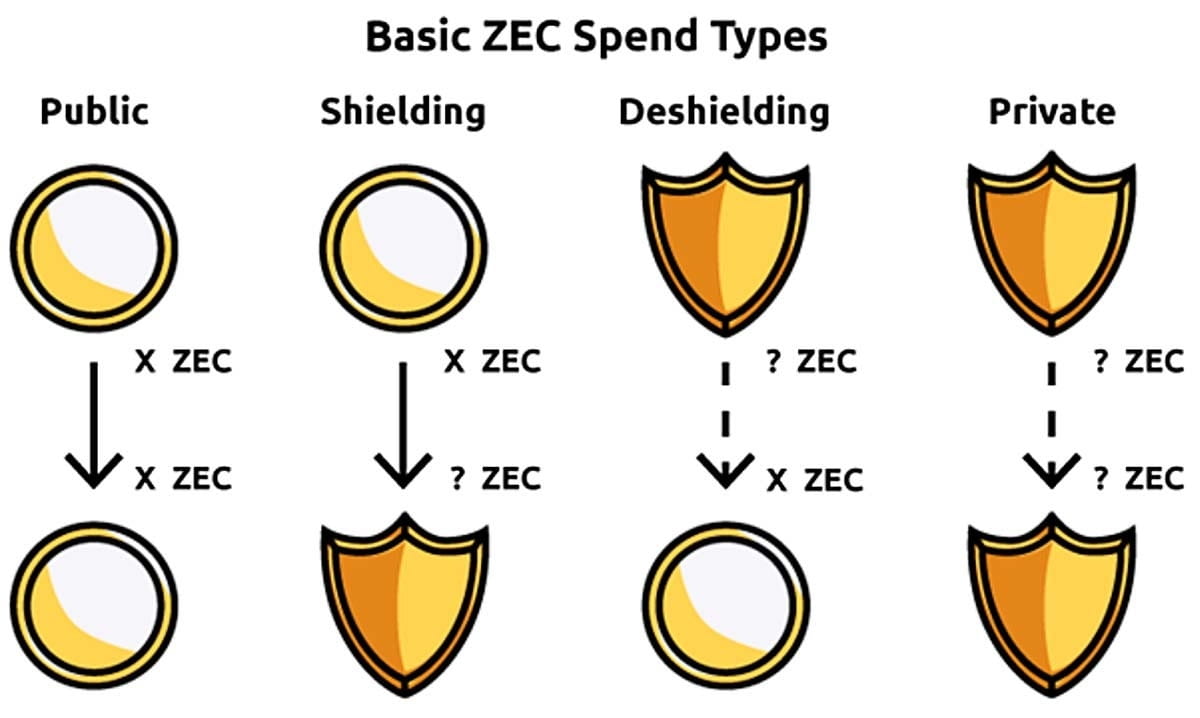
Zcash (ZEC) - uses solid zk-SNARKs technology, but… According to Chainalysis data, only 20-30% of transactions are shielded (have privacy protection mechanisms enabled). Using a z-addr type address thus becomes a readable sign that “someone is hiding something here”.
Dash (DASH) - the advertised PrivateSend option is CoinJoin with a pool of separate masternodes. With current analytical tools, the effectiveness of protection is questionable. It probably amounts to about 20-30% for larger amounts (i.e., those worth paying to uncover).
Horizen (ZEN) - in 2023 officially disabled shielded pools on the main chain to meet regulatory requirements. Since then, ZEN is no longer actually a privacy cryptocurrency – it only exists in experimental sidechains.
Decred (DCR) - offers an optional CoinShuffle mixer, but the entire state of the chain remains public and based on the UTXO model. Even after mixing, it is easy to link inputs and outputs through relatively simple analysis. Moreover, privacy is only optional.
Verge (XVG) - only hides the IP address. It has a built-in Tor protocol, but the blockchain itself is 100% public. Amounts, addresses, and the flow of funds are visible in the block explorer. The Wraith Protocol option only means hiding the amount in the wallet interface, not on the chain.
💎What does this lead to?
When we look deeper into the matter, we see that we are dealing with a certain paradox. The more effectively a coin protects our privacy, the harder it is to buy it. True anonymity has become a luxury commodity.
Meanwhile, privacy coins are a legal tool – their goal is to increase user privacy, just like VPNs or encrypted communicators. Unlike using mixers, when you use Monero or Zano, you are not breaking the law.
If you prefer to be cautious - on Binance you will find, among others, Zcash (ZEC), Dash (DASH), and Horizen (ZEN), combining a privacy atmosphere with full regulatory compliance and easy access.
And finally, the most important thing - crypto is a speculative market, and any coin, no matter how private, can expose you to losses. Investments in crypto can be very profitable only on the condition that you understand this fundamental assumption.