⚠️ $YALA Liquidity Depth Analysis Report: Huge Tear Between CEX and On-chain
We can clearly see how the market makers maintain the price stability. This is a typical structure of internal strength and external weakness: creating an illusion through orders on centralized exchanges (CEX), while on-chain (DEX), although there is some capital, it is extremely vulnerable compared to potential selling pressure.
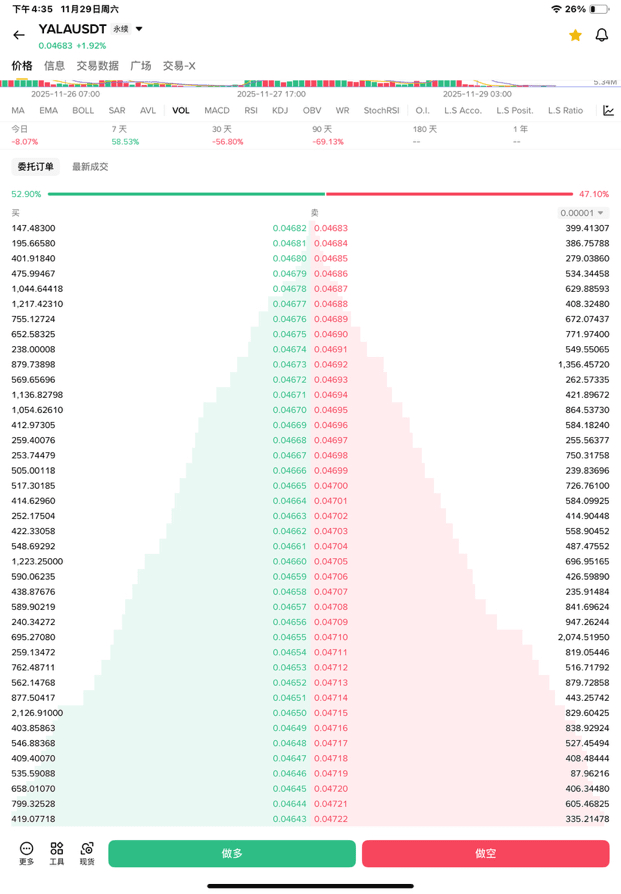
1. Exchange Order Book: Artificial 'Breakwater' (Figure 1)
Binance's buy and sell order situation.
• Phenomenon:
• Huge Buy Wall: Notice the buy orders (green part), where 2.12 million tokens are accumulated around 0.04650 (worth about 100,000 USD).
• Imbalance between buying and selling: In contrast, the sell orders above (in red) also have pressure, but the buy orders below look very 'thick' and orderly.
• Interpretation:
• Spoofing: This is likely the market maker's own funds being placed there. There are two purposes:
1. Give retail investors confidence: 'Look, there are big players supporting below, it won't drop, hurry and buy.'
2. Prevent price from collapsing suddenly.
• Risk of canceling orders at any time: The biggest trap of this buy wall is that it can be instantly canceled. Once the market maker decides to finish selling or no longer wants to take on positions, this buy order of over 2 million will disappear within 1 second, and the price will instantly plunge.
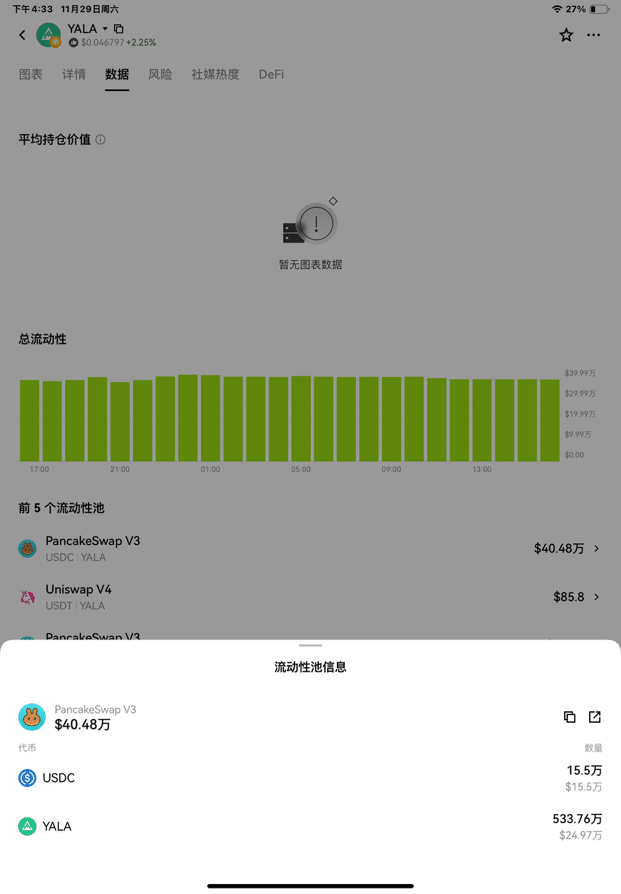
2. On-Chain Liquidity: Unable to withstand the 'thin pool' of whales (Figure 2).
This chart shows the real fund pool of PancakeSwap.
• Phenomenon:
• Total liquidity: The total funds in the PancakeSwap V3 pool are approximately $404,800.
• Capital composition: The pool holds approximately 155,000 USDC and 5.33 million YALA.
• Interpretation:
• Appears wealthy, but actually fragile: Although $400,000 does not seem like 'dead water', the key is to look at the depth in USD terms. Only 155,000 USDC in the pool is truly available for cashing out.
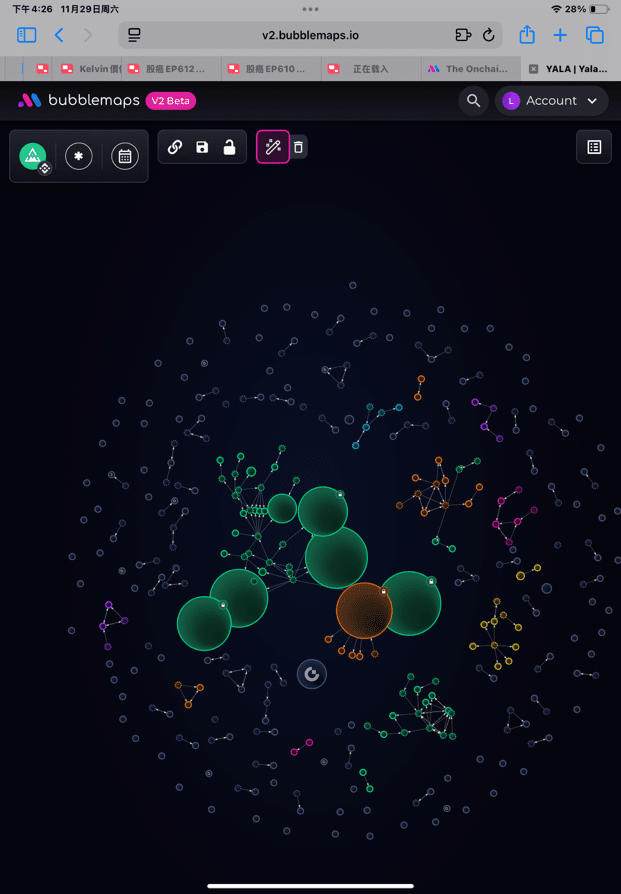
• Risk compared to bubble charts: Looking back at the previous Bubble Map, the value of the chips in the hands of those big players far exceeds $150,000.
• Conclusion: As long as one major player decides to liquidate, this 155,000 USDC will be instantly drained, and the on-chain price will drop to zero (or fall by more than 90%). The current liquidity cannot support the selling pressure from any major account.
3. Core contradiction: Why is this a dangerous signal? Conclusion: This is the 'close the door and hit the dog' period of the game.
Speculation:
1. The market maker is still present: The liquidity of $400,000 indicates that the project party or market maker has not completely drained the pool; they are still maintaining a basic trading environment.
2. Liquidity mismatch: There is only 155,000 USDC of 'real money' on-chain, while the previous bubble chart showed a huge whale holding. It's like an elephant trying to squeeze into a small bathtub. Major players cannot offload on-chain, so they must maintain the price on CEX to attract retail investors to buy on the exchange, thus completing the offload in a liquidity-rich exchange.
Warning: The current rise and buy wall are to provide 'exit liquidity' for retail investors. Once big players start selling in large volumes, the 150,000 U on-chain will be instantly depleted, and the price on CEX will also collapse.#Yala崩盘