


The co-founder of BitMEX, Arthur Hayes, warned that Tether could face bankruptcy on its balance sheet if its holdings of Bitcoin and gold drop by 30%.
An industry stakeholder pointed out that Tether still enjoys high liquidity, citing over $130 billion in government bonds and repurchase agreements.
They also noted that Tether's standard profitability and the owners' ability to inject capital reduce the likelihood of a financial solvency crisis for USDT.
Co-founder of BitMEX Arthur Hayes warned that Tether is at risk of bankruptcy on the balance sheet if its Bitcoin and gold reserves decline by 30%.
In his post on November 30, he targeted the structural weaknesses in Tether's recent asset allocation. He suggests that the company has tied its solvency to the performance of volatile risky assets instead of solely relying on the stability of government debt.
Hayes' criticism of Tether's golden and stablecoin holdings
Hayes' assessment includes Tether's third statement for the third quarter of 2025, which reveals significant turnover in non-cash collateral. The report shows that the issuer now holds $12.9 billion in precious metals and $9.9 billion in Bitcoin.
According to Hayes, this allocation represents a "deliberate interest rate trade." His thesis assumes that Tether is preparing for a Federal Reserve rate cut that will pressure the yield on its massive portfolio of U.S. Treasury bonds.
Hayes noted that "[Tether] believes that the Federal Reserve will cut interest rates, which will shrink their interest income. In response, they buy gold and BTC that should theoretically jump as the price of money falls."
However, Hayes argues that this strategy introduces asymmetric risk to the company's thin equity layer.
Hayes asserts that this figure exceeds Tether's surplus capital, theoretically rendering the company insolvent even if it remains operationally liquid.
He warned that such a scenario would likely require large stakeholders and platforms to request an immediate view of the balance sheet to assess the stability of the peg. He notes that this warning aligns with S&P Global's decision to rate USDT with a '5' rating, the lowest on its scale.
Industry stakeholders defend Tether
Industry supporters assert that the bankruptcy thesis conflates balance sheet accounting with actual liquidity risks.
Tran Hung, CEO of UQUID Card, dismissed the warning as fundamentally flawed.
He pointed out that the vast majority of Tether's balance sheet, amounting to $181.2 billion, remains parked in highly liquid and low-risk instruments. In fact, the statement confirms that Tether holds $112.4 billion in U.S. Treasury bonds and nearly $21 billion in repurchase agreements.
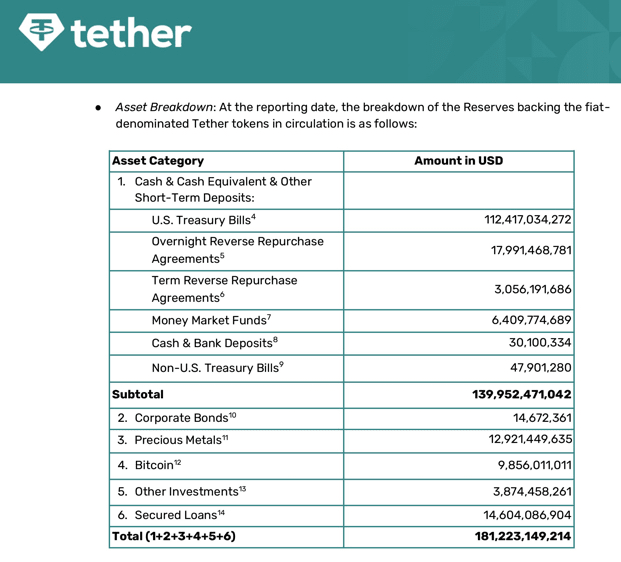
Reserves of Tether's stablecoin USDT. Source: Tether
Hong asserts that this "cash and cash equivalents" provide a sufficient liquidity buffer to cover the vast majority of USDT in circulation.
He clarified that, given this, Tether will remain fully redeemable even if a market downturn removes its equity barrier.
Hong stated that "Tether has consistently demonstrated a strong capacity for redemption, including redeeming $25 billion in just 20 days during the market crisis in 2022 (the FTX crisis), one of the largest stress tests in financial history."
At the same time, Corey Kleipsten, CEO of Swan Bitcoin, noted that Tether's leverage is more aggressive than traditional financial institutions.
Kleipsten stated that Tether operates with leverage of about 26x with an equity cushion of 3.7%. About three-quarters of the assets are short-term sovereigns and repos, and the other quarter is a mix of BTC, gold, loans, and obscure investments.
It was mentioned that a loss of 4% of the portfolio would lead to the wiping out of common equity, while a 16% decline in riskier assets would have the same effect.
Despite the structural leverage, he suggests that the risk is mitigated thanks to Tether's net profitability. Indeed, the issuer of the stablecoin is on track to record a profit exceeding $15 billion this year.
Moreover, Kleipsten also noted that Tether owners recently withdrew profits of $12 billion. Considering this, he argues that they have the capacity to immediately refinance the company if the reserve barrier is breached.
#TetherUpdate #Tether #BinanceSquareFamily #BinanceSquare #NewsAboutCrypto