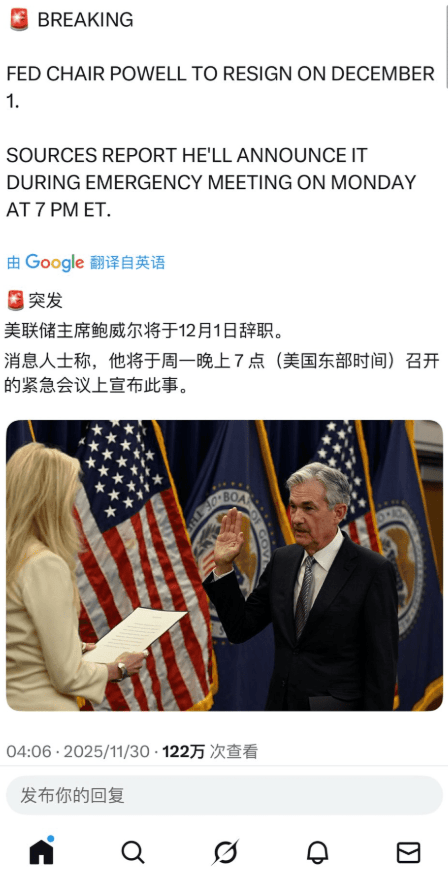
Regarding the current market rumors about Federal Reserve Chairman Powell's resignation, my core judgment is: there is insufficient basis for this news, but it deeply reflects the market's anxiety about policy stability, and this sentiment itself has become a key factor influencing short-term trends.
First of all, from a factual perspective, rumors claim that Powell will announce his resignation at an emergency meeting on Monday evening Eastern Time. This is in obvious contradiction to the public schedule. According to the Federal Reserve's official website, he is scheduled to attend a policy seminar that evening, not an emergency meeting. More importantly, Powell's legal term is clearly protected: his term as chairman lasts until 2026, and his term as a board member extends until 2028. He has also repeatedly committed to completing his term. Therefore, based solely on this sudden news, its credibility is very low.
However, the market's violent reaction to this is worth noting. There are three key logics behind this:
1. Deep concerns about independence: This is not the first time such rumors have emerged. What the market truly fears is that the Federal Reserve's decisions may be subjected to political interference. If there is a change in leadership in the future, will the core framework of its monetary policy—data dependence and independence—be shaken? This uncertainty itself will suppress risk appetite.
2. Fragile policy expectation environment: Currently, the market's expectation of the Federal Reserve shifting to interest rate cuts in December has risen to about 82%, and the sentiment itself is quite sensitive. Any rumors that could disrupt this policy path, whether true or false, can easily trigger a reflexive sell-off in the market.
3. Year-end special funding environment: December usually faces seasonal pressure from institutional capital return and tightening liquidity. Against this background, the market's resistance to negative news is inherently weak.
Therefore, when viewing this rumor, the focus should not be on its authenticity, but on how it exposes and amplifies the current fragile mindset of the market. Instead of over-interpreting unverified 'short essays', investors should pay more attention to the upcoming economic data (such as non-farm employment, CPI) and official statements, as these are reliable bases for judging the substantive direction of policy. In periods of potential increased volatility, maintaining position flexibility and avoiding impulsive trading based on rumors is a more rational response.
The market has experienced a sharp decline, and blood is flowing in the market. Later, I will prepare some strong coins suitable for bottom-fishing as part of a recovery plan. Brothers and sisters who want to keep up with the strategy can join the chat room.