
What is a perpetual contract? Four essential applications and complete teaching for beginners (including Binance referral link)
1. What is a perpetual contract?
A perpetual contract, fully known as a Perpetual Futures Contract, is abbreviated as PERP. For example: the BTCUSDT perpetual contract is referred to as BTC-PERP or BTC perpetual leveraged contract.
It evolves from traditional futures, but the biggest difference is:
There is no expiration date (you can hold positions indefinitely)
Through funding rates and mark price mechanisms, it maintains the balance between contract prices and spot prices.
You can go long or short and use leverage without holding the underlying asset.
This is also why many people say that perpetual contracts are a double-edged sword of 'quick wealth' and 'overnight liquidation.'
2. Explanation of the core mechanism of perpetual contracts
1. Going long (bullish)
You expect a future rise → Buy and then sell coin A from 100 → 120; going long on contracts can earn 20
2. Shorting (bearish)
You expect a future drop → Sell and then buy coin A from 100 → 80; going short on contracts can earn 20
3. Leverage multiple (1-125 times)
Leverage allows you to amplify positions with a small principal.
Opening a long position of 10x with $100 is equivalent to operating a $1,000 position: Up 10% → Earn $100 Down 10% → Lose all principal → Liquidation
4. Margin and liquidation mechanism
Initial margin: the collateral required to open a position (like the 100U you invested)
Maintenance margin: the minimum funds that must be maintained for the position
When losses approach the principal → The system automatically forces liquidation (liquidation)
5. Funding Rate
Perpetual contracts do not have an expiration date, so funding rates are needed to maintain price anchoring.
Positive fee rate (paying more for shorts) → Strong market bullish
Negative fee rate (paying more for longs) → Strong market bearish
Settled every 8 hours.
3. Explanation of terms in the perpetual contract interface (using Binance as an example)
If you have not registered for Binance yet, you can click my exclusive referral link: 👉 https://www.binance.com/zh-CN/join?ref=ADNKDVXD Invitation code: ADNKDVXD (permanent 20% fee discount)
Mark Price
Used to calculate the liquidation price, it is the most important price indicator.
Index Price
The average spot price from multiple exchanges, used to prevent needle manipulation.
Limit order
Place orders after setting prices, such as waiting for coin A to drop to 95U before buying.
Market order
Immediate transaction, suitable for chasing orders or quick entries and exits.
Take profit and stop loss
Essential for perpetual contracts to avoid emotional trading leading to liquidation.
4. U-based vs Coin-based
U-based (USDT-M)
➡ Margin and profits are calculated in USDT (most suitable for beginners)
Coin-M
➡ Margin is BTC/ETH and other cryptocurrencies, suitable for long-term holders
5. Common uses of perpetual contracts (four major strategies)
1. Going long or short (short-term trading)
Applicable when there is a short-term market judgment.
2. Using leverage to increase returns (extremely risky)
A 5% increase or decrease can lead to huge gains or losses. It is recommended for beginners to use 1-3 times light leverage.
3. Hedging
Holding spot but fearing a short-term drop → Shorting contracts can reduce volatility risk.
4. Term arbitrage (funding rate arbitrage)
Buy spot + short perpetual contracts to earn the difference in funding rates is a common conservative strategy in the crypto circle.
6. Risk warnings for perpetual contracts
The main risks of perpetual contracts come from:
High volatility spikes → Rapid liquidation triggers
Excessive leverage → Small fluctuations lead to liquidation
Not setting stop losses → Emotions lead to huge losses
Blindly going all-in or full position trading
Perpetual contracts are not a gambling tool, but they are definitely not something for beginners to open recklessly.
7. Binance perpetual contract opening tutorial (latest)
First register on Binance (with a 20% fee discount): 👉 https://www.binance.com/zh-CN/join?ref=ADNKDVXD Invitation code: ADNKDVXD
Step ①: Register & complete identity verification
Register using email
Complete KYC verification
Enable Google Authenticator
Step ②: Recharge or purchase USDT
Methods include:
Bank card trading
Third-party payment
P2P buying USDT
Step ③: Open a contract account
Open the APP
Click 'Contracts' at the bottom
The first time you use it, a prompt will appear: 'Open Binance Contracts'
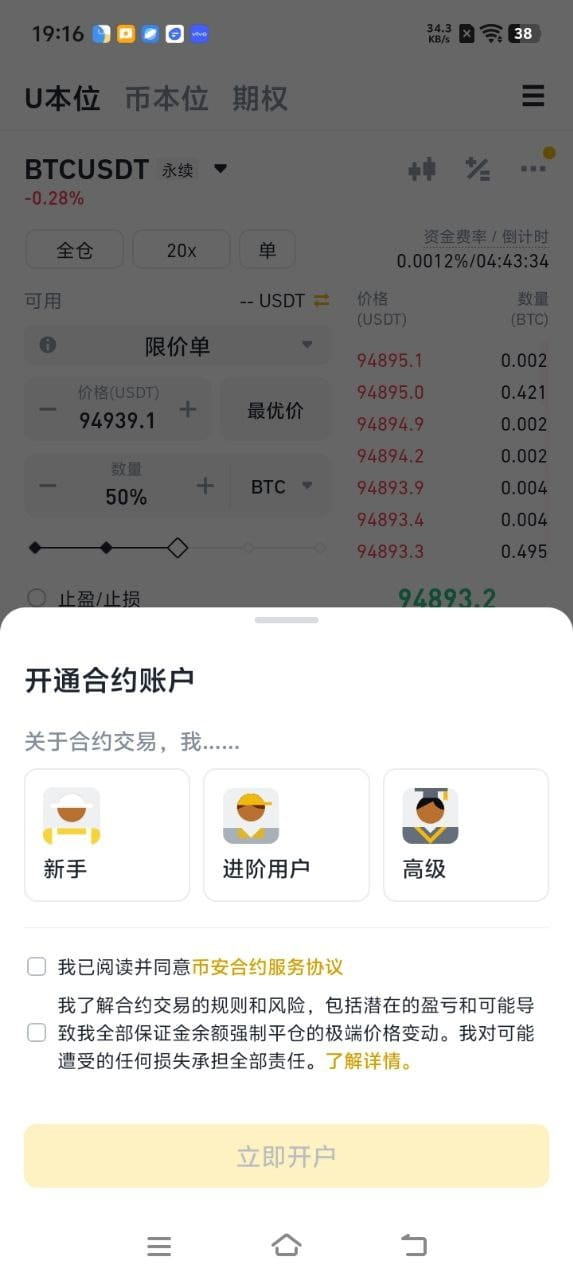
Check to agree to the risk agreement
Complete the novice contract exam (required by Binance)
You can enable USDT perpetual contracts
Step ④: Transfer in margin
Spot account → Transfer USDT to the contract account.
Step ⑤: Officially open an order
Choose 'USDT-M Perpetual'
Select contract pair BTC/ETH/others
Set leverage multiple (recommended 1-3 times)
Set limit or market price
Check take profit and stop loss
Click buy to open long or sell to open short
8. Conclusion: Perpetual contracts are not a gamble, but a tool
Perpetual contracts themselves are neutral tools:
Used well → Improves capital efficiency and stabilizes profits
Used poorly → Liquidation in minutes, losing all principal
As long as you set stop losses, control leverage, and use the right strategy, perpetual contracts can become a useful part of crypto asset allocation.

