
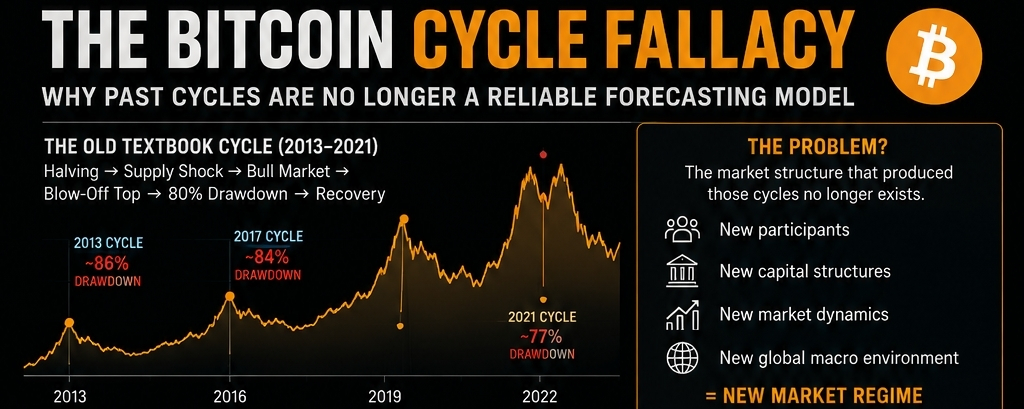
For over a decade, Bitcoin investors relied on a relatively simple framework:
Halving → Supply Shock → Bull Market → Blow-Off Top → 80% Drawdown → Recovery
The problem?
The market structure that produced those cycles no longer exists.
What Changed?
1. Institutional Capital Has Entered the Asset Class
Previous cycles were dominated by retail traders and crypto-native funds.
Today, Bitcoin is held by:
Asset managers
Pension funds
Sovereign entities
Public companies
Family offices
ETF investors
These participants operate on multi-year allocation models, not 4-year speculation cycles.
A 1–3% portfolio allocation by institutional capital can represent billions of dollars of demand that did not exist in 2013, 2017, or even 2021.
2. ETF Structure Created Persistent Demand
Spot Bitcoin ETFs fundamentally changed market mechanics.
Unlike previous cycles, capital can now enter Bitcoin through traditional brokerage accounts, retirement plans, and institutional mandates.
This creates:
Lower friction
Broader participation
Continuous capital inflows
Greater market depth
Demand is no longer limited to crypto exchanges.
3. Bitcoin Is Transitioning From Risk Asset to Strategic Reserve Asset
Historically:
Bitcoin traded like a speculative technology asset.
Increasingly:
Bitcoin is being evaluated as a strategic reserve asset.
Some governments are accumulating.
Corporations are adding BTC to treasury reserves.
Nation-state discussions are no longer theoretical.
When reserve behavior emerges, volatility structures change.
4. Supply Dynamics Are Becoming More Constrained
Bitcoin issuance continues to decline.
Meanwhile:
Long-term holders control significant supply.
Institutional custodians remove liquidity from exchanges.
Corporate treasuries rarely trade actively.
Lost coins remain permanently unavailable.
The result:
Available float is shrinking faster than many cycle models assume.
5. Market Capitalization Alters Volatility Behavior
A $10 billion market and a $2–5 trillion market do not behave similarly.
As market capitalization grows:
Volatility compresses
Drawdowns tend to moderate
Capital flows require larger catalysts
Market structure becomes more macro-driven
Expecting repeated 80–90% collapses simply because they occurred previously ignores market-scale effects.
Statistical Reality
Many investors suffer from sample-size bias.
Bitcoin has experienced only a handful of major market cycles.
From a statistical perspective:
Four or five observations are not enough to establish a permanent law.
Structural changes invalidate historical datasets.
Regime shifts reduce predictive power.
In quantitative finance, this is called a non-stationary market environment.
Past relationships often break when market participants change.
The New Framework
Bitcoin is increasingly influenced by:
1. Global liquidity conditions
2. Interest-rate cycles
3. Sovereign adoption
4. ETF flows
5. Corporate treasury demand
6. Regulatory developments
7. Institutional asset allocation models
These variables barely existed in earlier Bitcoin cycles.
Bottom Line
The biggest mistake investors can make is assuming:
"Bitcoin must behave exactly as it did in 2013, 2017, and 2021."
Markets evolve.
Participants evolve.
Capital structures evolve.
Bitcoin is no longer a niche speculative instrument driven primarily by retail enthusiasm.
It is becoming a globally recognized financial asset competing for allocation alongside gold, bonds, equities, and sovereign reserves.
History remains a reference point—but not a blueprint.
The next Bitcoin cycle may rhyme with the past, but expecting it to repeat textbook patterns ignores the profound structural transformation that has occurred across the Bitcoin ecosystem. #Bitcoin #BTC #InstitutionalFinance #DigitalAssets #MarketStructure #etf #MacroEconomics #CryptoMarkets #Finance #Investing #kohenoorai #kai