
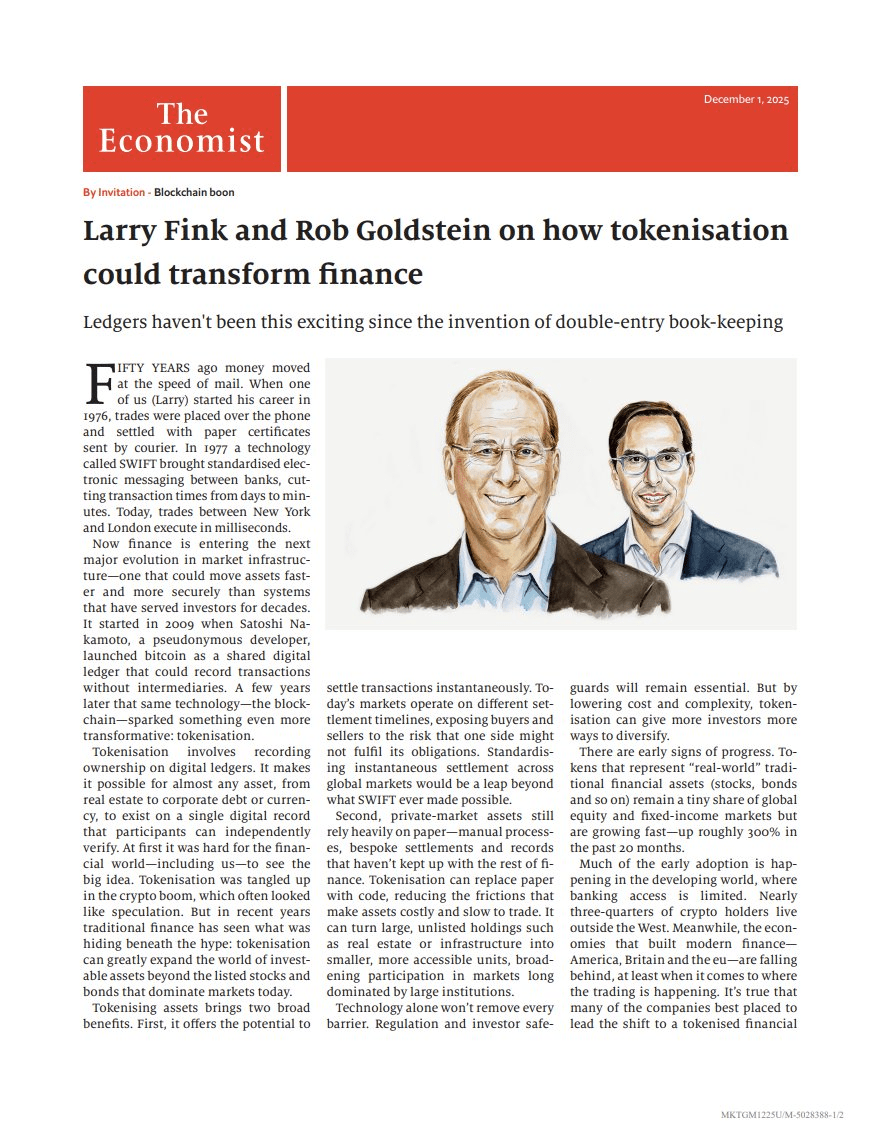
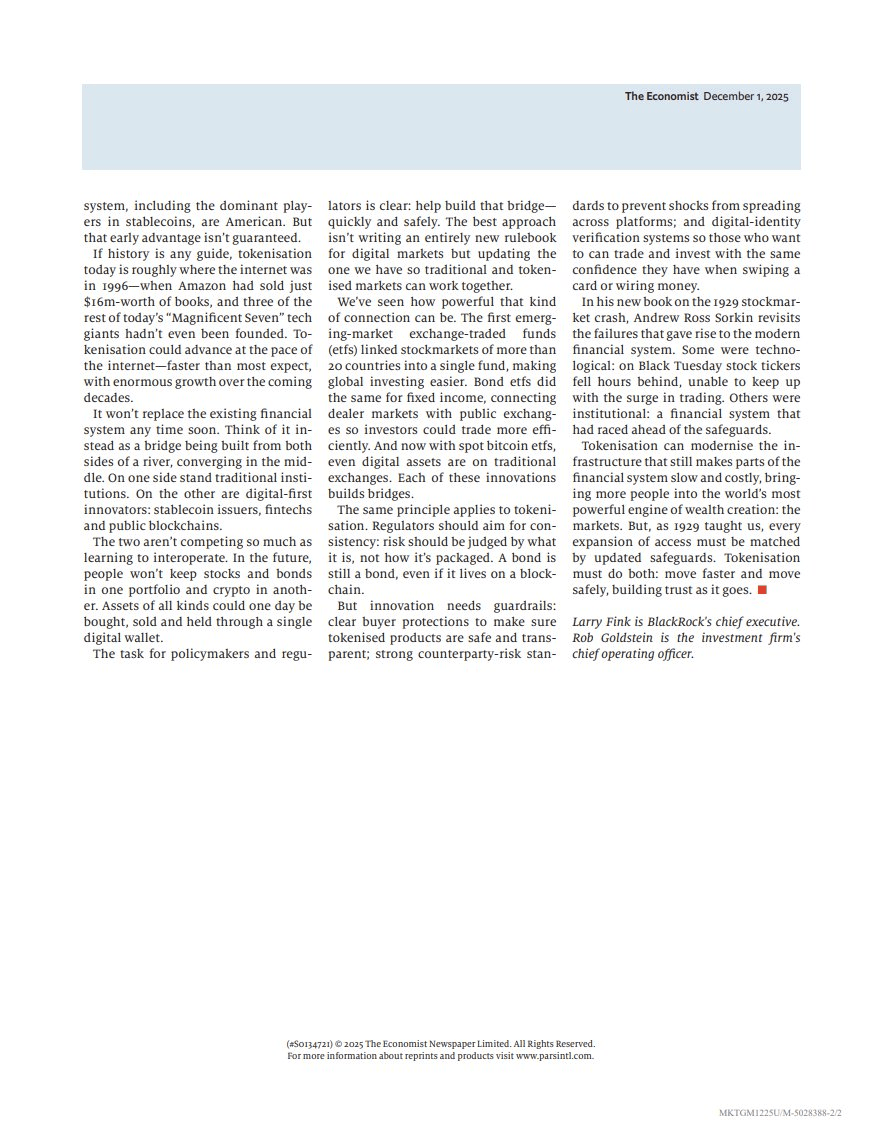
Recently, BlackRock executives Larry Fink and Rob Goldstein published a lengthy article in (The Economist), clearly pointing out a trend that is reshaping the global financial market:
> Tokenization will become the next stage of financial infrastructure
This is not a technological optimism article, nor is it a conceptual narrative commonly mentioned in the cryptocurrency industry. The author comes from the world's largest asset management firm, overseeing more than $9 trillion in assets, and the argument reflects that the traditional financial system has begun to view 'tokenization' as a necessary systemic change.
And this perspective is also changing the long-term positioning of the cryptocurrency industry.
---
'Tokenization' is no longer a speculative narrative, but an upgrade of financial infrastructure
The article points out that the significance of tokenization is:
Convert all assets into digital ownership that can be settled, recorded, and transferred on-chain.
The scope includes:
Real estate
Company equity
Government bonds
Commodities
Foreign exchange
Even all assets that can be split and traded can exist in on-chain form.
This approach brings two transformative values:
1. Structural efficiency
Real-time settlement
Eliminate multi-layer clearing institutions
Reduce the delegation process
Reduce systemic friction and costs
2. Financial inclusion
Bond shares can be cut very small
Anyone can access assets that previously belonged only to high-net-worth individuals
Blockchain has become the public entry point for the global capital market
The article even describes:
> Tokenization is 'the most revolutionary accounting infrastructure upgrade since the advent of self-replicating bookkeeping'.
---
Why is this moment particularly critical?
The article mentions a historical analogy:
> The era of tokenization is like the internet in 1996.
It is the initial stage when Amazon was just established, tech giants had not yet formed, and application systems had not yet exploded.
However, technical capabilities such as smart settlement, cross-border clearing, and asset segmentation have begun to initiate an irreversible path for traditional financial markets.
---
The way financial markets operate is about to be redefined
The article presents a core viewpoint:
> Future global market settlements will no longer be limited by paper securities, cross-border remittances, clearing settlements, and delay cycles.
SWIFT takes days,
Tokenized financial markets have the opportunity to complete settlements in milliseconds.
This means:
The role of the Clearing House is being replaced by code
The trading market can operate 24/7
Investment behavior is no longer restricted by time zones
Records with transparency, verifiability, and immutability characteristics
And this efficiency far exceeds what the current traditional financial infrastructure can achieve.
---
Tokenization does not replace traditional finance but 'integrates' it
The article clearly states:
> Tokenization is not a confrontation between Web3 and TradFi, but rather bridges the two from both ends, ultimately leading to interoperability.
Future asset forms may be as follows:
Stocks, bonds, and crypto assets are jointly held in the same digital wallet
Public and private market liquidity will be integrated
Traditional ETFs and on-chain assets coexist
All financial products could eventually exist in the form of blockchain documentation, transfer, and settlement
More importantly:
> Tokenization does not require overthrowing the old system, but rather uses a new framework to improve the originally high-cost, low-efficiency market system.
---
Expected largest adopters: emerging markets
The article points out that the regions where tokenization first took off on a large scale are likely not Europe and America, but emerging countries lacking mature capital flow systems.
The reason is:
The banking system is not widespread
Clearing and regulatory systems have not yet been shaped
Financial infrastructure efficiency is lagging behind
More easily rebuild the financial framework directly with new technology
The article bluntly states:
> Nearly 70% of crypto users come from emerging countries
And 'tokenized assets' are more likely to become investment tools that these countries can truly afford for the first time.
A small amount of money can hold government bonds, corporate bonds, or foreign financial assets, fully opening the participation threshold of the capital market.
---
Instead of discussing themes, we should think about 'where the financial system is moving.'
The article indicates:
Digital Bonds
Tokenized Securities
On-chain clearing
Bitcoin ETF
Global transaction unified clearing framework
These are not experiments, but the strategic direction officially initiated by the financial community.
BlackRock's views and data reveal one thing:
> The global capital market no longer views blockchain as an alternative speculative field, but as the next-generation market infrastructure.
The crypto market has driven prices for years through narratives, and now there are signs that the discourse is shifting to the institutional level.
---
Long-term signal: Tokenization will determine when the next bull market begins
The content of the article reveals a highly consistent direction:
Regulatory systems are beginning to understand and absorb blockchain
Financial enterprises are entering the experimental phase of tokenization
Investment institutions view blockchain as a solution to reduce market costs
And not as speculative containers.
A more direct observation is:
> Whoever can truly accommodate the demand for tokenization will be the core chain of the next round of financial infrastructure.
Fast speed, low cost, secure modules, and capable of supporting financial-grade clearing pressure will be reassessed under this framework.
---
As the system begins to take over, the logic of the crypto market is changing
The article concludes:
For tokenization to succeed, it must have:
Transparent and verifiable risk frameworks
Robust clearing and protection mechanisms
Cross-platform market collaboration
Safe governance that can interoperate with traditional finance
And the most important conclusion is:
> Blockchain technology is no longer viewed by the market as a speculative narrative, but is becoming public infrastructure for the global capital market.
This institutional recognition carries more weight than any thematic rotation.
Future capital flows will no longer just chase narratives, but will choose public chains and infrastructures that can truly meet the on-chain needs of 'the tokenization era'.
From a financial history perspective, when the system begins to accept, when regulation begins to establish, and when assets can be settled on the chain, the next stage of the market has quietly begun.
A true bull market is never ignited by speculation, but determined by the system.


