
Entering the Asian market on Tuesday (December 2), the crypto market remains shrouded in pessimism, with Bitcoin hovering around $87,000. It briefly fell below the $84,000 mark yesterday, and the latest round of selling seems primarily due to signals from the Bank of Japan regarding interest rate hikes suppressing risk assets, while weak ETF fund inflows and limited dip buying indicate that structural demand remains sluggish.
As of the time of writing, according to CoinDesk data, Bitcoin's trading price is around $87,000, having fallen about 30% from its historical peak of over $126,000 set on October 8.
Ethereum hovers around $2,794, continuing to face pressure. ETH-related tokens pegged to government bonds fell over 10% during Monday's crypto stock sell-off. Ethereum has depreciated about 22% in November, marking its worst month since a 32% plunge in February.
The latest round of Bitcoin's decline is related to Japan.
Emir Ibrahim, an analyst at Zerocap digital asset trading company, stated that Bitcoin briefly stabilized over the weekend before retreating again, reintroducing vulnerability and volatility. Upcoming U.S. data this week could change market expectations for interest rates, thereby affecting risk assets.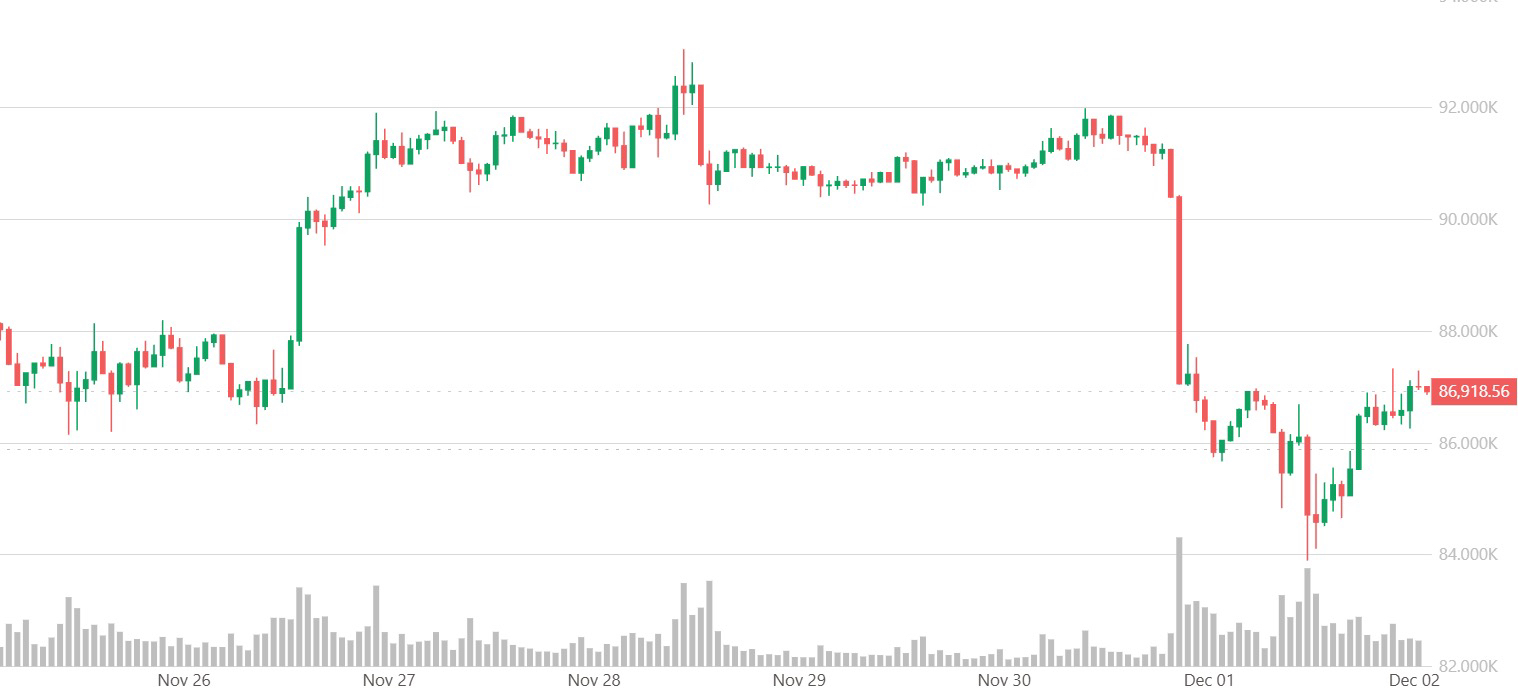
Analysts pointed out that weak inflows into Bitcoin ETFs and limited buying on dips indicate that structural demand remains sluggish.
Ibrahim stated that the latest round of cryptocurrency declines seems to coincide with the rise in Japanese government bond yields following comments from Bank of Japan Governor Kazuo Ueda on Monday, prompting the market to revert to risk-averse positions.
Forced liquidations have intensified, with over $500 million in Bitcoin leveraged long positions being liquidated. It is unclear whether this is related to concerns about the unwinding of 'Yen carry trades' (i.e., borrowing yen at low interest rates and converting it into higher-yielding assets like Bitcoin).
The total amount of forced liquidations approached $1 billion.
Bitcoin fell sharply yesterday, with the world's largest cryptocurrency dropping about 6%, heading towards its largest single-day decline since early November, as risk-averse sentiment led investors to sell digital assets and other assets. According to CoinGlass data, the total amount of forced liquidations in the crypto market in the past 24 hours approached $1 billion.
According to Reuters data, this trend emerged after Bitcoin recently experienced its largest monthly decline since mid-2021. Bitcoin evaporated over $18,000 in November, with significant funds withdrawing from the market, marking the largest monthly dollar decline since the collapse of various cryptocurrencies in May 2021.
Adding to the pessimistic atmosphere on Monday was the downgrade of 2025 earnings expectations by Strategy, the largest Bitcoin corporate holder globally, due to Bitcoin's weak performance. Strategy's stock price fell 3.3%.
The retreat of crypto enthusiasm.
Juan Perez, trading director at Monex USA (Washington), said: “Bitcoin seems to be affected by the retreat of enthusiasm in the crypto market and even the entire tech sector.”
He said: “The current negative sentiment is related to increased market concentration and doubts about the sustainability of overall growth, including infrastructure issues and reduced global trade cooperation.”
Recently, the stock market has also pulled back due to excessive optimism regarding AI trading and concerns about the overvaluation of tech stocks. On Monday, most global stock markets fell, with the MSCI World Index down about 0.40% and the S&P 500 Index down 0.5%.
Risk indicators and market correlation.
Due to Bitcoin's relatively short existence, its performance in December lacks a clear seasonal pattern. On average, Bitcoin tends to rise about 9.7% in December, ranking third in performance. October is usually the strongest month, with an average increase of 16.6%; September is the weakest, with an average decline of 3.5%.
Some strategists are closely monitoring the correlation between Bitcoin and the stock market, with some believing that Bitcoin could be a leading indicator of risk assets.
Joe Saluzzi, co-founder of Themis Trading in New Jersey, stated that crypto assets and stocks may be linked through ETFs, but they do not always move in sync. For example, the stock market only fell moderately on Monday, while crypto assets saw significant sell-offs.
XTB Research Director Kathleen Brooks pointed out in the report: “Bitcoin currently tends to be a leading indicator of overall risk sentiment. Its decline is not a good sign for the stock market's performance at the beginning of the month.”
She added: “Monday did not have any obvious direct driving factors. However, last week saw a significant decline in volatility, with the VIX dropping below the average level of the past 12 months, which may have made some investors who are still uneasy about the year-end outlook even more anxious.”
CME's Bitcoin futures also reflect an increasingly bearish sentiment in the market. Bitcoin futures expiring in three months saw their premium over this month's contracts drop to the lowest level in at least a year, indicating that investor expectations for continued price increases have diminished.
Negative factors are piling up.
Jefferies strategist Mohit Kumar stated that multiple unfavorable factors for the crypto market intensified Bitcoin's pressure on Monday.
S&P Global downgraded the rating of the world's largest stablecoin, Tether (USDT), last week, citing an increase in the proportion of high-risk assets in its reserves and a 'persistent disclosure gap.' Tether strongly disagreed with this. Other crypto-related company stocks also fell, with Coinbase down 4.8%.
According to CoinGecko data, since the crypto market reached a historic high of $4.3 trillion, over $1 trillion in market capitalization has evaporated.
Marc Chandler, chief market strategist at Bannockburn Capital Markets, stated that the key is that “people are discussing” what has happened to Bitcoin. “I see many people trying to link the sell-off in the crypto market to declines in other asset markets. But we need to examine this narrative. It is currently unclear... but we must pay close attention.”
Preparing for a drop below $80,000.
Bitcoin traders are increasingly adopting defensive positions in preparation for a possible drop below $80,000 in the new year.
Nick Forster, co-founder of Derive, stated in a market commentary: “The significant decline in volatility skew shows that traders are buying a large number of put options, particularly concentrated around contracts expiring on December 26, with open interest mainly focused on strike prices of $84,000 and $80,000.”
He added: “This position configuration means that the probability of Bitcoin falling below $80,000 in early 2026 is not low.”
Forster indicated that the downward trend may not yet be over, and market participants are pricing in a highly volatile December. “I don't think Bitcoin has bottomed out. Short-term volatility has exceeded long-term volatility, indicating that the market expects greater fluctuations as the new year approaches.”


