
This round of 'fear cycle' has finally come to an end, as there is only this last month left in 2025. If I had to pick the darkest month for this year's crypto market—November would undoubtedly be the choice. We all anticipated that there would likely be another major sell-off this year, but we didn't expect it to come so early on 10·11, bringing the entire crypto market into a bear market.
The past month: a dark November
The global cryptocurrency market value has fallen for three consecutive weeks; BTC has twice broken through key moving averages, dropping to around 80,000 USD, with over 1 million people liquidated in the futures market, and ETF funds continuing to flow out.
The macro side is frequently bouncing back and forth: U.S. government shutdown, Federal Reserve decisions, significant pullbacks in Asian markets.
Japan's disaster relief budget impacts the bond market, triggering a spread of risk-averse sentiment, and market sentiment switches from 'aggressive FOMO' to 'deep panic' in an instant. But all markets have cycles.
The dark November has passed, and we should think more about: what will happen in December?

One, November: What exactly happened?
Why did this drop catch everyone off guard?
① Macroeconomic mutation - 'interest rate cut expectations' suddenly disappear.
At the end of October, the market still believed there was a 70% chance the Federal Reserve would cut rates in December. But strong U.S. economic data in early November shattered that fantasy: non-farm employment exceeded expectations, core inflation is sticky, and treasury yields surged.
Therefore: interest rate cut expectations → delayed; liquidity risk → increased; cryptocurrency → comprehensive downgrade.
Cryptocurrency assets, as 'high-risk assets,' naturally bear the heaviest pressure.
② Japan's bond market earthquake: speculation of a rate hike for the first time in 40 years.
The most important black swan in Asia in November is not China, but Japan's potential end to negative interest rates and entry into a rate hike cycle.
This means: global arbitrage capital is forced to flow back to Japan, U.S. bonds are under pressure, global risk assets are declining synchronously, and the crypto market is facing liquidity withdrawal.
Japan is the world's largest debtor nation; once it raises interest rates, it will trigger an explosion of the entire global asset pricing system.
③ ETF inflows have slowed, and institutions are taking a short-term 'break.'
In the first three months, the strong inflow of BTC ETF was the hardcore support for the market.
But in November: ETF inflows have significantly slowed, corporate accumulation has slowed down, and some funds have chosen to realize profits. The market lacks 'new funds,' so prices are naturally unstable.
④ On-chain data deteriorated: selling pressure concentrated in the short term.
A very obvious feature appeared on-chain in November:
Short-term holders (1-3 months) are choosing to sell in the 3-7% retracement range, with an increase in BTC inflow to mainstream exchanges and a slowdown in Ethereum's coin accumulation rate.
In short: short-term traders are panicking and leaving, while long-term capital hasn't had time to take over.
This has caused: the decline to be amplified, panic to spread, and liquidations to enter a death spiral.
Two, December: The Federal Reserve has officially stopped QT!
Although there hasn't been any significant change in the size of the balance sheet, sentiment will still be somewhat boosted!
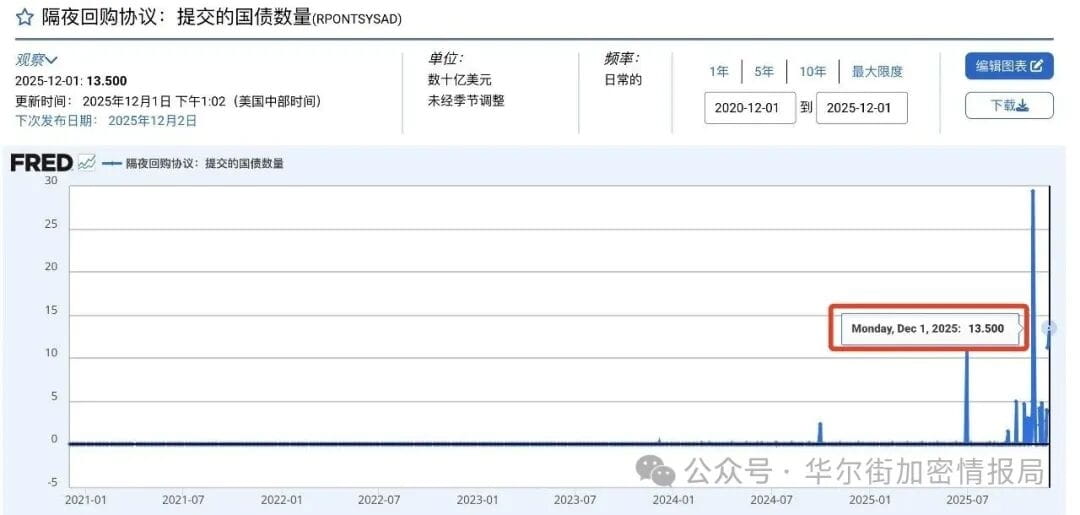
Don't panic, the Federal Reserve has begun injecting liquidity; on December 1st, an overnight repurchase of $13.5 billion, second only to the 2020 pandemic, exceeding the 2000 internet bubble!
Let's briefly explain what 'overnight repurchase' is? In simple terms, it is a kind of 'short-term lending' between the Federal Reserve and banks. Bank: Boss, I'm tight on money, lend me some, and I'll pay you back tomorrow! I'll use treasury bonds as collateral.
The Federal Reserve: Alright, here's $13.5 billion (this time), charging you a little interest, and tomorrow you'll pay me back the principal + interest, and take away the treasury bonds. This is called 'overnight repurchase.'
For banks, it is a lifesaver; for the Federal Reserve, it is a tool for injecting liquidity into the market.
In the short term, it is good for the market!
Liquidity is back → banks have money to lend or invest → the market is not short of money → stock markets, bond markets, and cryptocurrencies may all be pushed higher.
The Federal Reserve's action shows it is 'keeping a close watch' and will not let the market face major issues, giving everyone a sense of reassurance. In times of panic, one should bottom fish.
Three, so what will December bring?
Will it continue to be dark, or will it head towards a reversal? Yongqi systematically judges from macro + capital flow + technical aspects + narrative cycles.
First, the macro aspect:
The most important keyword for December is only one - 'return of certainty.' Compared with the variable-filled November, December will see two signals of 'enhanced certainty' in the macro.
1. Federal Reserve meeting: will not raise interest rates, whether to cut rates is the focus. The December meeting is the most critical one of the year, as it will determine: the interest rate path for next year, and inflation target range.
The Federal Reserve continues to raise interest rates? The probability is almost 0%. As long as there are no rate hikes, it is good news for structural assets.
2. Japan's interest rate hike expectations have cooled.
The panic in November is not because Japan really raised interest rates, but because the 'expectation suddenly strengthened.' However, the Japanese government has clearly stated: 'Monetary easing policy is still necessary.'
This means: the strengthening of the yen will slow down, and the risk appetite for crypto will increase, which is a significant positive for the market.
Second, capital situation:
Long-term capital is quietly flowing back, with the latest data showing: ETF inflows are recovering, the pace of institutional accumulation of ETH has returned to September levels; wallets holding >10 BTC are increasing; long-term holders (LTH) have reached a historical high.
This means: no one thinks the market has peaked, just that November is a necessary 'technical washout.'
December is generally a month for institutions to reallocate, so the capital situation will improve, not deteriorate.
Third, the technical aspect:
November was a deep pullback; December enters a 'directional choice area.'
The key intervals for BTC and ETH are as follows: BTC: $83,000~$95,000 is the directional choice area.
If it breaks 100,000 → new highs are expected; if it falls below 80,000 → a pullback to 75,000 is a normal retracement.
But the overall structure remains: the large-scale upward trend has not changed.
ETH: $3,900~$4,250 is the most critical interval, and Ethereum's strength determines the switch for all ALTS.
If ETH is strong → altcoin season arrives early; if ETH is sideways → altcoins will differentiate.
If ETH falls below 2600 → enters structural adjustment, the cycle will be relatively long.
But currently, the biggest benefit for ETH is that the 'institutional coin rush' has not ended.
Fourth, the narrative aspect:
December is the 'new narrative launch month.' Reviewing history:
December 2020: Institutional FOMO.
December 2021: NFT explosion.
December 2023: BTC ETF expectations.
December 2024: The heat of AI on-chain computing explodes.
So what will December 2025 be? - A clear policy inflection point: Trump as the new Federal Reserve Chairman + cryptocurrency-friendly policies being implemented.
Four, so what does all this mean for ordinary investors?
Will it rise in December? What should we do?
First, let's be clear: December is not the month when a major bull market starts, but it is very likely to become the 'reversal confirmation month.'
My judgment is:
1) BTC: Fluctuating slightly stronger, opportunities after Christmas.
Reason: The Federal Reserve meeting has concluded, ETF funds are flowing back in, uncertainty around Japan's interest rate hike expectations, and end-of-quarter rebalancing is driving capital back.
2) ETH: Performance will be stronger than BTC.
The institutional coin rush + technical narrative upgrade is the hard-core backing for ETH.
Predicting that January 2026 is very likely to be: 4,050~4,600.
3) Altcoin market: it will not explode overall, but there are huge structural opportunities.
December will not enter a 'full altcoin season,' but there will be 'structural double coins.'
At this time of year-end, institutions are also unlikely to engage in crazy pump actions; they need to stabilize, see the trend clearly, and then plan for the coming year, while also providing a good explanation for investors, giving large funds a good data picture.

Five, as an old player, I found:
This bear market is different from all past cycles.
Whether you entered the market in 2017 or only truly felt the bull-bear cycle in 2021, this year's 'bearish pullback' must have given you a strong intuition: this bear market is completely different from before. The real change lies in people's hearts.
Specifically reflected in the following four points:
① In the past, altcoins were standard for bottom fishing; this time everyone has completely lost interest.
Every major pullback in 2018, 2020, and 2022 has a common phenomenon: the more it falls, the more people bet on altcoin rebounds. Because altcoins fall deep but also rise quickly. However, in 2025, an unprecedented apathy has emerged:
Altcoins dropping 60% go unpicked; meme coins plummeting 80% are also ignored; even the top 50 market cap projects hardly see any incremental funding.
It's not that 'there's less money,' but rather: everyone finally understands: not all altcoins will have the next round. In the new narrative era, sunk costs will only lead to greater losses.
② In the past, there were layouts for altcoins in the top 100 market cap; now no one dares to touch them.
From 2017 to 2021, many people's strategies were very simple: the top 100 market cap projects will never go to zero, right? Leading altcoins must rise in a bull market, right? Bottom fishing the top 50 is much safer than betting on junk coins, right?
But reality has brutally torn apart the illusion: among the top 50 projects by market cap in 2021, over 72% have already receded; from 2023 to 2025, over 50% will not reach new highs.
The narrative is undergoing a comprehensive upgrade, and no institution is willing to take over 'old era altcoins.'
Thus, the market has seen an unprecedented phenomenon: altcoins are increasingly resembling small-cap junk stocks. It's not that they don't rise, but they can never return to past highs. This has completely invalidated the logic of 'top 100 must retain value.'
③ No matter how miserable the last bull market was, everyone believed in the future; this time many OGs have cleared out and exited.
This is the most intriguing change. After the last bull market ended, many old OGs are still holding onto BTC, even increasing their positions as prices drop; the sentiment in the entire circle is 'firm faith, optimistic about the future.'
And this time: many OGs have sold off BTC and ETH that they held for 5-8 years; some have sold their holdings to institutions; some have chosen to 'lie flat and exit.'
This is a collapse of sentiment that has never happened before. Why? Because they realize: it is no longer the era of 'crypto-centric narratives.' BTC and ETH will not disappear, but their growth rates will change. This has led the OGs who were originally determined to hold on to start rethinking their asset direction.
④ In the past, the crypto circle was the center of innovation; now civilization-level innovation is in AI.
In the past decade: Was Web3 the biggest variable disrupting finance? Is DeFi the world's most complex experimental field? Did NFTs sweep the cultural industry? Are Layer 1 and Layer 2 computational model laboratories?
But the reality from 2023 to 2025 tells us: the main characters of civilization-level innovation have changed. It is AI. This does not mean crypto has lost value, but rather: crypto has moved from being the main character → to the underlying technology → to the new capital margin.
This will make crypto capital more cautious than in the previous cycle and also slow down the pace of narrative advancement - but it also means that assets with true long-term value (BTC, ETH, computation direction) will be more favored. After the bubble decreases, value becomes clearer.
Six, Yongqi summarizes: final conclusion.
This bear market is not about price changing; it is about the era changing.
The past crypto market: simple narratives, rapid sentiment spread, altcoins — a 20x increase is the norm, and the growth rates of BTC and ETH are 'very competitive.'
And now: the global macro cycle has entered a high inflation era, with institutions as the main characters, not retail investors. Crypto has shifted from being a 'frenzied industry' to a 'mature asset pool.' There is structural growth but no longer rampant surges.
This is why: this bear market is colder, slower, and more realistic.
But because of this, the next bull market will be more stable, stronger, and more lasting.
November was excessive panic, December is emotional recovery; this time point must be: seeking stability.
The December market will not skyrocket but will transition from: panic → recovery; uncertainty → clarity; lack of liquidity → liquidity.
More critically: all macro variables will land in December. Landing = good news.
The crypto market has never been a 'light after darkness,' but rather: uncertainty disappears → price rebounds → sentiment reverses → bull market starts.

