
13 ministries have called for a halt, and 7 major associations have issued documents:
The moment when the regulatory "barrier" was fully closed, the true boundaries of China's cryptocurrency market arrived.
In the past two weeks, the entire cryptocurrency circle has been asking: Is this another round of large-scale "crackdowns"? Or is it a precursor to a bull market surge?
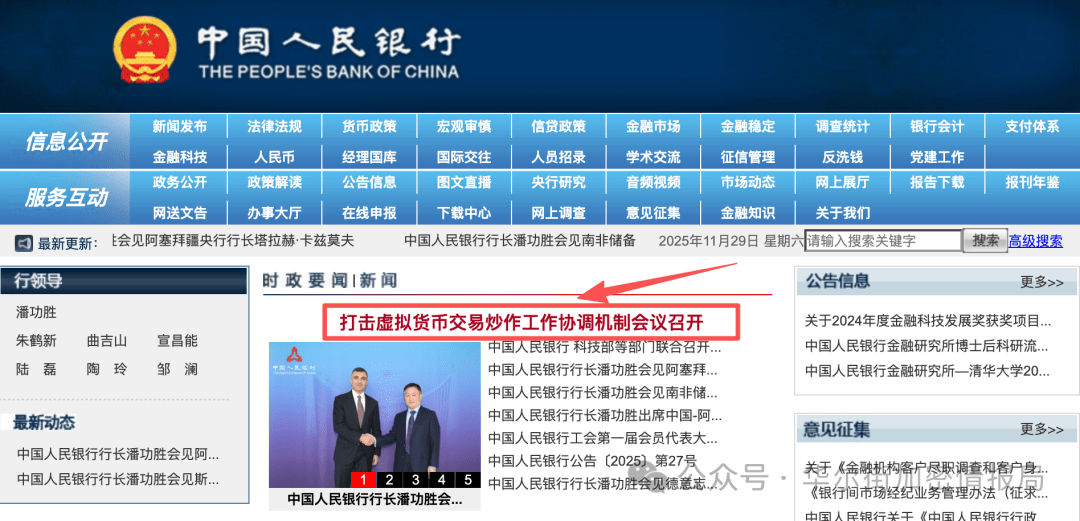
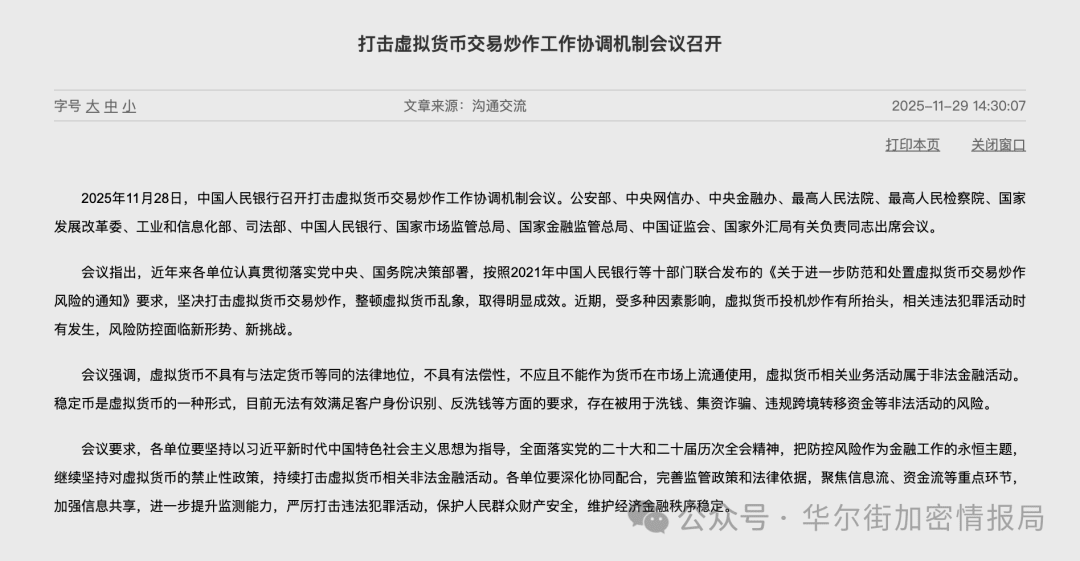
Thirteen departments have stopped illegal virtual currency activities, and seven industry associations have unusually issued risk warnings simultaneously, while institutions have begun inspections... The atmosphere is tense, but if you carefully read the documents,
you will be surprised to find that the regulatory focus has never been on the "crypto circle," but rather on illegal activities such as air coins, illegal use of stablecoins, illegal issuance of RWA, cross-border money laundering, and Ponzi-style mining.
In summary: Ordinary crypto traders are not the target, but those involved in illegal fundraising, air coins, and cross-border evasion cannot escape.
More critically - from the 1998 storm to 2013, 2017, 2021, and then to 2025, China's 'crypto boundary' has extended from the central bank's top-level design to the last mile of the grassroots.
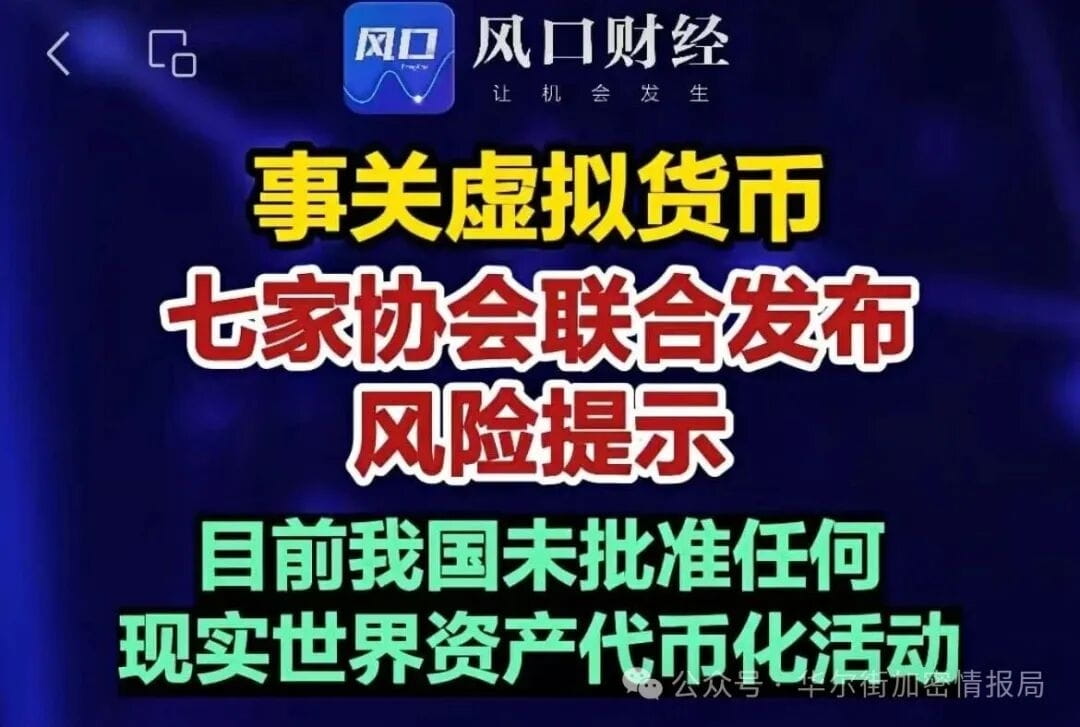
01 | Seven major associations made statements on the same day: The regulatory chain is fully closed for the first time.
The units making this statement include:
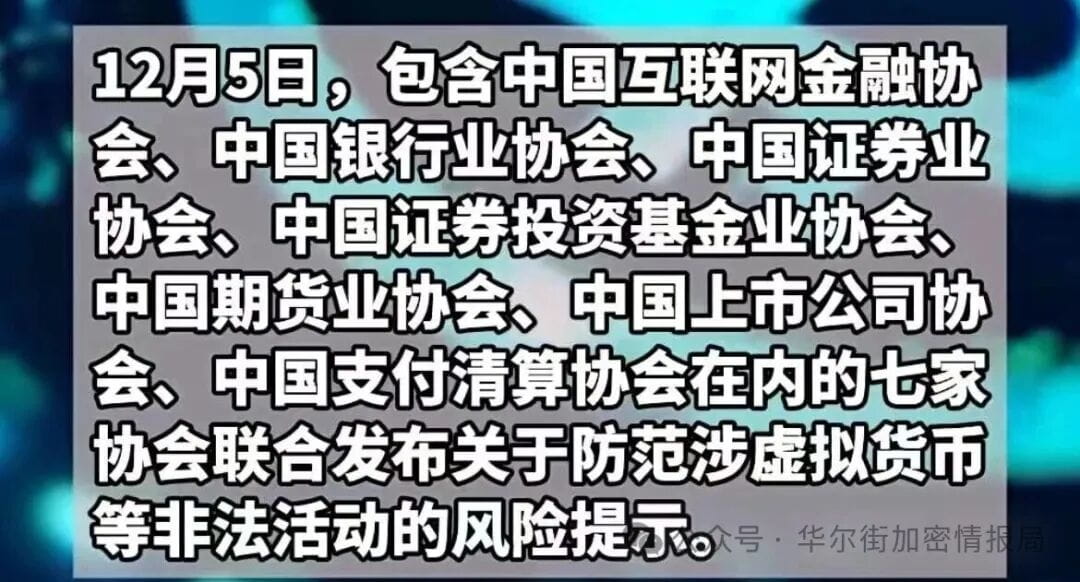
This lineup last appeared on September 24, 2021.
At that time, it was announced that 'virtual currency trading is an illegal financial activity', over 300 exchanges withdrew from China, and China's mining power directly dropped from 75% of the global total to 2%.
And this time, it is more comprehensive than in 2021:
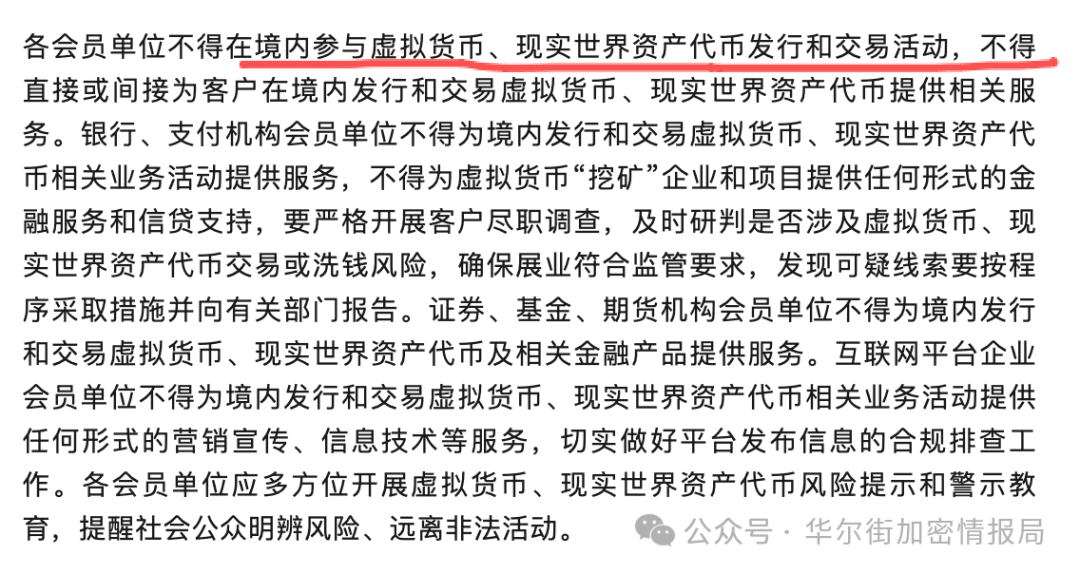
Banking Association + Payment and Clearing Association: Block funding flows → Buy and sell USDT, cross-border transfers.
Securities, Fund, and Futures Associations: Block financial products → Ban tokenized securities and virtual funds.
Internet Finance Association: Block traffic and platforms → Ban Web3 promotion and clean up trading traffic.
Listed Companies Association: Block traditional finance 'gray areas' → Ban companies from disguised financing through tokenization.
This means: funding, products, platforms, institutions, promotions... All touchpoints that virtual currency can reach are completely blocked at once.

Data evidence:
Estimated scale of China's underground OTC in Q3 2025 is about 50 billion RMB.
The banking system intercepted 'suspected currency purchase transfers' over 12,000 times, involving funds of 4.6 billion.
This is not a 'crackdown', this is a systemic blockade.
The intent of regulation is not to expel the crypto circle, but to prevent the crypto circle from becoming a breeding ground for capital outflows, fraud, and illegal financial activities.
02 | For the first time, RWA is specifically named: Why the sudden 'crackdown'?
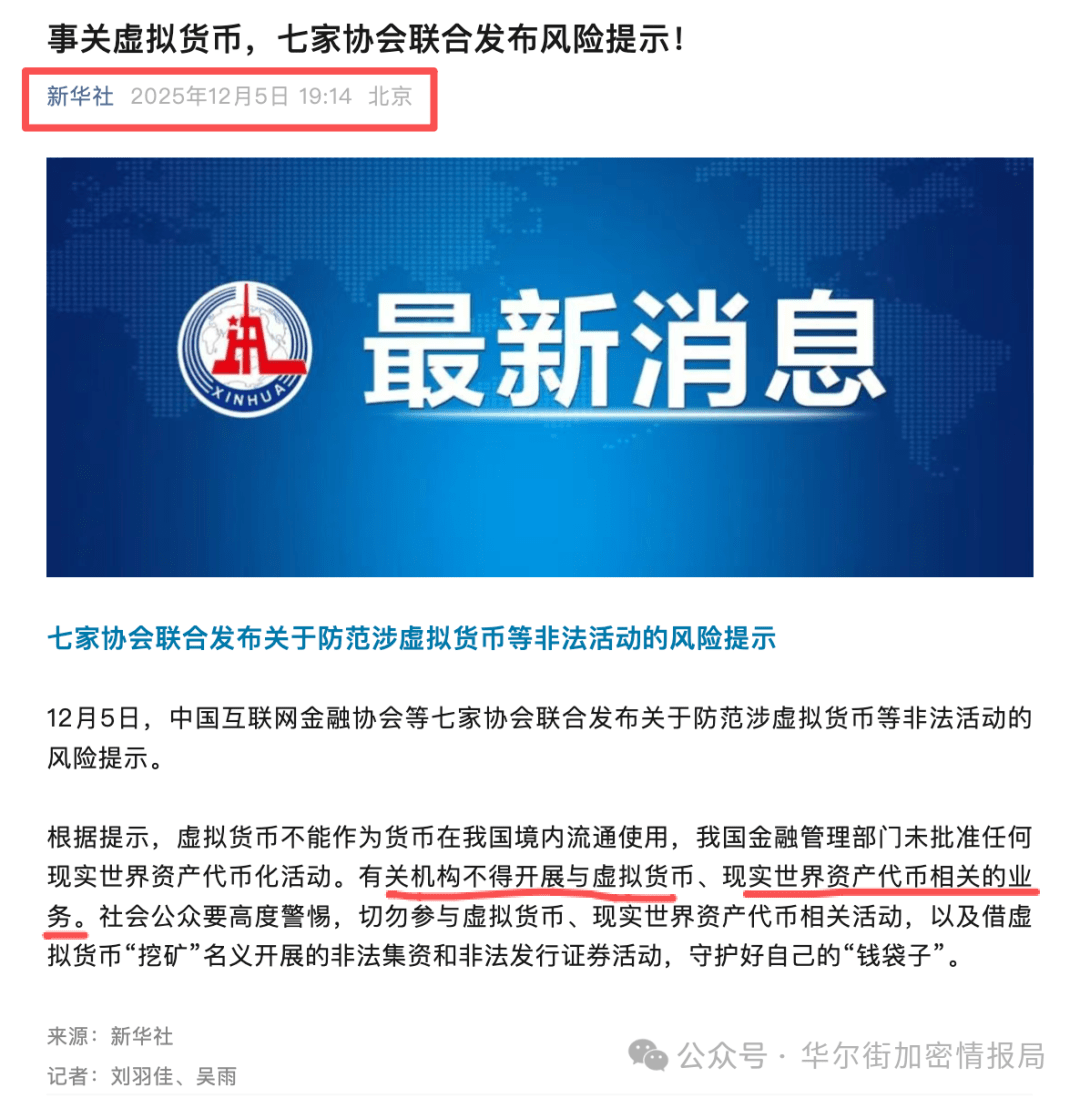
This is the sentence that caused the most industry shock in this risk warning: 'Currently, China's financial management department has not approved any tokenization of real-world assets.'
The key point is 'not approved any', not 'temporarily not approved', and not 'strengthening regulation'.
This is: an absolute denial.

Why name it now? Because RWA is no longer a niche concept, but a track being reshaped by global financial giants.
Global RWA scale: Over $30 billion.
BlackRock BUIDL: $2 billion scale.
Franklin Templeton partners with Binance: Launching on-chain funds.
JPMorgan, Citigroup, Fidelity: all are engaged in on-chain bonds, on-chain funds, and on-chain settlements.
The problem is: overseas 'compliant RWA' is not recognized by China as 'domestic compliant financial activities'.
More seriously: RWA is a 'huge loophole' in China's foreign exchange control.
During the depreciation of the RMB in 2015-2016, China lost nearly $1 trillion in foreign reserves due to capital outflows. This was through trade fraud, underground banks, arbitrage...
If 'RWA of Chinese real estate' is allowed, the difficulty of capital outflow will be reduced by an order of magnitude. Regulators now clearly state: this loophole cannot be opened, zero tolerance.
03 | 'Air coins + stablecoins + mining + RWA'
All four lines are tightened.
The four types of risky activities named in the document all point directly to 'pain points'.
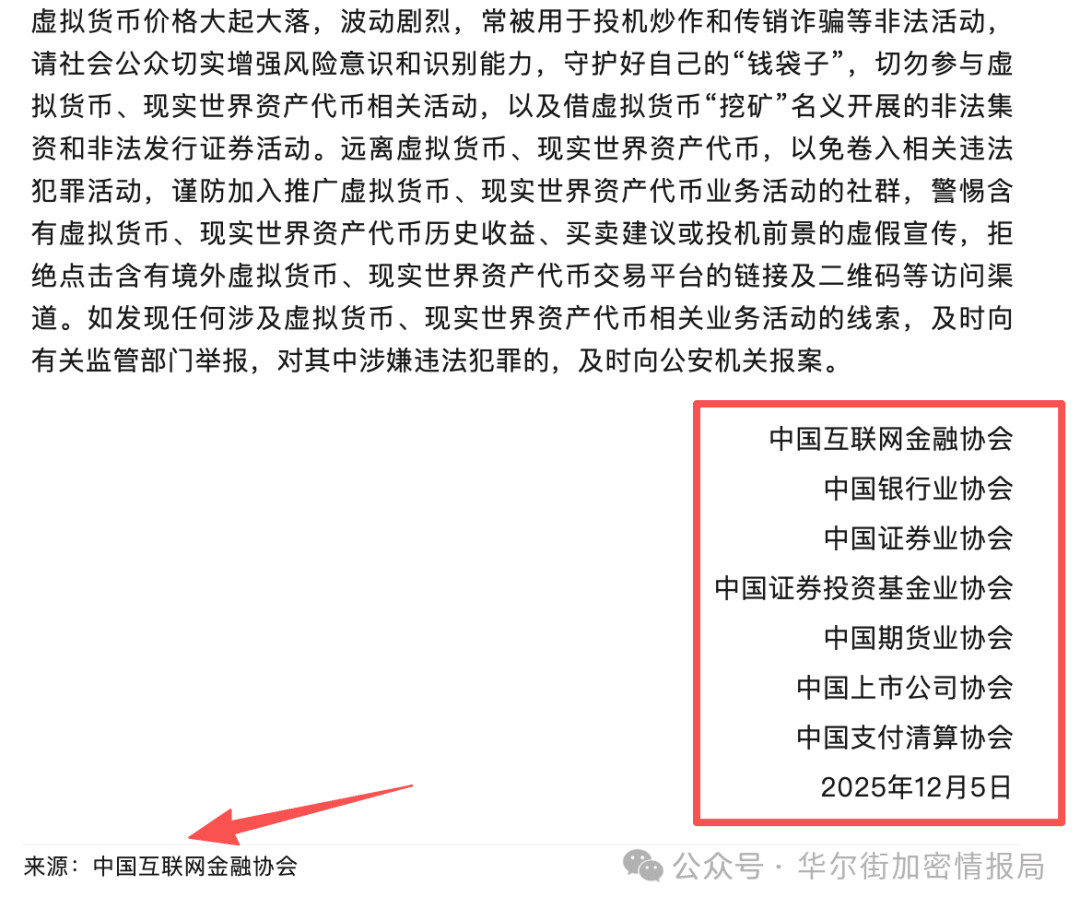
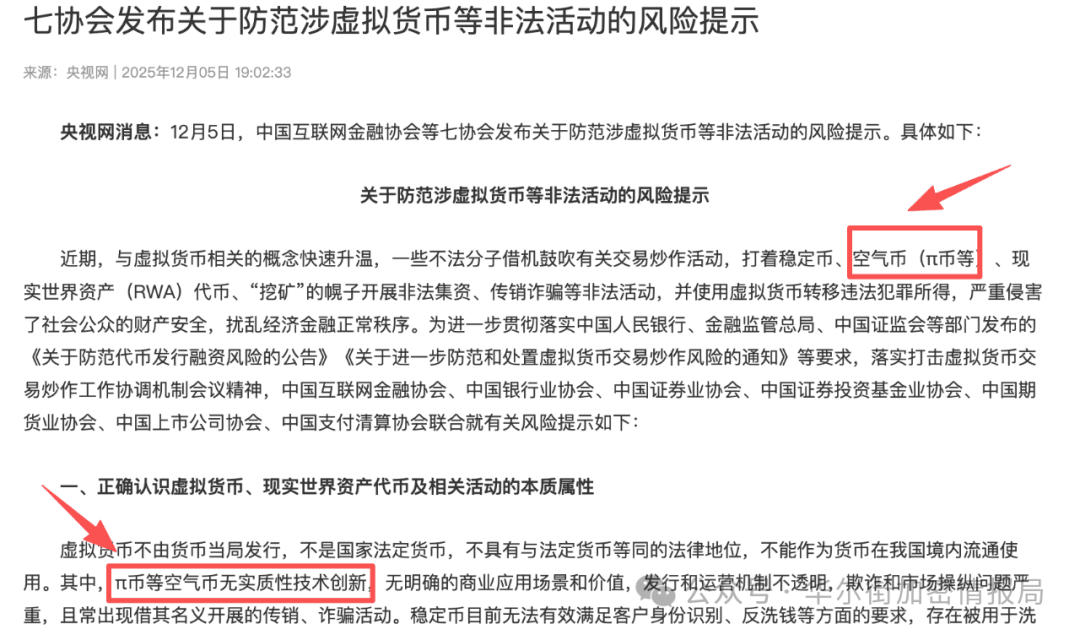
① Air coins (with π coin as a typical representative).
The original text points out the characteristics of air coins: no technology, no scenario, highly centralized, opaque issuance mechanism, relying on promoting through referrals, π coins have been repeatedly classified by local authorities as a pyramid scheme structure.
The goal is very clear: to combat fraud, not to attack coin speculation.
② Stablecoins (USDT/USDC)
On November 28, the central bank meeting made it clear: stablecoins = virtual currency (not classified as legal digital currency).
Risks include: cross-border money laundering, suspected fraudulent fund flows, OTC bypassing bank regulation.
This is not related to 'crypto investment', but rather the field of financial security.
③ Mining (especially 'cloud computing' scams).
China was once the global computing power center (accounting for 75%), so mining is a regulatory focus.
The most dangerous thing now is not mining farms, but: cloud computing 'distributed storage'. Many are funding schemes disguised as 'mining machines'.
④ RWA (explicitly prohibited for the first time)
The core is 'disguised financing + cross-border asset transfer + regulatory arbitrage'.
The convergence of four directions means: thoroughly clearing the parts that could generate systemic financial risks in China's grassroots crypto activities. And 'speculating on coins' is not included.
04 | The real source of the crypto 'boundary':
From the 1998 storm to the 2025 ban.
Why is China's regulation more resolute than any other country? Because the history is too profound.
1998: The long-lasting memory of the Asian financial crisis.
Thailand's collapse → Indonesia's political turmoil → South Korea's bankruptcy → Multiple countries seeking aid. Hot money can destroy a country's currency system.
Hong Kong used HKD 118 billion in 1998 to defend the Hong Kong dollar. This experience made China extremely sensitive to 'cross-border capital impacts'.
2009: Offshore RMB just started, and was strictly limited.
The personal annual foreign exchange purchase limit of $50,000 is not set arbitrarily. It is to prevent capital from flowing out of control during the initial stage of the internationalization of the RMB. The essence of stablecoins + RWA is: not through banks for 'disguised foreign exchange purchases'.
This is the core red line of the policy.
2013-2025: Complete timeline of ten years of crypto regulation.
2013: Bitcoin surged from $13 to $1100 before dropping back to $200. First risk warning.
2014: Mt. Gox collapsed, triggering a crisis of trust.
2017: The ICO boom arose, and scams ran rampant. ICOs were completely banned.
2018: Binance launched, trading volume surged, and regulation increased pressure.
2020: BTC prices fluctuated violently during the pandemic.
2021: China banned mining, and computing power transferred to the United States. A complete ban on mining.
2022: LUNA collapsed, evaporating $40 billion in market value.
2023: ETFs approved, institutional funds entered the market.
2024: BTC surged to $80,000 before falling back to $60,000.
2025: Multiple market liquidation events led to cumulative losses of about $270 billion, with volatility like a roller coaster. RWA is explicitly prohibited for the first time.
Every regulatory measure occurs during stages of industry overheating and outbreak of fraud. This time is no exception - scammers are back, so regulation is heavy-handed.

05 | Is this a negative signal? No,
This is the final confirmation of China's crypto 'survival boundary'.
This document has only three sentences for ordinary people:
① Do not touch air coins: scammers rely on this to harvest referrals.
② Do not participate in pyramid-style mining or cloud computing: 90% are funding schemes.
③ Do not engage in stablecoin money laundering, cross-border transfers, or illegal financing of RWA: this is in the realm of financial crime, red line level.
As long as you avoid these three points, you are: an ordinary coin trader, and the policy does not target you.
It can be said: the negative signals have been fully released, the true boundaries have been clearly drawn:
—— Speculating on coins is allowed, but capital outflow is not.
—— Investment is allowed, but harvesting retail investors is not.
—— Research is allowed, but issuing tokens is not. The game rules of the entire industry have finally stabilized.
Finally: Yongqi summarizes.
The boundary has taken shape, but this is instead a 'safe boundary' rather than a negative signal.
In the past decade, China's crypto regulation has been misunderstood by outsiders as a 'complete ban'.
But in fact: it has not banned holding, researching, or learning.
What is truly prohibited are activities that threaten financial order, defraud the public, and cause capital outflow.
When the final boundary is clearly drawn, the market will actually become healthier.
For ordinary people, the only thing to remember is one sentence: do not engage in high-risk behaviors named by the policy, other activities can be played calmly.
If you are still struggling with whether buying Bitcoin is legal? Then please look at: Is buying Bitcoin illegal? Understand the policy red line in 1 minute!
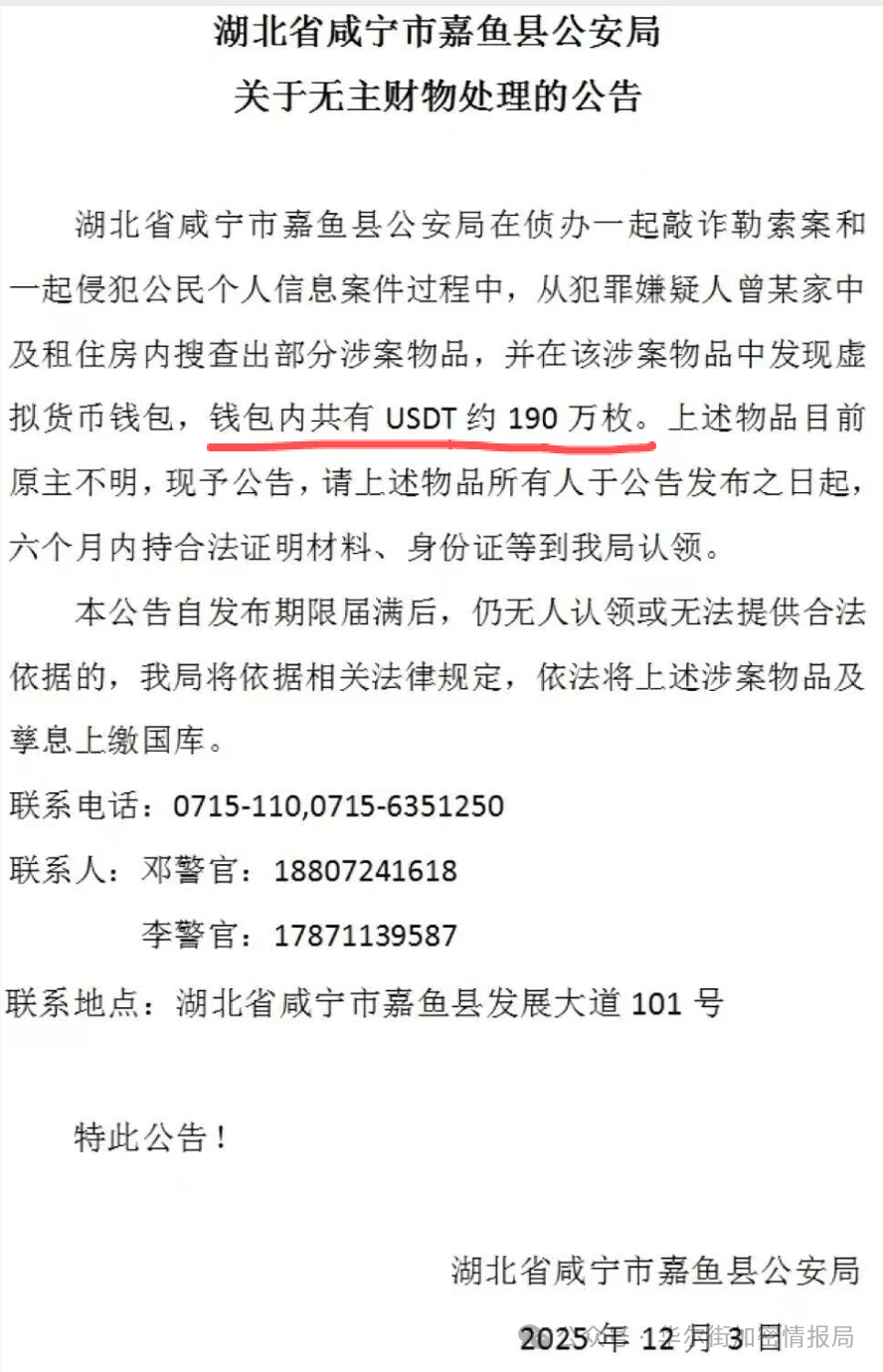
The key point is one sentence: virtual assets are defined as: property under criminal law! You can take a good look. You will understand after reading it.
In-depth observation · Independent thinking · Value goes beyond price.
Star #Wall Street Crypto Intelligence Bureau, good content not to be missed ⭐
Finally: Many of the views in the article represent my personal understanding of the market and do not constitute advice for your investment.


