
Entering the Asian market on Wednesday (December 3), Bitcoin held onto yesterday's significant gains and attempted to climb further, currently trading above $93,000. This rebound provides a brief respite from months of decline, but traders remain cautious, market sentiment is still fragile, and there are still signs of tension in the crypto market.
Bitcoin broke through $90,000 again on Tuesday, successfully rebounding from a sell-off that caught Wall Street off guard, erasing nearly $1 billion in new leveraged bets.
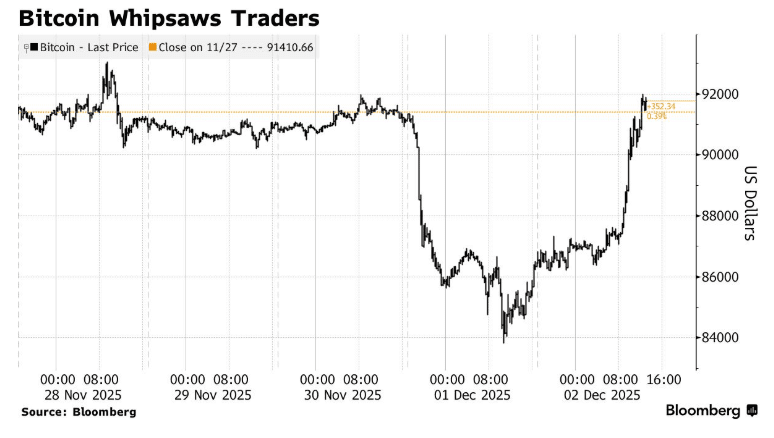
Bitcoin's price rose by as much as 6.8%, reaching $92,323, while its biggest competitor Ethereum also rebounded by over 8%, pushing its price back above $3,000. Smaller and less liquid tokens, such as Cardano, Solana, and Chainlink, saw increases of over 10%.
Several positive signs are emerging in the market.
Traders indicated that after weeks of weak investor demand, the market is showing several positive signs, including comments from SEC Chairman Paul Atkins about announcing 'innovation exemption' measures that would benefit digital asset companies. Additionally, Vanguard has announced that it will allow cryptocurrency-focused ETFs and mutual funds to trade on its platform.
Jasper De Maere, a desk strategist at Wintermute, stated: “It seems that a combination of industry-specific headlines and the synchronization of cryptocurrencies with the broader market has driven this strong price activity.”
Bloomberg strategist Brendan Fagan stated: “The latest rebound in cryptocurrency indicates that the market is transitioning from a liquidation mode to a risk-on stance. The fundamentals remain uneven, but the washed-out positions and increasing institutional support provide a more solid foundation for the market than in recent weeks.”
On Monday, the token price initially plummeted sharply following comments from the CEO of Strategy Inc. (formerly MicroStrategy) suggesting that Bitcoin collectors might sell Bitcoin to repay debts. The company subsequently announced it would establish a $1.4 billion reserve to maintain cash availability.
Spencer Hallarn, head of global OTC trading at GSR Crypto Investment, stated: “While the market initially perceived this as an extremely negative development, they are now cautiously addressing liquidity issues, reducing the probability of extreme negative events occurring in the future.”
The recovery may be uneven.
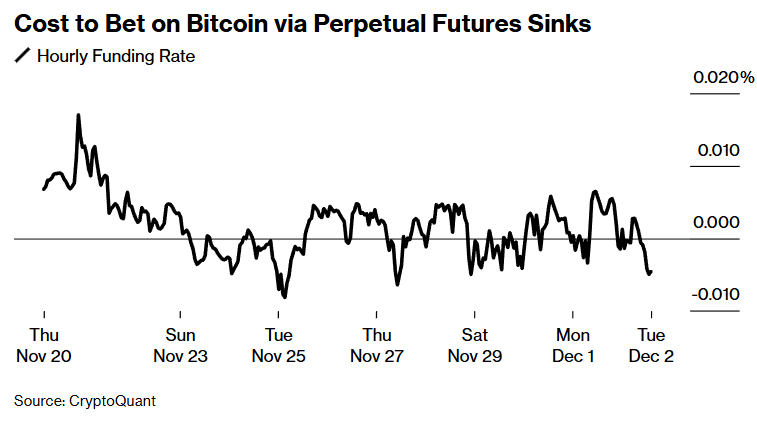
Nevertheless, market observers indicate that multiple indicators still suggest the recovery may be uneven. According to CryptoQuant, Bitcoin's funding rate—a key indicator of crypto market sentiment—has turned negative in recent days, indicating that demand to short Bitcoin exceeds demand to go long.
Chris Kim, CEO of Axis Quant Asset Management, stated: “Overall sentiment remains cautious, and crypto-native traders are feeling nervous.” He noted that institutional investors seem to be waiting for the Federal Reserve's interest rate decision next week before increasing their risk.
Since reaching an all-time high in early October, Bitcoin has dropped nearly 30%, and the digital asset market remains in a fragile state after several weeks of sell-offs. This decline has exacerbated the clearing of about $19 billion in leveraged bets.
Virtual currencies related to the Trump family have also been affected.
Virtual currencies associated with the Trump family were also affected by this sell-off. Shares of American Bitcoin Corp., a crypto mining company co-founded by Eric Trump, saw its market value evaporate by more than half in less than 30 minutes on Tuesday, although trading was paused multiple times due to extreme volatility. The stock fell by as much as 51%.
Since its launch in January, Trump's official meme coin TRUMP has dropped from a record $73.40 to about $6 now, according to CoinGecko data. The token WLFI of the decentralized finance platform World Liberty Financial, associated with Trump, has fallen about 30% since September. First Lady Melania's meme coin MELANIA has lost nearly all its value since its peak in January, currently trading at 13 cents.
Another phenomenon of caution.
According to analysts at Bitfinex, another sign indicating cautiousness among investors is the rise in stablecoin balances on cryptocurrency exchanges like USDT and USDC, suggesting that traders are parking capital rather than actively buying the dip.
In a report, they stated: “This is a typical end-of-cycle correction: investors are hedging by turning to stablecoins until ETF liquidity stabilizes and macro uncertainty is cleared.” They pointed out: “Importantly, this is not the behavior seen at a long-term top when stablecoin liquidity was exhausted; here, liquidity is accumulating off-exchange, indicating that funds are waiting for clear guidance.”
CoinMarketCap's 'Fear and Greed Index' showed 'Extreme Fear' on Tuesday, maintaining this level for the past three weeks.


