
One, meeting overview
- Time and place: November 28, 2025, hosted by the People's Bank of China.
- Participating departments: Ministry of Public Security, Central Cyberspace Affairs Commission, Supreme People's Court, Supreme People's Procuratorate, National Financial Regulatory Administration, Securities Regulatory Commission, State Administration of Foreign Exchange and other 13 departments.
- Nature of the meeting: Establish a normalized inter-departmental strike mechanism, further than the joint document of 10 departments in the '9·24 Announcement' of 2021.
Two, core information (four key points)
1. Centralized governance of illegal activities
- Focus on cracking down on money laundering, fundraising fraud, and illegal cross-border transfer of funds.
- Full-chain monitoring of capital flow and information flow, with a normalized high-pressure situation.
2. Stablecoins become the number one target
- Stablecoins like USDT, USDC will be under strict control and crackdown for a long time.
- Due to its difficulty in meeting anti-money laundering and KYC requirements, it is prone to being used for illegal financial activities.
3. Legislative acceleration
- Legislation related to virtual currency is underway, but it is unlikely to be legalized.
- The legislative direction is to improve prohibitive regulations and penalty mechanisms.
4. Strict control of publicity and information dissemination
- Content related to virtual currency on social media, video platforms, live broadcasts, articles, etc., will be strictly reviewed and cleaned up.
- Account bans and removals will become the norm.
Three, the impact on different roles
Retail investors
- Risk increase in the deposit phase: Financial institutions and payment institutions are strictly prohibited from providing services for virtual currency transactions.
- Withdrawal remains the biggest risk point: Once receiving illicit funds, penalties are stricter, and unfreezing bank cards is more difficult.
- Suggestion: Stay away from any trading speculation, do not participate in OTC or overseas platform trading.
Currency traders (on-site/off-site)
- Illicit funds must be refunded, and criminal liability may even be pursued.
- In the future, there may be a 'one-size-fits-all' approach; regardless of on-site or off-site, as long as it involves illicit funds, it may be investigated.
- Suggestion: Strictly select trading counterparts, establish risk control models, and reject unfamiliar accounts and newly registered users.
Mining and other practitioners
- Mining continues to be severely cracked down on, mining machines and illegal gains will be confiscated.
- Holding coins, contracts, quantitative trading, NFTs (cat breeding), etc., all need to assess legal red lines to avoid triggering criminal risks.
Four, key conclusions
- The trading speculation of virtual currency within the territory has no space for legalization.
- Policy tone: prohibition to the end, normalization of strikes, full-chain prevention and control.
- It is basically impossible to 'trade coins compliantly'; participation means risk is self-borne.
Five, compliance suggestions
- Stay away from trading: Do not buy, sell, exchange, or promote virtual currency.
- Choosing legal alternatives: Prioritize using digital RMB for payments and transfers.
- Increase legal awareness: Understand the nature of business and red lines, seek professional legal advice when necessary.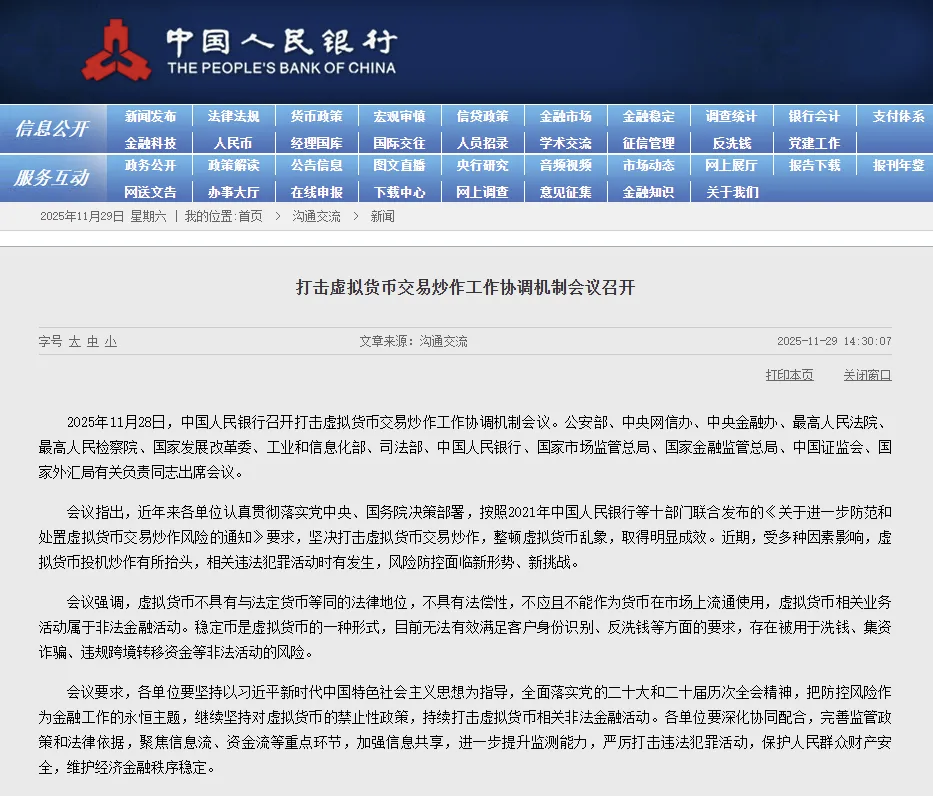 。
。
