
During the recent market downturn, Tron performed the strongest, showcasing a rare resilience among mainstream altcoins. Since August, most large-cap cryptocurrencies have seen declines of 40% or more, while Tron’s drop was only 24%, nearly outperforming the entire altcoin sector. This relative advantage highlights the unique positioning of the Tron network and its ability to continuously attract stable demand despite the overall market weakness.
A key factor behind this resilience is Tron’s increasingly dominant position in the stablecoin ecosystem. According to Tronscan data shared by Lookonchain, Tether has issued an additional 1 billion USDT on Tron, indicating Tether's confidence in Tron’s ability to handle large-scale stablecoin issuance. This issuance has pushed Tron’s stablecoin market capitalization over 80.2 billion USD, solidifying its status as the leading blockchain for USDT circulation.
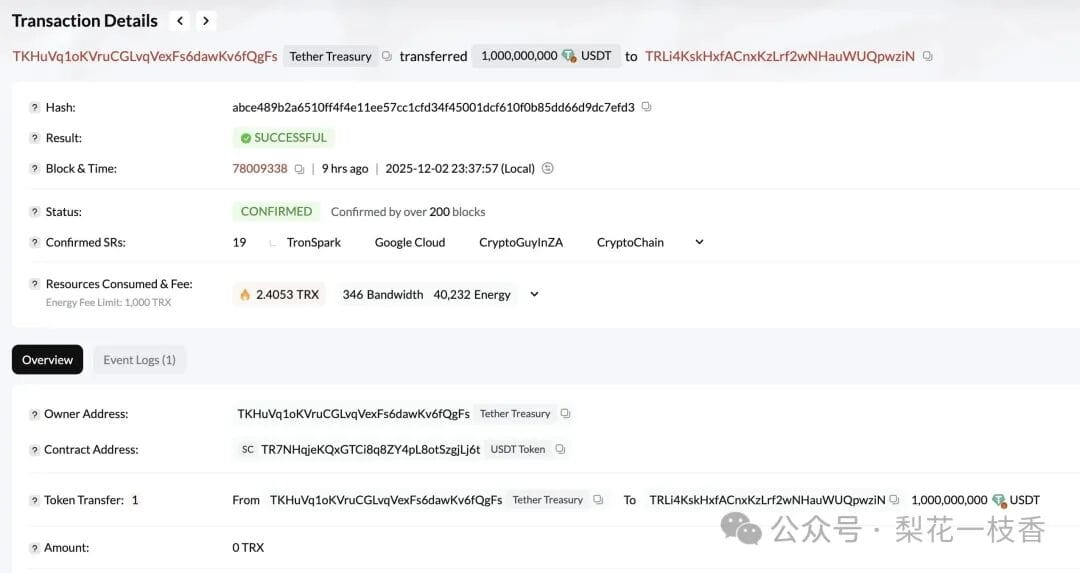 Tether issues 1 billion USDT on the Tron platform | Source: Tronscan
As funds shift to stablecoins for defensive purposes, Tron often gains disproportionate benefits. While other cryptocurrencies are collapsing, Tron remains relatively stable, further confirming that the demand driven by Tron's utility remains solid, and this demand may continue to provide support even amidst ongoing market volatility.
Tron solidifies its position as the second-largest stablecoin network
Tron has become a core pillar of the global stablecoin ecosystem, firmly holding the position of the second-largest stablecoin blockchain worldwide. Its appeal lies in fast settlement, extremely low transaction fees, and ample liquidity—features that make it the preferred network for large USDT transfers, especially among exchanges, over-the-counter trading platforms, and remittance channels.
This infrastructure allows Tron to attract a large inflow of stablecoin funds, with its total stablecoin market capitalization now exceeding $80.2 billion, largely due to Tether's continued issuance on the network.
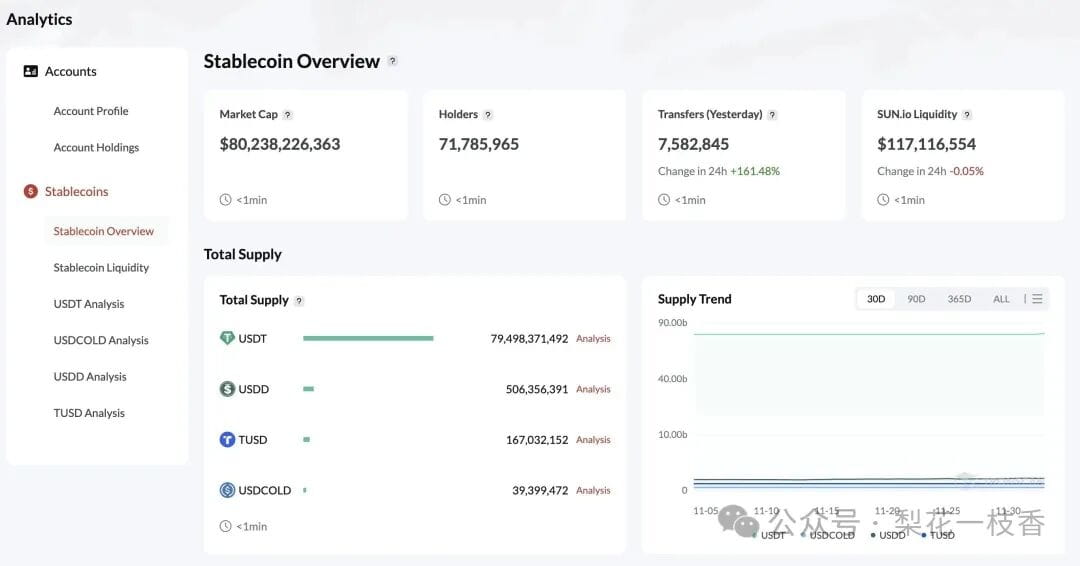 Tron stablecoin market capitalization | Source: Tronscan
However, despite Tron's significant growth, Ethereum still dominates the stablecoin space, with a market capitalization of approximately $166 billion, nearly double that of Tron. Ethereum's leading position benefits from its broader DeFi ecosystem, support from institutional investors, and high-value activities achieved through smart contracts, lending protocols, and on-chain financial applications.
Stablecoins on Ethereum typically provide liquidity for complex trading and yield strategies, while stablecoins on Tron are primarily used for settlement, payments, and trading processes.
These two ecosystems complement each other, meeting different market needs. Ethereum is at the core of institutional and decentralized finance (DeFi) driven stablecoin use, while Tron leads in high throughput and low-cost transactions. As global demand for stablecoins continues to grow, both networks are solidifying their positions. One excels in scalability and speed, while the other shines in the depth of DeFi and capital concentration.
Despite high volatility, TRX maintains a strong weekly structure
Compared to the overall market condition, Tron's weekly chart shows significant resilience. While many other cryptocurrencies have experienced deeper declines, TRX has remained above the support area of $0.27 to $0.28, maintaining a strong high time frame structure. Recent pullbacks have pulled the price down from the $0.36 area, but TRX still stays above the 50-week moving average. This moving average is currently around $0.28, forming direct dynamic support.
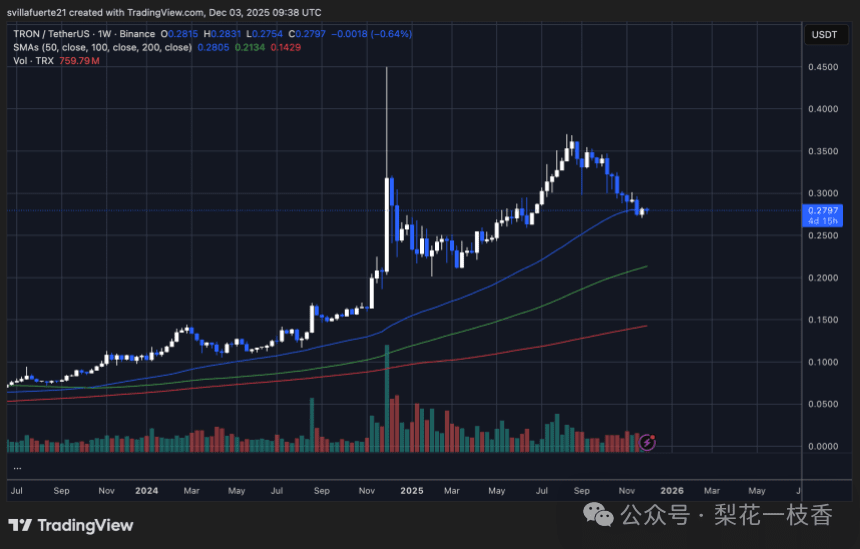
This strength is significant. Throughout 2025, the TRX moving average trend aligns with the rising moving averages. Especially the 50-week moving average has provided consistent support during each market pullback. The 100-week and 200-week moving averages are currently well below the current price, indicating that the long-term upward trend remains solid.
For Tron to regain upward momentum, it must firmly establish itself in the $0.30 to $0.32 area. This area was a support level during the last bullish phase and has now turned into a resistance level. If the weekly closing price strongly breaks through this area, it is expected to test the highs of $0.34 to $0.36 again. Before that, TRX remains one of the more stable tokens in the market, showing controllable downside space and a robust structure.


