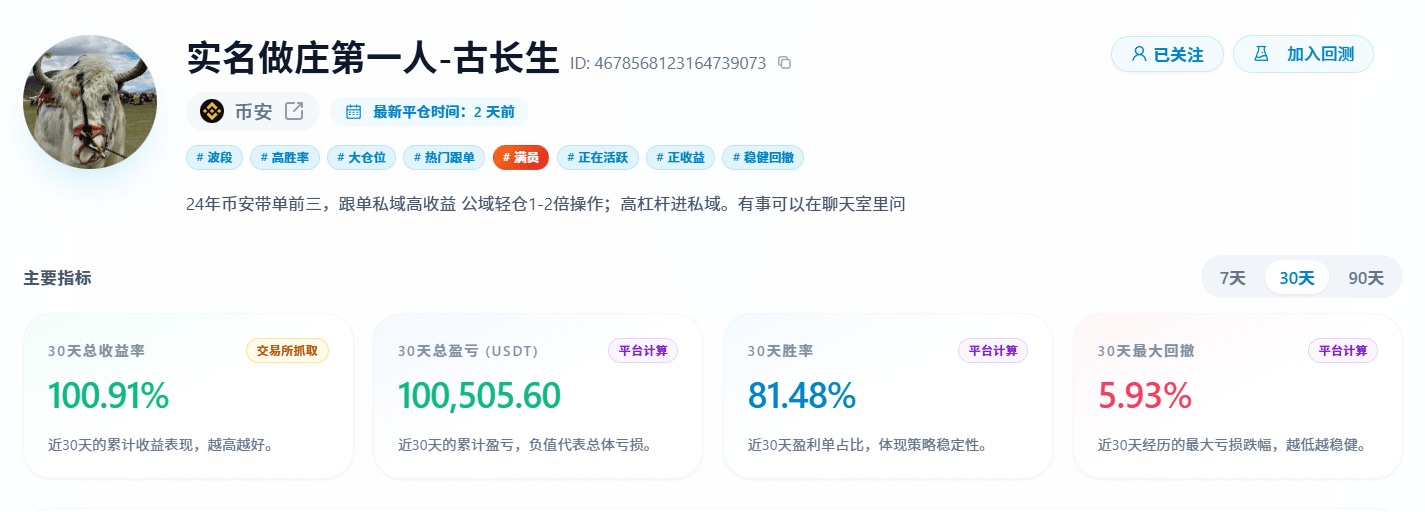
The performance report of the lead trader 'The First Person to Trade Under Real Name - Gu Changsheng' is a well-known case in the crypto circle: a 180-day ROI of up to 96.38%, a nominal win rate of 67.82%, with the number of followers nearing the limit of 1,000, and total profits in the follower community exceeding 72,000 USDT, with a margin balance of nearly 100,000 USDT—based on surface data, this trader demonstrates strong profitability.
After in-depth analysis of the data, it was found that behind this performance is a unique combination of trading strategies and risk characteristics: among 2026 profitable trades, nearly 50% are micro-profit trades with profit ≤ 1U, while there are also records of long-term positions with a single loss exceeding 10,000 USDT. The realization of 96% ROI relies on specific trading logic and is not suitable for all investors.
I. Breaking down the trading logic: The path to high win rate and high returns
1. 67.82% win rate: A combination of high-frequency trading and low-profit take-profit.
Gu Changsheng's high win rate stems from his strategy of "high-frequency trading + small-profit taking":
Of the 2026 profitable trades, 1018 yielded profits of ≤1U, accounting for nearly 50%. There were even instances of ETHUSDT long positions being held for only 4 seconds and closed with a profit of 0.0009U. This pattern is not uncommon in cryptocurrency trading; by quickly locking in small profits and increasing the number of profitable trades, the win rate metric in publicly available data is improved.
The stark contrast between the number of profitable and losing trades (2026 vs 138) keeps the nominal win rate at a high level. However, it should be noted that after excluding small winning trades, the proportion of "effective profitable trades" that contribute to the core returns is relatively low.
2. 96% ROI: The complementarity of short-term bottom-fishing and swing trading with heavy positions
His profit structure is characterized by "high-frequency short-term trading + a few heavily leveraged breakouts":
95% of the trades are intraday short-term trades, with an average holding period of only 5 hours and 1 minute, accumulating profits through rapid opening and closing of positions;
The core profits come from a few high-risk, high-reward trades: for example, shorting BTCUSDT on November 13th and holding the position for 8 days yielded a profit of 69,832.60 USDT. These large profits played a key supporting role in the overall ROI, forming a profit model of "multiple small profits + a few large profits".
The trading strategy clearly favors going long, with 1,519 long trades, more than double the 645 short trades, indicating that its trading system is more effective in upward market conditions.
3. Asset Allocation: Balancing Mainstream Cryptocurrencies as a Base and Altcoins for Potential Gains
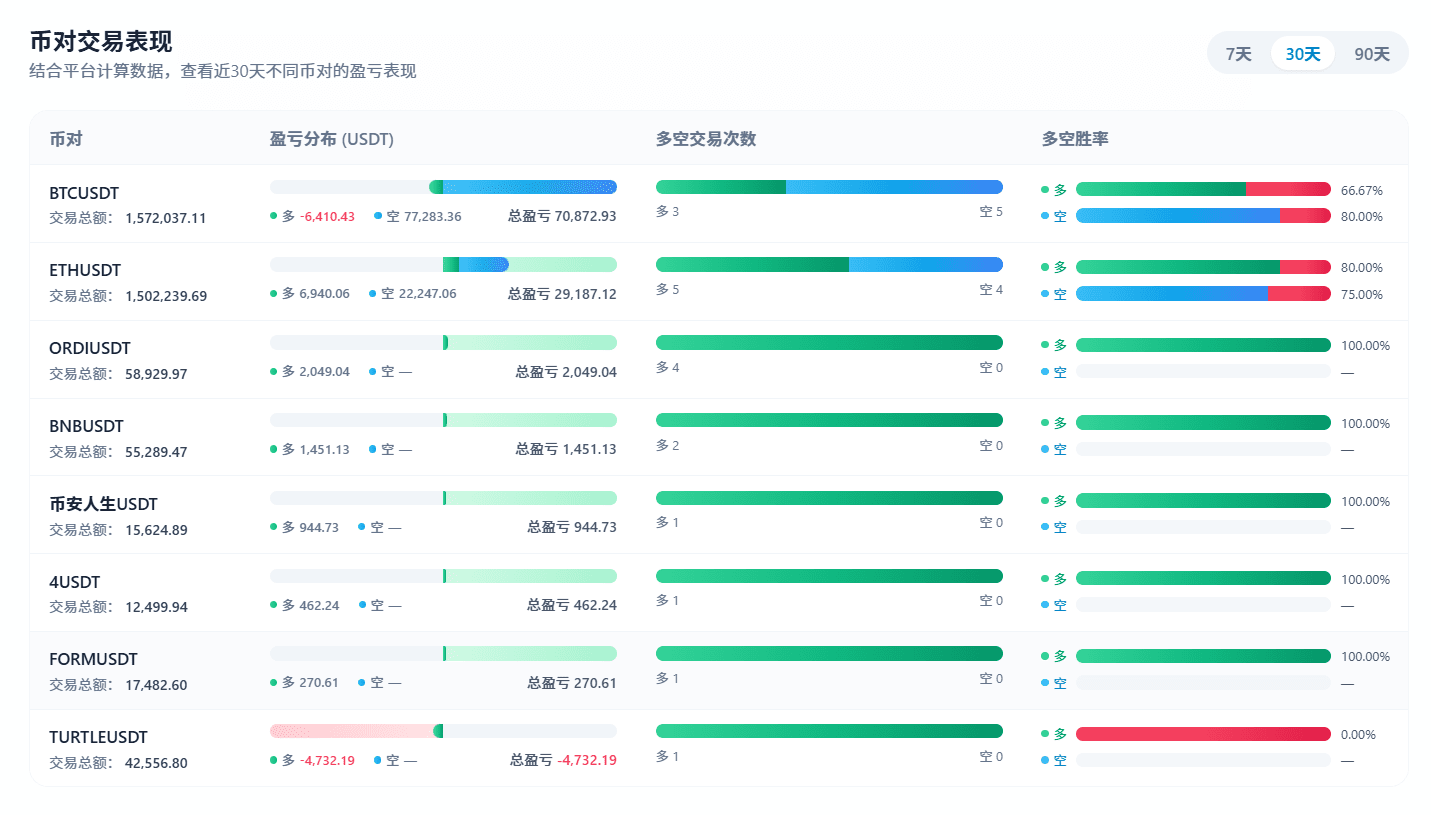
His trading targets cover a wide range, balancing stability and return flexibility:
It not only invests in mainstream cryptocurrencies such as BTC and ETH, which have high liquidity and relatively controllable volatility, but also participates in the trading of small and medium-sized altcoins such as NEIRO, 1000PEPE, and TURTLE.
Nearly half of the holdings are concentrated in the "other altcoins" category. Although these assets have poor liquidity and are highly volatile, they may generate excess returns during hot market conditions, which is the source of the "high elasticity" part of their return structure.
II. Behavioral Insights: The Objective Presentation of Strategic Consistency and Contradictions
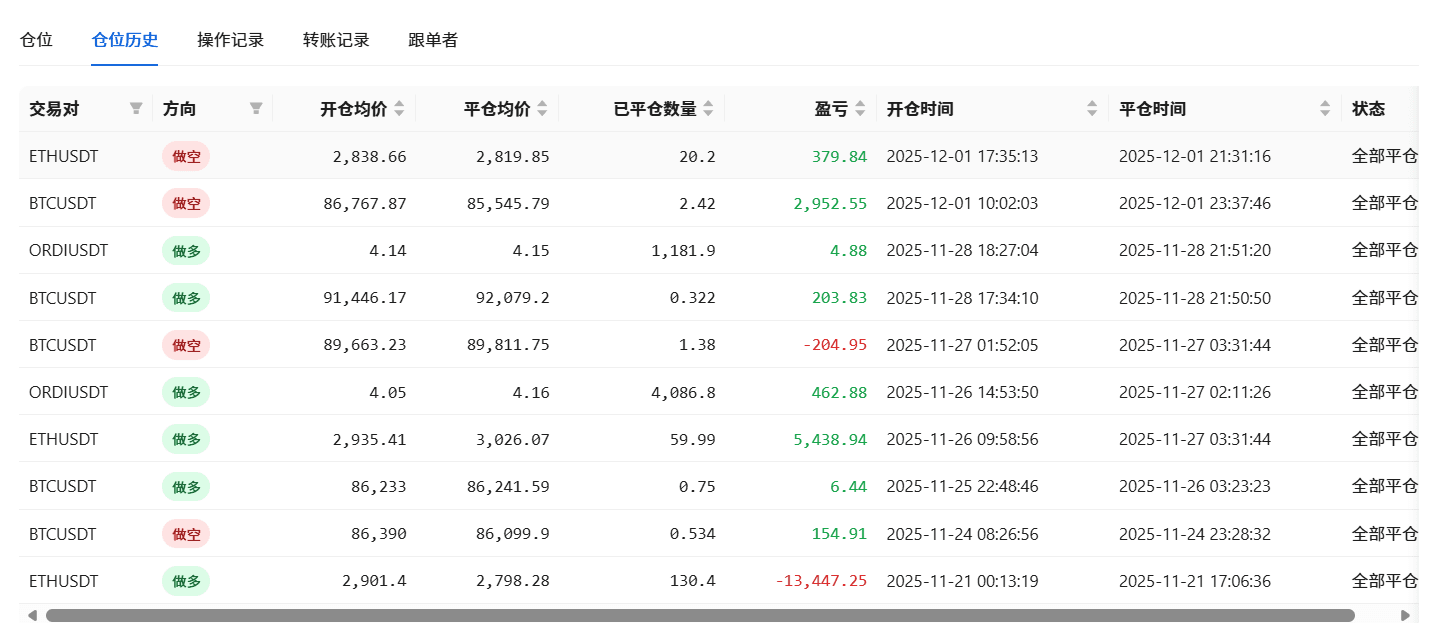
1. Trading style: Primarily short-term, shifting to long-term holding when the trend is against the market.
Gu Changsheng's trading strategy exhibits a dual characteristic: "short-term trading with the trend + holding losing positions against the trend."
When the market moves as expected, execute a high-frequency short-term strategy to quickly take profits and exit the market.
When the trading direction is opposite to the market trend, the strategy is to extend the holding period and wait for a reversal: for example, shorting CAKEUSDT for 4 days and 5 hours resulted in a loss of 11,533.30 USDT; going long TURTLEUSDT for 5 days and 10 hours resulted in a loss of 4,732.19 USDT. This approach contrasts with a short-term trading style, demonstrating both adherence to market judgment and amplifying the potential risk of loss.
2. The difference between promotion and practice: Cognitive bias between the description of light positions and the actual practice of heavy positions.
In his self-introduction, he mentioned "public domain light position 1-2x leverage operation," but judging from the trading results, the profit or loss of a single trade often reached tens of thousands of USDT, suggesting that the actual leverage or position size was higher than the conventional understanding of "light position." This discrepancy is not an isolated case. The promotional statements of those providing trading guidance often focus more on risk warnings, while actual operation requires adjusting positions based on market opportunities. Investors need to rationally view this cognitive bias.
3. Profit Distribution in Copy Trading Communities: Impressive Overall Profits vs. Limited Average Returns per User
The copy trading community's total profit exceeding 72,000 USDT is commendable. However, when divided among 999 copy traders, the average profit per person is approximately 72 USDT, exhibiting a distribution pattern of "a few making big money, while the majority making small money."
Some followers accurately followed the large, profitable trades that involved heavy leverage during the swing trading period, and reaped considerable profits.
Most copy traders only participated in high-frequency, low-profit trading, resulting in limited gains.
A small number of followers experienced losses from holding onto losing positions, which lowered the overall average return per person.
III. Four Major Potential Risks: Rationally Viewing the Uncertainties Behind the Strategy
1. Risk of profit drawdown: Significant short-term volatility.
The yield curve shows significant volatility in the account, with single-day yield drops exceeding 15% on October 7th and October 23rd. This means that followers must withstand substantial short-term fluctuations in account funds, placing high demands on their psychological resilience and liquidity.
2. Lack of stop-loss strategy: Potential risks of holding onto losing positions.
Multiple cases of holding positions against the trend for extended periods indicate a lack of strict stop-loss mechanisms for individual trades, relying instead on substantial capital and waiting for market reversals to generate profits. This model demands a significant amount of capital from the lead trader (nearly 100,000 USDT in margin), while ordinary followers have smaller capital. In the event of a sustained one-sided market trend, they may face the risk of forced liquidation before the market reverses.
3. Altcoin liquidity risk: slippage erodes returns.
While participating extensively in trading small- and mid-cap altcoins may yield excess returns, these coins have poor liquidity. Furthermore, with nearly a thousand followers operating simultaneously, slippage can easily occur when opening and closing positions: the follower's transaction price may be better or worse than the lead trader's, thus affecting actual returns. In extreme market conditions, there may even be situations where positions cannot be closed in time.
4. Difficulty in replicating the strategy: The challenge of balancing small profits and heavy leverage.
Gu Changsheng's strategy places high demands on those who follow it: they must be able to keep up with the rapid, high-frequency, low-profit operations, withstand the long-term holding and volatility of high-leverage trades, and accurately identify which trades are the "core profit opportunities." Ordinary investors find it difficult to fully replicate this strategy and are prone to either "only following low-profit trades and missing out on high-leverage trades" or "following high-leverage trades but unable to withstand volatility."
IV. Rational advice for copy trading: Matching your own risk tolerance is key.
✅ Suitable for investors who copy trades
They have a strong risk tolerance and can accept short-term capital drawdowns of over 15%.
Possessing certain trading experience, able to distinguish between low-profit scalping and core profit trading, and reasonably adjusting the pace of copy trading;
Aggressive investors who pursue high returns but are not fixated on short-term stable returns.
❌ Not suitable for investors who copy trades
Novice investors or risk-averse individuals cannot tolerate large fluctuations in their accounts;
Users who seek a stable cash flow and hope to obtain continuous income through copy trading;
Investors with smaller amounts of capital (less than 10,000 USDT) who are sensitive to transaction fees and slippage;
Users who are accustomed to using leverage of 5 times or more and have weak risk tolerance.
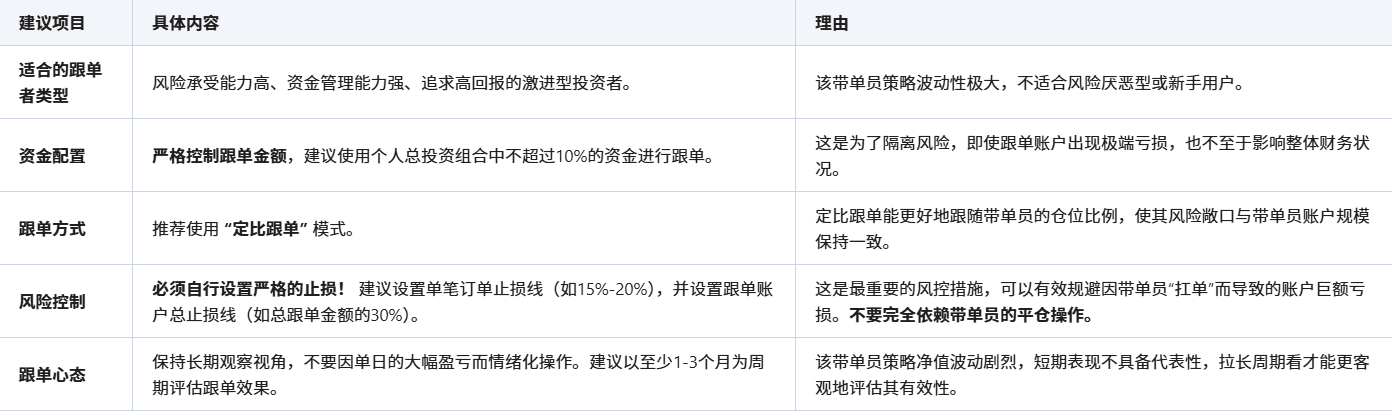
If you choose to copy trades, it is recommended to follow these principles.
1. Rational allocation of funds: Only use no more than 10% of your total personal investment funds for copy trading to avoid the impact of fluctuations in the copy trading account on your overall financial situation;
2. Choose the appropriate copy trading mode: It is recommended to use "fixed ratio copy trading" to keep your risk exposure consistent with the account size of the person providing the trading advice, thereby reducing the risk caused by mismatched positions;
3. Establish an independent risk control system: Set a stop-loss line of 15%-20% for each transaction and a maximum drawdown limit of 30% of the total capital of the copy trading account, without relying on the closing operations of the lead trader, and actively control risks;
4. Long-term perspective for evaluating results: Evaluate the returns of copy trading over a period of 1-3 months, avoid emotional trading based on large daily profits or losses, and rationally balance short-term fluctuations with long-term returns.
Summarize
Gu Changsheng's trading strategy is a typical example of the "high risk, high return" model in the crypto market: behind the 96% ROI and 67.82% win rate is a combination of high-frequency low-profit, swing trading heavy positions, long-short preferences and asset allocation. It has its unique profit logic, but also hides risks that cannot be ignored.
There is no "guaranteed profit" strategy in cryptocurrency trading. Choosing to copy trades is essentially choosing a trading model that matches your own risk tolerance and trading knowledge. For traders like Gu Changsheng, investors need to abandon the illusion of "blindly following and making money," rationally assess data highlights and potential risks, and make decisions based on their own circumstances—protecting principal is always the core premise of investment.
The above analysis is for reference only. Trading advice carries risks, and decisions should be made with caution. Market changes are unpredictable, and no trading advice guarantees absolute returns. Please maintain rational judgment, avoid blindly following others, and safeguard your own funds.
This is a simplified version of the report. The full analysis report can be accessed using the widget on the homepage.