
ZCash’s recent price action looks uncannily similar to Bitcoin’s historic boom-and-bust cycle from 2013–2014. After a rapid 10x surge and an equally fast collapse, ZEC has entered a calm, compressed consolidation phase that analysts—including Brian Cohen—believe could set the stage for a powerful rebound. Far from signaling weakness, this pattern resembles the early structure of a larger cyclical move.
ZCash climbed explosively from a long, quiet base near $25–$40 and shot toward $745 before losing momentum. The price has since settled around $356, leading some observers to assume the move is over.
But Cohen highlights that the structure of this surge-and-crash mirrors Bitcoin’s move from $100 to $1,200 and then down to $250. While BTC took months to complete its emotional and technical arc, ZEC did it almost five times faster, compressing the entire cycle into weeks instead of months.
Importantly, the forces behind ZEC’s decline differ from Bitcoin’s historical crash. BTC fell in 2013 due to immature market infrastructure—thin liquidity, exchange issues, and Mt. Gox’s collapse. ZCash’s drop, however, stemmed from liquidity compression and rapid leverage unwinds, not weakening fundamentals.
Cohen argues that thin liquidity can trigger fast declines but also creates the perfect conditions for fast recoveries.
This parallel extends to potential rebound mechanics. Bitcoin bottomed near $250 and then spent years building toward its monumental run to $20,000. ZCash, with its capped 21M supply and steady development—from Zashi wallet updates to Halo2 and NU6 progress—may now be entering a similar rebuilding phase.
However, because the crypto market today is more mature, with institutional participation, derivatives, and ETF flows, ZEC’s recovery could unfold far more quickly than Bitcoin’s slow early climb.
Cohen also notes that reflexive cycles are stronger now. Privacy narratives are gaining traction, and some traders are exploring BTC–ZEC dual-cap strategies. Thin liquidity means sudden upward surges can appear without warning.
Conditions like these once pushed Bitcoin from $250 to $1,000 in a short burst before it entered its long-term uptrend.
Market psychology also mirrors Bitcoin’s historic lows. Doubt is rising, sentiment is weak, and many claim $ZEC will never revisit $700—similar to how traders once insisted $BTC would never recover from $250.
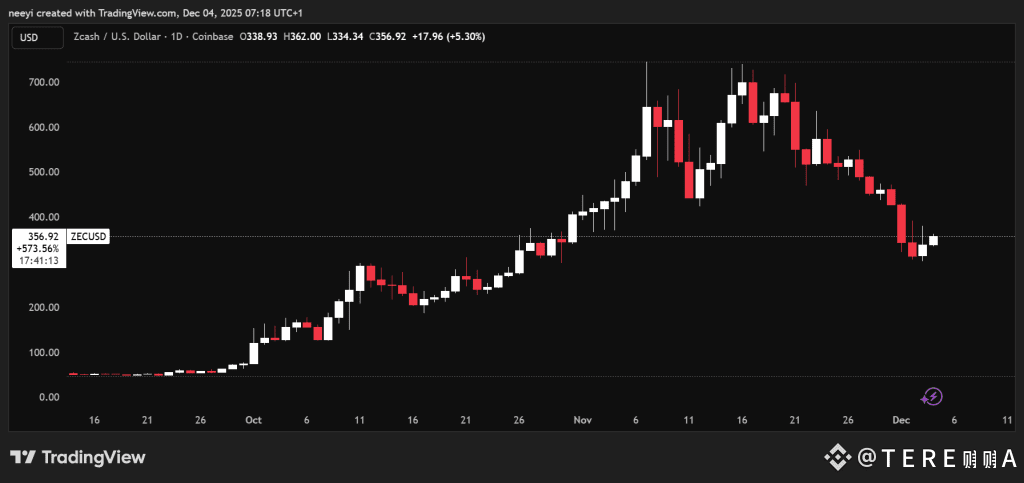
But fundamentals remain intact, development is ongoing, and the emotional stages of a classic cycle appear almost complete.
Cohen outlines the traditional progression: undervaluation, enthusiasm, sharp reset, and eventual expansion. ZCash has already moved through the first three stages. With cycle compression accelerating everything, the next major move—if it comes—could be far faster than expected.
Nothing is guaranteed, but ZEC now sits at a point where fear is high, fundamentals are steady, and historical patterns suggest the possibility of a strong rebound. The chart looks less like the end of a story—and more like the beginning of a new chapter.


