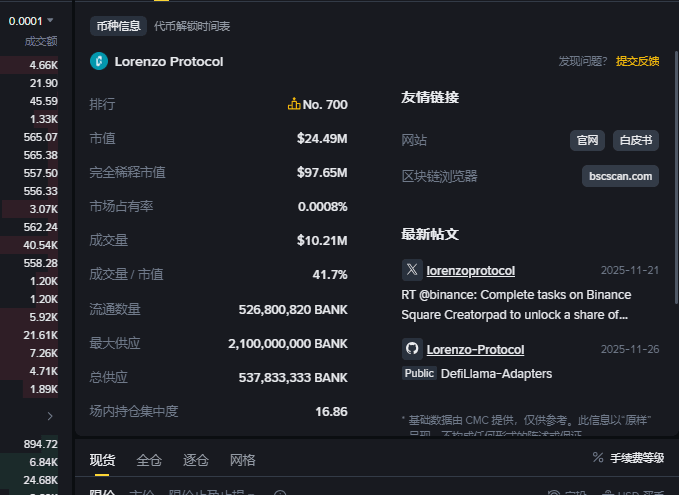
When your idle stablecoin can only sit in your wallet gathering dust, or be thrown into a few old-fashioned DeFi pools, have you ever thought that they could play a greater role? Now, there is a class of protocols trying to answer this question: how to enable capital in the crypto world to flow more efficiently to the real world and create real impact?
Lorenzo Protocol is one of the important problem solvers.
From 'saving money' to 'deploying capital': a diverse strategy behind a token
Imagine a scenario: a growing tech company with some idle USDC. In the traditional world, choices are very limited. But on Lorenzo, they can simply purchase a tokenized fund share called 'OTF'.
This OTF is not just a simple deposit certificate. It is more like an automatically operating "smart vault," backed by a complete set of strategies designed by professional fund managers. Once your funds enter, they will be automatically allocated to perform various tasks:
Some may enter algorithmic trading strategies to capture market fluctuations.
Some will be allocated to filtered DeFi yield farms to obtain basic returns.
A portion may flow into compliance-designed real-world assets, such as trade finance or government bonds.
All of this is encapsulated in a simple token. You do not need to operate multiple platforms yourself; just holding OTF will allow you to obtain a comprehensive return from a basket of strategies.
Core innovation: Financial "abstraction layer," leaving complexity to the protocol and simplicity to the user.
The core of Lorenzo is a financial abstraction layer. You can think of it as a fully automated "investment command center."
User deposits (stablecoins) enter → The abstraction layer allocates funds to different areas based on preset strategies → All returns are automatically aggregated, settled, and updated in the net asset value of the fund on the blockchain.
For users, the entire process is greatly simplified: buy, hold, and view net asset value. The complex operations behind such as portfolio adjustment, rebalancing, and yield harvesting are all automatically completed by the protocol layer. This significantly lowers the threshold for participating in professional-grade asset management.
BANK Token: Not just governance, but also an ecological coordinator.
The protocol's native token BANK plays a key role here.
Users can lock BANK to obtain veBANK. veBANK holders are not just voters; they essentially become members of the fund's "governance committee" and can influence key decisions, such as:
Decide the allocation ratio of funds among different strategies.
Vote to decide whether to include new fund managers or strategies.
Participate in the governance of protocol upgrades.
This design binds the long-term interests of investors, fund managers, and the protocol together. Holding veBANK means you are deeply correlated with the fund's performance, not just engaging in a speculative game.
Real-world use cases and growth potential.
Currently, the management scale of its flagship fund "1 Dollar + Fund" has exceeded 12 million dollars, attracting the attention of early institutions and mature retail investors.
The greater imagination lies in integration:
For wallets and emerging digital banks, they can integrate Lorenzo's OTF with one click to provide their users with yield products far exceeding current interest rates.
For RWA (real-world assets) issuers, this is a brand new and efficient capital raising and matching channel.
For developers, they can utilize its modular architecture to quickly build their own structured financial products.
What Lorenzo is building is a pipeline system connecting crypto capital and traditional productivity.
Challenges and Future: Trust is the cornerstone, scale is the engine.
Of course, this path is fraught with challenges:
Trust and Transparency: The execution of off-chain strategies relies on reliable custody and auditing. The protocol builds trust through clear on-chain reports and audited operations.
Regulatory Compliance: Involving RWA requires careful handling of financial regulations around the world while innovating.
Liquidity Depth: The growth of the fund's scale requires continuous capital inflow, which is a dual test for the protocol's market capability and strategy stability.
If these challenges can be properly addressed, the vision depicted by Lorenzo is highly attractive: allowing anyone to conveniently invest in a diversified global asset portfolio managed by professional managers through a crypto wallet, spanning on-chain and off-chain.
Conclusion: More than just returns, it is a revolution of capital efficiency.
The significance of Lorenzo Protocol goes beyond providing a high-yield product. It represents a trend: blockchain is not only a speculative market but can also become an efficient infrastructure for optimizing global capital allocation.
It will "tokenize" complex asset management, making capital flow unprecedentedly smooth. If successful, it validates a new path: the on-chain transformation of professional finance and the positive injection of crypto capital into the real world.
For those tired of simple mining and trading, who hope their assets can connect with a broader economic landscape, this is undoubtedly a new direction worth closely observing.
Disclaimer: This article serves only as an introduction to project concepts and industry analysis, and does not constitute any investment advice. DeFi and RWA-related protocols carry high risks; readers must fully understand the risks and conduct independent research before making decisions.
@Lorenzo Protocol #LorenzoProtocol $BANK