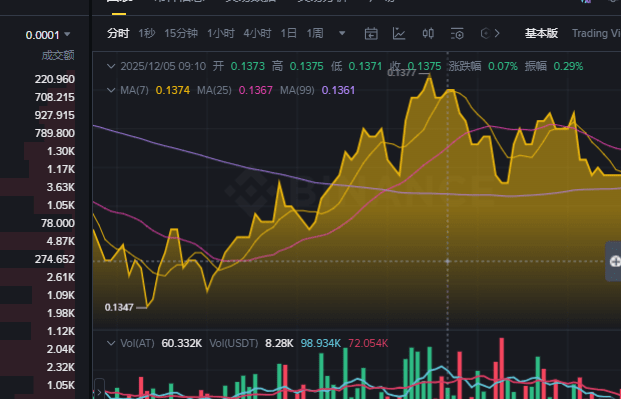
Recently, I reviewed Apro's ecological progress and on-chain data carefully again, and found that it is no longer a simple 'oracle' project, but is competing for the core hub position of the future on-chain data system.
This positioning is far more critical than simply providing data sources, and it is also more challenging. Once formed, it will be deeply tied to the growth of the entire crypto ecosystem.
Why do I say this? Because after observing the on-chain trends in recent months, I found that whether it is AI agents, RWA compliant data, or cross-chain security monitoring and the assetization process of the BTC ecosystem, they are all placing higher demands on data:
Faster, more accurate
More dimensions
Fully verifiable
The past model of 'only feeding one price' is no longer sufficient. The industry is forcing a comprehensive upgrade of the data infrastructure, and Apro happens to be at this node.
One, industry evolution: from 'using data' to 'relying on data'
In the past, I used to categorize on-chain protocols as 'data-sensitive' and 'data-driven', but now, almost all protocols are becoming the latter:
Lending requires risk factor and liquidation depth analysis
Derivatives rely on real-time order books and trading volume details
AI agents need continuous states, trends, and behavioral characteristics
Cross-chain protocols must monitor on-chain asset distribution
RWA requires off-chain structured information
Data quality is becoming a key part of protocol competitiveness. The emergence of Apro is precisely filling this increasingly widening 'data structural gap'.
Two, Apro's positioning: heavier than oracles, smarter than data transportation
Many people understand Apro as 'a smarter oracle', but in fact, its design is closer to 'on-chain data understanding layer'.
It handles three types of information:
Structured data: price, trading volume, on-chain behavior
Semi-structured data: event streams, cross-chain asset trends
Unstructured data: news, sentiment, AI-readable information
Traditional oracles mostly remain at the first type, while Apro incorporates the latter two into the system, enabling it to output 'executable information', not just raw values.
More critically, Apro places model inference at the data processing layer rather than the application layer. This means that on-chain applications can directly obtain interpreted and verified results without having to handle complex reasoning themselves—this effectively provides a reliable execution foundation for the on-chainization of AI agents.
Three, multi-chain stickiness: the key to future value
In my view, Apro's core value lies not in single chain but in 'multi-chain':
BTC ecosystem expansion requires external data support
EVM multi-chain applications call for consistent cross-chain data sources
Ethereum L2 explosion lacks unified data standards
AI agents inherently require cross-chain data interfaces
These demands have jointly spawned a new industry gap: multi-chain data hubs. Apro's current design resembles a 'data network' rather than a 'single-chain service provider', and this positioning will become increasingly important in the multi-chain era.
Four, future competition: the key is not speed, but 'understanding ability'
Competition at the data layer is ultimately not about who is faster, but about who can better 'understand' and 'express' data.
Apro provides not just data, but also:
Trends and deviations, rather than simple prices
Structured buying and selling pressure, rather than simple depth
Degree of event impact, rather than the event itself
Behavior classification and model explanation, rather than raw on-chain records
This shift from 'transmission' to 'understanding' is qualitatively different.
Five, growth logic: driven naturally by industry demand
Apro's growth does not rely on a single narrative but is rooted in several clear mainline demands:
The popularization of AI agents
Cross-chain security monitoring
RWA data structuring
BTC ecosystem assetization
Real-time requirements for high-frequency derivatives
Regardless of which mainline emerges, the demand for Apro will rise simultaneously. This 'demand stacking' growth model is often more resilient and has a higher ceiling than projects that rely on a single track.
Six, how to judge its true progress?
Rather than price fluctuations, more attention should be paid to these indicators:
Integrated protocol quality, rather than quantity
Continuous growth of on-chain calls
Expansion of data categories
Verifiability and stability of model inference
Scale and depth of cross-chain collaboration
Demand-driven projects will continue to make progress in these dimensions.
Seven, summary
Apro is not a traditional oracle but an infrastructure that approaches from data, aiming to become the 'understanding layer' on-chain.
What it aims to do is not just transport prices but understand data; it serves not just a single chain but multi-chain consensus; it connects not only protocols but the future AI agents and an automated world.
Such projects will not fully reflect their value in short-term sentiment but will gradually emerge amidst structural changes in the industry. I am willing to regard it as an early form of the next generation on-chain data system, a foundational layer candidate worth continuous observation and verification.
In the future, I will continue to track its call growth, ecological expansion, and multi-chain implementation. Time will tell us whether it can ultimately occupy that central position.