

Sometimes technologies evolve in parallel for too long.
And then comes a moment when you have to force them to collide—not for drama, but because neither can move forward without the other.
That’s exactly what’s happening with AI and Web3.
We’re used to thinking of AI as automation and Web3 as trust. But when you try to make autonomous agents operate inside a decentralized economy, the whole system breaks down.
Not because the idea is bad, but because the infrastructure for this kind of symbiosis simply didn’t exist.
Kite AI is the first attempt to build a base layer for machines, not users. Not “another L1,” but an architecture where AI is treated as a full participant of the network.
Why Web3 Wasn’t Ready for Autonomous AI
Traditional blockchains assume humans are behind actions—or at least smart contracts they control.
But an autonomous AI cannot:
pay for its own computations,
store its state outside a centralized app server,
prove the value of its work transparently,
show why it reached a certain conclusion.
This is exactly where every previous “AI + Web3” integration failed.
The agent simply had no economic slot to occupy.
Kite’s Answer: Treat Machine Economy as Layer Zero
Kite doesn’t try to make Web3 more complex—it shifts its center of gravity.
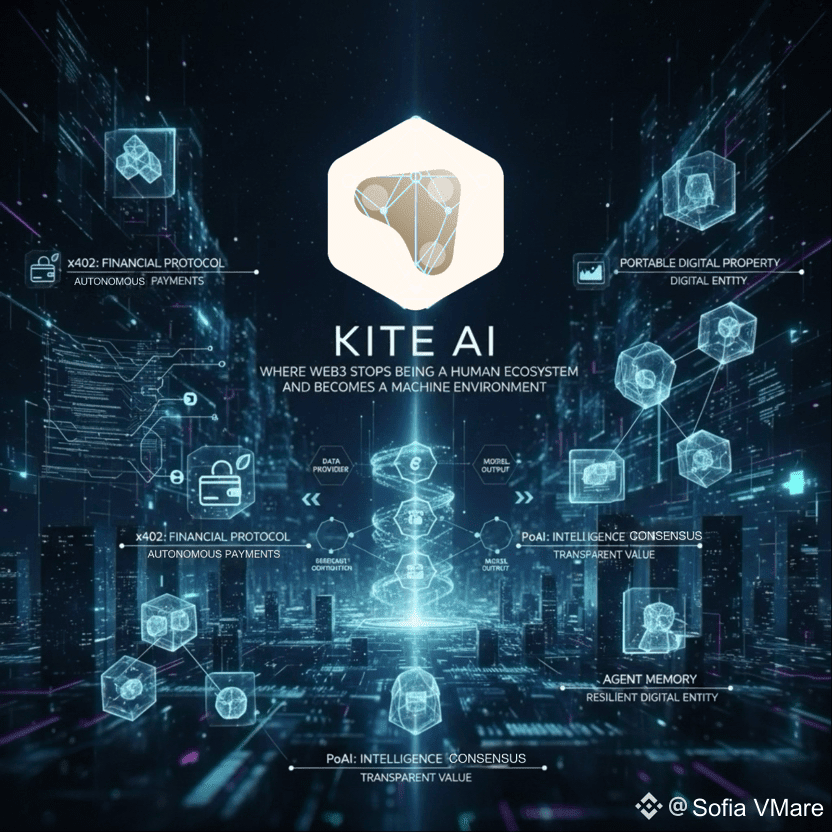
1. x402 — the financial protocol machines can actually use
In simple terms, agents get a wallet and the basic rails for money operations:
micropayments for compute,
autonomous API payments,
stablecoin-based transactions without human top-ups.
It sounds minimalistic, but it’s the foundation of economic independence.
An AI can decide for itself: what resource to buy, which service to call, how to scale its activity.
What previously required constant manual balance refills becomes a fully automated cycle.
2. PoAI — a consensus that tracks not only blocks, but intelligence
Classic networks reward validators.
Kite records intellectual contribution instead.
It captures:
who provided the data,
who performed the computation,
whose model output became part of the result.
Every step is transparent.
This is no longer a “black box” like traditional AI, but a system where value is cryptographically demonstrated.
Most importantly:
model operators can prove that their work produced real outcomes—and get paid for them.
3. Agent memory as portable digital property
A typical AI “lives” inside an app’s server.
If the app dies, the AI disappears with it.
Kite reverses this logic:
an agent stores its state, experience, and interaction history in a decentralized environment—allowing it to move freely between services, just like a user with a wallet.
This turns AI from a feature into a resilient digital entity.
What This Convergence Leads To
Kite AI is not competing with Ethereum or Solana—it doesn’t need to.
It operates in a space with almost no rivals: infrastructure for machines acting independently.
Things that sounded like sci-fi start looking realistic:
agents pay each other for services,
models monetize their outputs directly,
memory isn’t owned by a corporation,
transparency is built into the protocol itself.
This isn’t “another blockchain.”
It’s an attempt to rebuild Web3 from the ground up—assuming the next wave of users won’t be humans at all.
And the final question — philosophical
If machines become economic participants,
what happens to the very definition of “network user” in the years ahead?


