Data availability sampling technology reduces node storage burden by 80%, marking a key step forward for the Ethereum network in Layer 2 scalability.
On December 3, 2025, the Ethereum network completed a significant upgrade again - Fusaka was successfully activated on the mainnet. This upgrade marks a solid step forward for Ethereum on the 'The Surge' scalability roadmap, increasing blob capacity by 8 times through data availability sampling technology, expected to bring a 40%-60% reduction in fees for Layer 2 networks.
The Fusaka upgrade combines improvements from the consensus layer Fulu and the execution layer Osaka, focusing on backend optimization rather than user interface changes. This upgrade has sparked lively discussions in the Ethereum community, with some believing it will greatly enhance Ethereum's market competitiveness, while others express caution about the stability brought by the rapid hard fork pace.

01 Core Upgrade
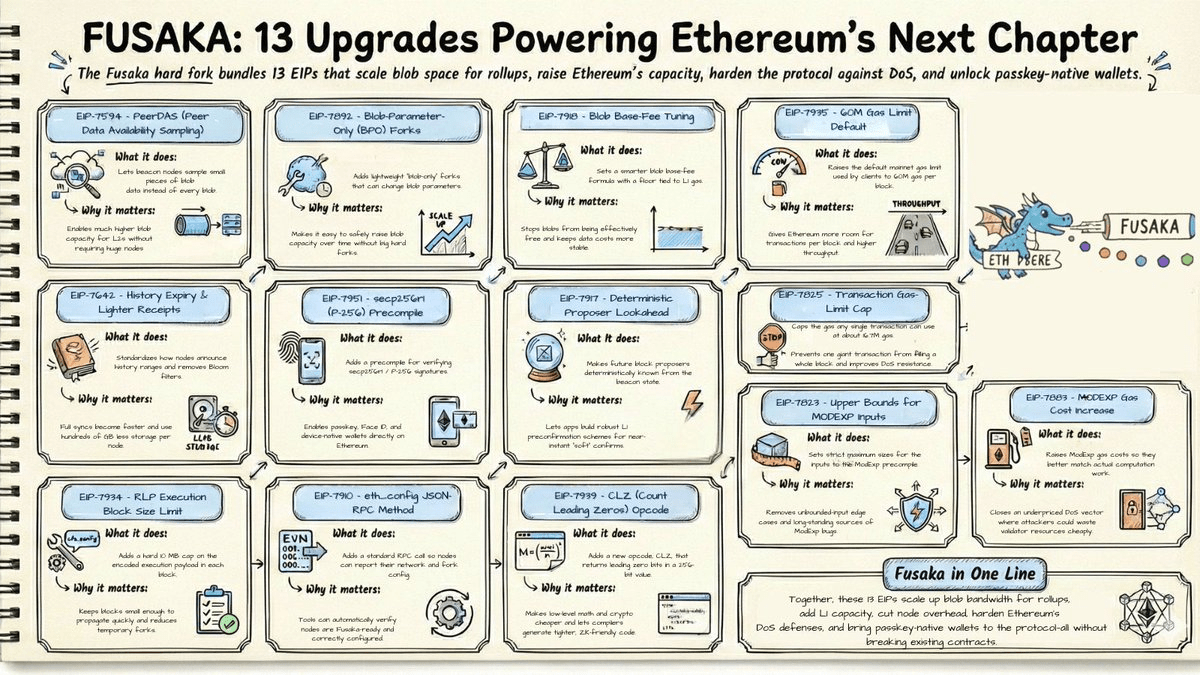
Ethereum's Fusaka upgrade was successfully activated on December 3, 2025, marking another milestone after Dencun and Pectra. This upgrade incorporates improvements to the consensus layer Fulu and the execution layer Osaka, and includes 13 EIP proposals.
The Fusaka upgrade marks a significant step forward in Ethereum's "The Surge" expansion roadmap. Unlike previous upgrades, this one adopted a more rapid hard fork pacing—twice a year—allowing the network to make more flexible and gradual adjustments.
The upgrade focuses on data availability sampling and gas optimization mechanisms. While these changes will not directly affect Layer 1 transaction fees, they are significant for improving the efficiency of the Layer 2 ecosystem and lay the foundation for the future Glamsterdam upgrade to introduce parallel transaction processing.
02 Technological Breakthrough
The introduction of PeerDAS technology is central to the Fusaka upgrade. This technology allows nodes to store only 1/8 of the blob data and reconstruct the complete information through data sampling. This breakthrough increases blob capacity by 8 times, significantly enhancing the network's data processing capabilities.
In terms of bandwidth requirements, full nodes saw a decrease of approximately 80%, while solo stakers experienced a reduction of approximately 50%. This efficiency improvement translates to lower operating costs and greater accessibility for users running nodes.
Ethereum co-founder Vitalik Buterin pointed out in an interview that data availability sampling is a crucial component of realizing Ethereum's scaling vision. The Blob parameter-only fork mechanism allows for a gradual increase in capacity targets between major upgrades.
03 Fee Adjustment
The Fusaka upgrade made significant adjustments to the fee mechanism. EIP-7825 proposed setting the transaction gas cap at approximately 16.8 million, a measure that effectively prevents a single transaction from consuming the resources of an entire block.
EIP-7883 adjusts the gas cost of modular exponentiation to ensure that complex calculations do not unnecessarily consume network resources or cause congestion. Meanwhile, the EIP-7918 proposal binds the base cost of a blob to the execution cost, preventing the cost from dropping to an unreasonably low level.
These fine-tuning adjustments offer significant room for fee reductions. According to research by the Ethereum Foundation, these optimizations are expected to bring a 40%-60% fee reduction to Layer 2 networks, providing solid support for the affordability and accessibility of the Ethereum ecosystem.
04 User Experience
From a user perspective, Fusaka brings substantial improvements to the user experience. The most notable improvement is the introduction of the pre-compiled secp256r1, which supports pass keys and device-native signatures.
This improvement allows users to securely manage their wallet assets without relying on traditional seed phrases, significantly lowering the barrier to entry for new users. Ethereum security expert CollinTown2000 stated on the X platform that this could be "one of the most significant user experience improvements since account abstraction."
At the same time, the potential increase in the default gas limit also creates more room for regular transactions. This means the network can process more transactions in the same amount of time, reducing congestion and fee spikes faced by users during peak hours.
05 Market Reaction
Following Fusaka's activation, its price performance was remarkable. The price briefly surpassed the $3,000 mark, reaching a new high in recent months. The market responded positively to this technological upgrade.
It is worth noting that this price trend forms an interesting contrast with the market reaction after the Pectra upgrade, when the price rose by about 60% within a month of the upgrade.
However, not all reactions were positive. Data showed that the Prysm client experienced technical issues, causing a short-term 25% drop in voting activity. This situation briefly raised concerns in the community about network stability, and Ethereum developers quickly released a patch to fix it.
06 Ecological Effects
The DeFi ecosystem has reacted very positively to the Fusaka upgrade. Token prices for major DeFi protocols such as AAVE and CRV have risen significantly, demonstrating market recognition of the improvements in Ethereum infrastructure.
The upgrade directly benefits the rollup ecosystem, with Layer 2 solutions like ZKsync expected to see operating costs reduced by up to 40%. This will provide them with greater flexibility to optimize user experience and reduce expenses.
Institutional investors have also demonstrated confidence in the upgrade. Cryptocurrency mining company BitMine accumulated 97,000 ETH before the upgrade, indicating its strong belief in the long-term value of Ethereum. These positive signals collectively support the healthy development of the Ethereum ecosystem.

07 Controversy and Challenges
The Fusaka upgrade also faces some controversies and challenges. Some developers have pointed out that while the twice-yearly hard fork schedule accelerates the improvement process, it may also introduce new security vulnerabilities.
For solo stakers, while the overall computational burden is reduced, the increased network complexity means a slightly higher technical barrier to entry for running nodes. Some members of the community are concerned that this could further exacerbate Ethereum's decentralization challenges.
The bug in the Prysm client exposed potential stability issues arising from a rapid pace of updates. Although the problem was quickly resolved, this incident serves as a reminder to developers the need to find a balance between the speed of innovation and network stability.
08 Future Outlook
The Fusaka upgrade laid the foundation for the future development of Ethereum. It not only improved the current network's data processing capabilities but also paved the way for subsequent upgrades such as Glamsterdam.
In the long run, these improvements will enable the Ethereum ecosystem to achieve a combined throughput of over 1 million TPS. The successful implementation of PeerDAS technology will also enhance the resilience of the Ethereum network.
Ethereum researcher Dennison Bertram noted on the X platform that Fusaka marks another key step in Ethereum's transformation from a proof-of-stake platform to a fully scalable platform.
The community's reaction to Fusaka has been polarized: optimists see it as a crucial step for Ethereum to maintain its leadership in the smart contract platform space, while cautious observers emphasize the need to observe the upgrade's actual performance. A popular discussion on Reddit stated, "Fusaka is not the end, but just another step for Ethereum towards becoming a global-scale blockchain."
Regardless, the successful implementation of data availability sampling has already brought immediate benefits to the entire ecosystem. As blob capacity gradually increases from its current level to the target range of 10-14, the Ethereum network will be better able to support the next wave of decentralized applications.