


The cryptocurrency asset management firm CoinShares stated that the bubble of digital asset treasury companies (DAT) has largely burst. Some companies traded at 3 to 10 times their market net asset value (mNAV) in the summer of 2025, but have now significantly fallen back to about 1 time or even below, causing a severe repricing for a trading model that once viewed token treasuries as a growth engine.
CoinShares' research director James Butterfill wrote in a blog post that the next key trend depends on corporate behavioral choices: either a price drop triggers a wave of disorderly sell-offs, or companies choose to continue holding their positions, waiting for a market rebound.
Butterfill states that he leans towards the latter scenario, reasoning that the overall economic environment is gradually improving, coupled with the possibility of interest rate cuts in December, which could support the cryptocurrency market.
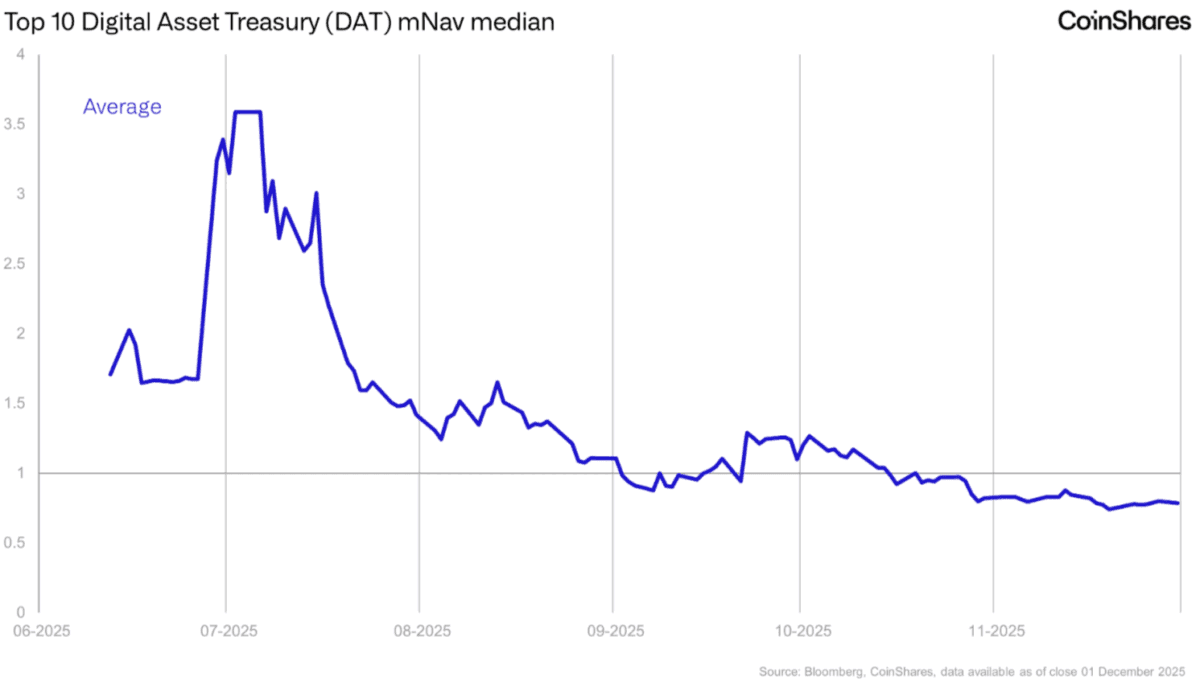 Source: CoinShares
According to Butterfill, the bigger challenge lies in the structural aspect. With a wave of companies accumulating excessively large token treasuries in the open market without building truly sustainable revenue-generating businesses, investors' tolerance for continuous dilution of equity, asset concentration in a single token, and lack of substantive revenue is clearly declining, which also undermines the trust in the entire DAT concept stock sector.
The report notes that as financially sound companies begin to use Bitcoin as a disciplined financial and currency management tool, early signs of a healthier development path for the market have emerged.
Butterfill indicates that the concept of DAT has not disappeared but is being reclassified. Investors are likely to begin distinguishing more clearly between different types of companies, such as speculative DAT packaged with treasury, disciplined financial strategy enterprises, diversified token investment vehicles, and strategic companies using Bitcoin as a macro hedge.
The report concludes by stating that the next generation of DAT companies must be built on fundamentals: possessing credible business models, more rigorous corporate governance, and holding more pragmatic expectations regarding the role of digital assets on corporate balance sheets—digital assets should be seen as a tool, not the entirety of the story.
Reference
Source
