
Injective has become one of the most advanced blockchains in the industry because it continues to evolve in ways that directly empower builders. One of the most transformative upgrades in its journey is the introduction of Multi VM architecture. This new design allows Injective to support multiple virtual machines natively. It creates a unified environment where developers from different backgrounds can build, deploy, and scale applications without barriers. It is a major step that changes what builders can do on chain.
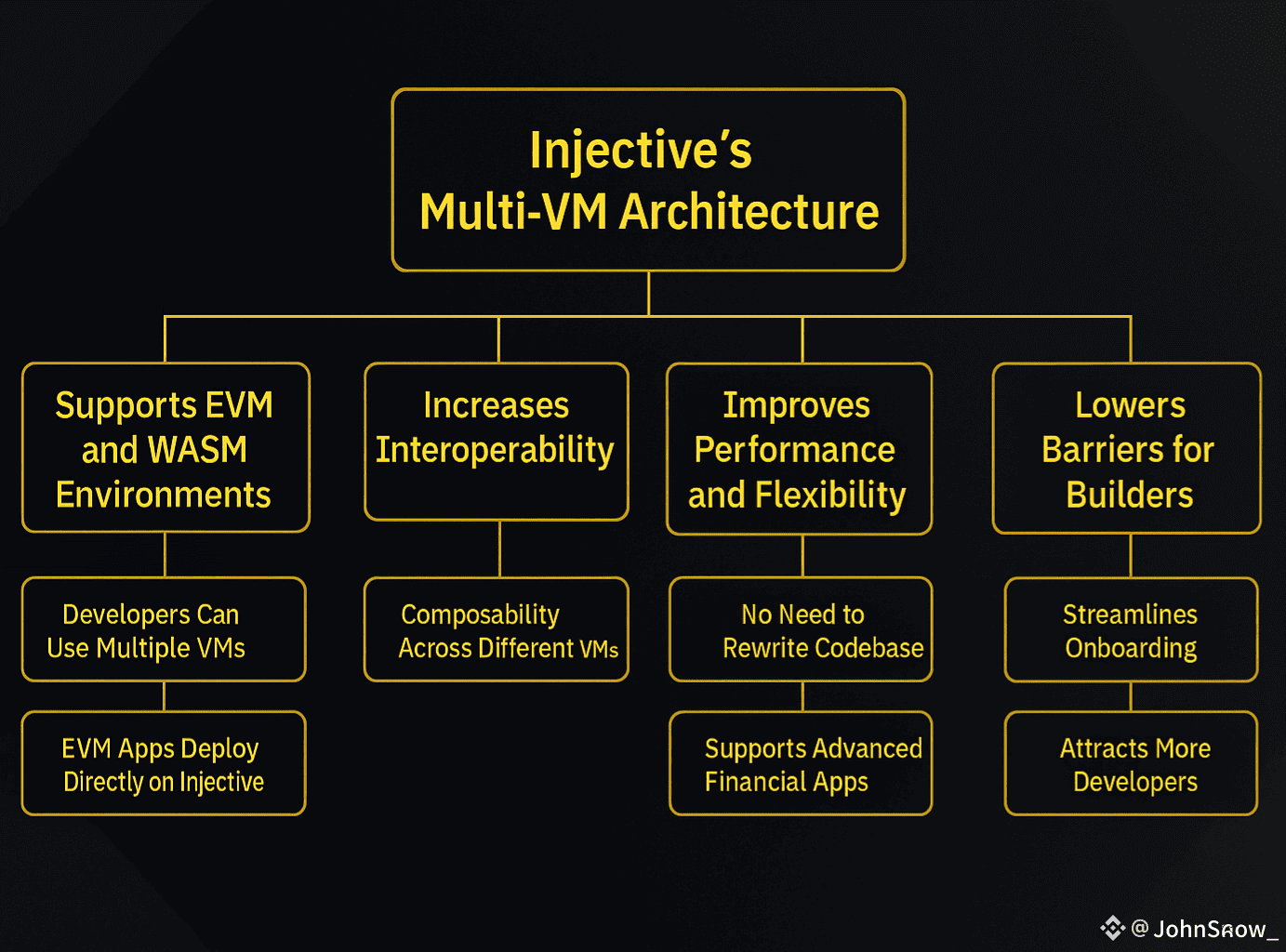
The rise of Multi VM architecture signals a shift in how modern blockchains operate. Earlier networks forced developers to use a single programming model. This limited creativity and prevented many teams from joining ecosystems they were unfamiliar with. Injective solves this by giving builders the freedom to choose the tools that fit their workflow. They can build using EVM, WASM, or future virtual machines that the network may adopt. This flexibility removes friction and opens the door to rapid innovation across the Injective ecosystem.
The choice to support multiple virtual machines is not just a technical decision. It is a strategic move that reflects Injective’s vision of becoming the most builder friendly financial layer in Web3. Developers no longer need to worry about migrating their entire codebase to a new language or rewriting applications from scratch. They can deploy existing Ethereum based applications directly on Injective. They can also use high performance WASM environments to build advanced financial applications that require speed and efficiency.
This flexibility creates a bridge between development worlds that were previously separated. EVM applications can now interact with Injective’s high speed infrastructure, and WASM contracts can operate alongside them. This combination gives Injective one of the most diverse development ecosystems in the blockchain industry. Builders gain the freedom to experiment, explore different architectures, and choose the environment that aligns with their goals.
One of the most exciting aspects of Multi VM architecture is how it accelerates adoption. For years developers have struggled with slow networks, high fees, and complicated tooling. Injective addresses these challenges by offering a unified platform where performance is no longer a limitation. Applications deployed on Injective gain immediate access to fast finality, low fees, and deep interoperability across multiple chains. This environment makes it easier for developers to launch products that scale globally.
The impact on DeFi is especially important. Financial applications require precision and speed. Many DeFi protocols on other networks suffer from slow execution and unpredictable transaction costs. Injective solves these problems at the base layer. When combined with Multi VM support, developers can now bring advanced financial tools to Injective without compromising performance. They can build decentralized exchanges, perpetual markets, lending protocols, automated strategies, and trading platforms designed to handle real world volumes.
Another advantage unlocked by Multi VM architecture is composability. Applications built using different virtual machines can interact seamlessly on Injective. This means an EVM based protocol can integrate with a WASM based liquidity engine. A lending protocol can connect to a derivatives platform built with different technologies. This interconnected environment creates a powerful layer of innovation where developers can build on each other’s work without limitations.
The opportunity for cross chain builders is also significant. Many teams operate on Ethereum, Solana, Cosmos, and other ecosystems. Injective’s Multi VM architecture gives them a way to unify these experiences. A team with an Ethereum application can deploy the same contract directly on Injective and benefit from faster execution. A team familiar with Cosmos SDK can build high throughput applications in WASM while interacting with EVM tools. This level of interoperability is rare in blockchain and is one of Injective’s biggest strengths.
Another major benefit for developers is the reduction in onboarding complexity. Many builders hesitate to adopt new blockchains because learning a new stack takes time and resources. Injective removes this obstacle by letting builders use the languages and frameworks they already know. Solidity developers can deploy EVM smart contracts. Rust developers can launch WASM contracts. This accessibility brings more builders into Injective’s ecosystem and supports a healthier rate of innovation.
The introduction of Multi VM support also improves ecosystem resilience. With multiple environments coexisting, Injective becomes more flexible in handling new emerging technologies. If a new virtual machine becomes popular in the industry, Injective can integrate it without disrupting existing applications. This evolutionary capacity is crucial for long term relevance in a fast moving industry like blockchain.
Developers also gain immediate performance upgrades by building on Injective. The network provides sub second finality. It offers extremely low fees. It supports real time market operations. These features allow builders to create financial systems that would not be possible on slower chains. A derivatives platform can operate smoothly. An AI driven trading engine can execute strategies accurately. A real world asset marketplace can settle transactions instantly.
When developers launch applications on Injective, they also benefit from the network’s interoperability with Ethereum, Solana, and Cosmos ecosystems. This gives projects instant access to a massive user base and liquidity pool. Builders can bridge assets across chains, integrate cross chain data sources, and create applications that function as multi chain platforms. This is especially valuable for DeFi projects that depend on liquidity and user access.
The Multi VM architecture also helps Injective attract institutional developers. Institutions want stable, predictable environments where applications can run efficiently. They need the ability to use safe and familiar programming models. Injective’s architecture gives them confidence that they can migrate their systems without major restructuring. This is important for institutions experimenting with tokenization, automated financial products, and real time settlement systems.
A powerful aspect of this upgrade is what it means for future innovation. Blockchains often struggle with evolving technology because they are locked into a single virtual machine. Injective’s Multi VM design means the network can grow organically as the industry changes. It can adopt new VMs, support new languages, and integrate cutting edge technologies without disrupting the ecosystem. This future readiness is rare and is one of the main reasons developers see Injective as a long term platform.
The combination of EVM support and WASM performance creates a unique environment for high end financial applications. Builders can create contracts that execute faster and more efficiently than on traditional EVM chains. They can design logic heavy financial tools without worrying about gas limits or performance bottlenecks. This advantage makes Injective an ideal environment for algorithmic trading systems, on chain order books, liquidity engines, and high volume exchanges.
Another area where Multi VM architecture shines is in the creation of hybrid applications. Developers can build protocols that use EVM for user facing interactions while using WASM for high performance backend calculations. This dual system gives builders flexibility and efficiency unmatched by most other chains. It also leads to safer applications because developers can choose the right environment for different parts of their code.
The architecture also improves the scalability of the ecosystem. When applications are distributed across multiple VMs, no single environment becomes overloaded. Developers can optimize performance by choosing the VM that fits their application’s needs. This balanced structure helps Injective maintain stable performance as the number of applications increases.
Injective’s Multi VM architecture also encourages deeper experimentation. Builders can test new ideas using different programming models without needing to switch blockchains. They can compare performance, customize execution, and design innovative systems that take advantage of both VMs. This freedom fuels creativity and leads to more sophisticated applications in the ecosystem.
The upgrade also greatly benefits developers migrating from Ethereum. Many teams want the speed and low fees of Injective but do not want to rewrite their entire codebase. Multi VM solves this instantly. Solidity developers can deploy their contracts on Injective in the same way they do on Ethereum. They can interact with users, build dApps, and integrate tokens with minimal changes. This smooth migration path supports large scale adoption.
Developers also gain a competitive advantage when building on Injective. The network’s performance improves the user experience significantly. Applications feel faster. Markets update instantly. Transactions confirm quickly. These features attract users and traders who value speed. Builders can grow their user base faster because users notice the difference immediately.
Multi VM architecture also opens the door for new categories of applications. AI powered trading systems can run at scale. Real time risk engines can update instantly. Tokenized assets can settle without delay. Prediction markets can operate with low latency. These applications require fast compute and flexible design. Injective provides the perfect foundation.
The architecture also supports advanced economic models. Because applications can be built in multiple environments, developers can design custom financial logic with better efficiency. This creates new opportunities in structured finance, synthetic markets, algorithmic risk management, and decentralized capital tools. These advanced tools help Injective build a financial ecosystem that rivals traditional markets.
The long term impact of Multi VM architecture becomes even clearer when looking at network effects. Each new developer who joins Injective brings new ideas. Each application attracts new users. Each user increases activity on the chain. This creates a cycle where the ecosystem grows larger and more diverse. Multi VM support accelerates this cycle because it removes the barriers that stop builders from participating.
The combination of flexibility, speed, low fees, and cross chain interoperability makes Injective one of the strongest environments for Web3 builders today. The network feels familiar to Ethereum developers. It feels powerful to Rust and Cosmos developers. It feels scalable to institutions. It feels open and flexible to experimenters. This inclusive design attracts every category of builder.
In the coming years Injective will likely become a leading destination for financial applications that require speed and customization. Its Multi VM architecture positions it ahead of networks that depend on a single VM. As more builders discover the possibilities, the Injective ecosystem will grow into a complete financial layer for the decentralized economy.
Injective has always aimed to redefine what is possible with on chain finance. Multi VM architecture is a major leap toward fulfilling that vision. It gives developers the tools, performance, and flexibility they need to create a new generation of decentralized applications.
Injective is not just offering a better environment for builders. It is creating a future where financial systems can run entirely on chain with efficiency and scale. Multi VM support is the foundation that makes this future possible. And with more developers joining every day, the evolution of the Injective ecosystem is only beginning.
