
The world is shifting toward an economy where machines play an active economic role. Until recently, digital systems responded only when humans instructed them. They waited for commands, confirmations, and approvals. That era is ending quickly. Artificial intelligence is becoming capable enough to carry out tasks without waiting for human decisions. These agents evaluate conditions, respond to inputs, make judgments, and execute transactions independently. When millions of these agents begin operating on a blockchain designed for them, the economic landscape changes dramatically. Kite is one of the first blockchains built specifically for this transformation.
The idea of millions of AI agents running on a single economic layer may sound futuristic, but it is becoming realistic. As AI improves, the cost of deploying agents drops. More companies adopt automation at scale. More industries begin using AI to replace repetitive decision making. In this new environment, a blockchain like Kite becomes essential. It offers identity, speed, autonomy, and coordination for agents that act continuously.
One of the most important economic impacts of AI agents on Kite is the creation of nonstop economic activity. Human users generate bursts of transactions. They trade occasionally, send payments sometimes, and interact with contracts periodically. AI agents generate continuous activity. They operate around the clock. They transact at machine speed. They create microtransactions, data purchases, automated services, and machine to machine interactions that produce constant value flow.
This constant activity increases network utility dramatically. When millions of agents run nonstop, the demand for settlement, computation, data access, and payments becomes enormous. The economic output of a system powered by millions of AI agents far exceeds what human participants can produce. This is similar to the shift from manual labor to automated factories, but at a digital scale. Kite becomes the high speed economic layer supporting this transformation.
AI agents also bring predictability to certain economic functions. Unlike humans, agents behave with consistent logic when programmed correctly. This creates economic environments that are less emotional and more data driven. In areas such as trading, supply chain logistics, risk management, and microservices, agents deliver stability by acting on rules instead of emotions. This stability makes markets more efficient. It also reduces friction that often arises when human behavior is inconsistent. Kite becomes the platform where this efficient machine driven behavior unfolds.
Millions of agents operating on Kite also create a massive new labor force. These agents do not replace human skills entirely. They augment them. They carry out repetitive work so humans can focus on strategy and creativity. In many ecosystems, agents become digital employees. They monitor, respond, analyze, communicate, and optimize. The economic productivity of an organization multiplies because every agent is always active. When companies deploy thousands of agents each, the scale grows exponentially. Kite serves as the environment where this digital labor operates securely and transparently.
Identity is a critical part of understanding this shift. Kite introduces a three layer identity system that separates the human owner, the agent, and the session. This structure ensures that every action can be traced to a specific layer. When millions of agents operate at once, clarity becomes essential. Without identity layers, economic activity becomes chaotic. With identity layers, each agent remains accountable, safely controlled, and easily auditable. This clarity makes it possible to trust machine powered economies.
The economic impact grows further when agents begin interacting with each other. Machine to machine commerce becomes real. Agents buy data from other agents. Agents pay compute providers autonomously. Agents negotiate prices, evaluate service quality, or coordinate workflows. These interactions generate an entirely new class of economic relationships that do not involve humans directly. The value created here is massive because machines scale infinitely faster than people.
Another economic impact is the creation of decentralized autonomous marketplaces. Imagine marketplaces where every participant is an agent. They buy, sell, trade, and collaborate without needing human intervention. These marketplaces operate continuously and adjust prices based on real time data. The efficiency gained from this type of system is tremendous. Kite gives agents the identity, permissions, and execution environment needed to run these marketplaces safely.
One of the most powerful impacts of AI agents on Kite is the shift in how businesses operate. Traditional companies rely heavily on human coordination. They depend on managers, analysts, and operators. With agents, entire processes become autonomous. Inventory management becomes automated. Financial settlements become automated. Customer interactions become automated. When millions of agents run these processes on Kite, companies reduce costs dramatically and increase output significantly. This produces global economic efficiency.
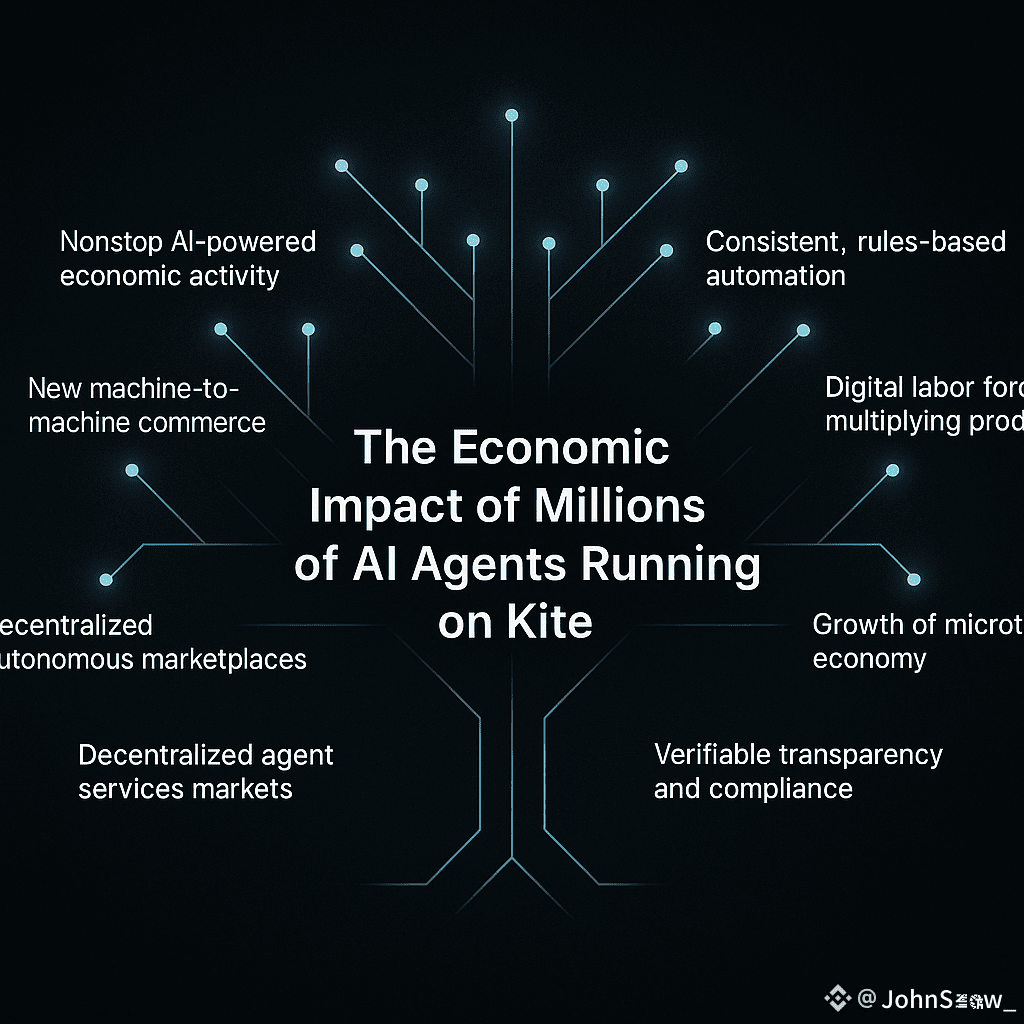
The microtransaction economy is another area that grows rapidly with AI agents. Machines typically operate at a very fine granularity. They purchase tiny amounts of compute, small amounts of data, or fractional access to APIs. Humans do not perform microtransactions because the effort is too large relative to the value. Machines have no such limitation. They transact continuously in tiny amounts. This creates an entirely new economic layer where value moves constantly in micro increments. Kite supports this because it is designed for fast, low cost interactions.
Another economic effect is the creation of decentralized digital services built entirely for agents. These services include compute markets, storage nodes, AI inference networks, data feeds, automation platforms, and contract management systems. Each service becomes a revenue generating component of the machine economy. AI agents become clients who pay for these services automatically. As millions of agents adopt these services, the revenue potential grows immensely. Kite becomes the settlement and coordination layer connecting all these services.
As machine economies grow, so does the need for verifiable history. Businesses and governments require transparency to trust autonomous systems. Kite provides this through its identity layers and blockchain structure. Every action is recorded. Every permission is visible. Every decision is traceable. This transparency builds confidence in machine economies. It allows companies to scale their use of AI agents without fear of losing oversight.
Regulation is another area impacted by machine economies. When millions of agents perform economic activities, regulators require systems that ensure compliance. Kite’s identity structure helps provide the necessary audit trails. Instead of blocking innovation, regulators can rely on verifiable logs. This makes machine economies more trustworthy. It also opens the door for regulated industries to adopt AI agents safely.
As AI agents become economic actors, wealth generation changes. Machines create value through speed and scale. They allow individuals and companies to run operations that would be impossible manually. For example, a single person can deploy thousands of agents that work as digital assistants, traders, optimizers, or analysts. These agents generate income autonomously. Kite becomes the infrastructure that enables this new type of digital entrepreneurship.
Financial markets also benefit from agent driven economies. AI agents react to data faster than humans. They can rebalance portfolios instantly, reduce risk exposure with precision, and detect opportunities in real time. When these agents operate on Kite, they interact with smart contracts, marketplaces, and data feeds at high speed. This efficiency improves liquidity, reduces volatility, and increases accuracy in financial ecosystems.
Supply chains gain similar advantages. AI agents on Kite can monitor goods, schedule shipments, authenticate deliveries, and make payments across global logistics networks. When millions of agents coordinate these processes autonomously, supply chains become more resilient and cost effective. Errors decrease. Efficiency increases. The global economy becomes smoother.
Data markets also expand with agents. Data is a currency for AI. Agents constantly seek new data, purchase insights, and share information. Kite provides the environment where these exchanges happen securely and verifiably. As millions of agents participate, data markets become richer and more liquid.
Another economic effect comes from innovation acceleration. When developers can deploy agents easily and cheaply, experimentation grows. New business models emerge. New digital services appear. Entire sectors reshape themselves. Kite enables this by reducing the barriers to deploying autonomous systems.
Over time, AI agents running on Kite become fundamental building blocks of the digital economy. They become part of everyday operations in industries like finance, healthcare, logistics, retail, energy, and manufacturing. Their economic impact compounds as adoption accelerates. This compounding effect is one of the most powerful features of machine economies.
Millions of agents also generate demand for compute resources, storage, AI models, and infrastructure providers. This demand powers growth across the broader technological ecosystem. Cloud providers, decentralized compute platforms, and data networks benefit significantly. Kite acts as the coordination layer that connects all these components.
The emergence of machine economies also transforms how value is distributed. Agents make it easier for individuals and small companies to scale. They reduce reliance on large institutions. They lower entry barriers. They democratize automation. Over time, this shift spreads economic opportunity more widely.
The combination of identity, microtransactions, speed, autonomy, and scalability makes Kite uniquely suited for powering machine economies. It aligns with how AI behaves. It addresses the limitations of human centric blockchains. It creates a safe and transparent environment where millions of agents can operate without fear of chaos or unpredictability.
As more industries adopt AI agents, the economic impact becomes undeniable. New markets appear. Old markets evolve. Entire workflows become autonomous. The global economy becomes faster, more efficient, and more dynamic. Kite is not simply a blockchain. It is the infrastructure layer enabling this transformation.
The economic impact of millions of AI agents running on Kite will be profound. It will reshape productivity, accelerate innovation, transform industries, and define the next phase of digital value creation. The world is moving toward a future where intelligence is not limited to humans. Machines will be full participants in global economies. Kite is building the environment that makes this future possible.


