

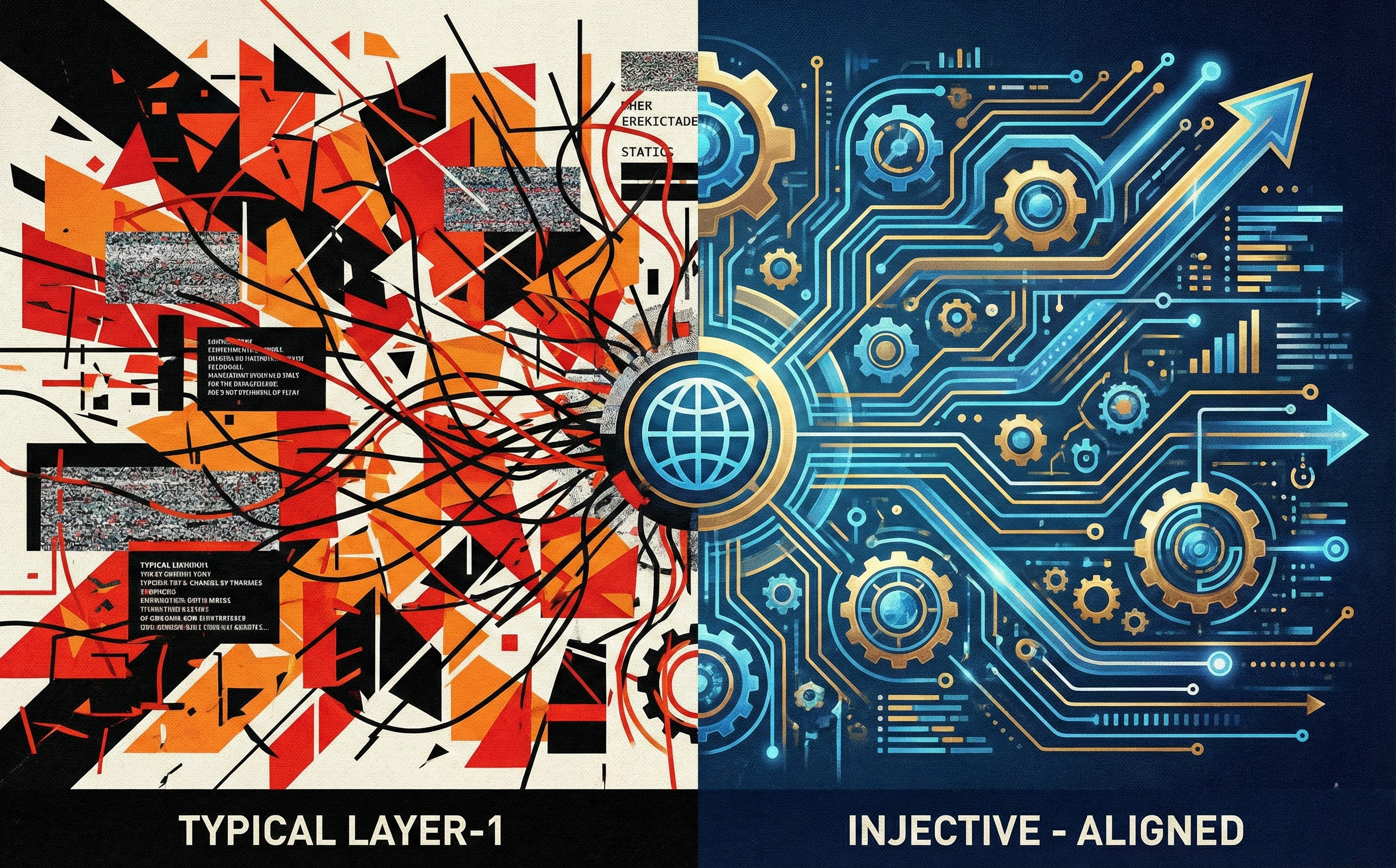
In the early days of blockchain, performance metrics dominated the conversation transactions per second, block times, confirmation speeds, network throughput. It was easy to believe that faster systems would naturally become the ones finance trusted most. But as decentralized markets matured, it became clear that speed wasn’t the actual barrier. The real limitation was coordination specifically, the ability for a blockchain to maintain coherent behavior across thousands of actors, under unpredictable market conditions, without forcing participants to compensate for its weaknesses. When I first examined Injective, what struck me wasn’t just its speed, or its interoperability, or its low fees. What stood out was how deliberately it addressed this coordination challenge, almost as if the team understood an industry truth most Layer-1s never openly discuss: finance fails not when systems slow down, but when systems become misaligned. Injective’s architecture seems built for alignment.
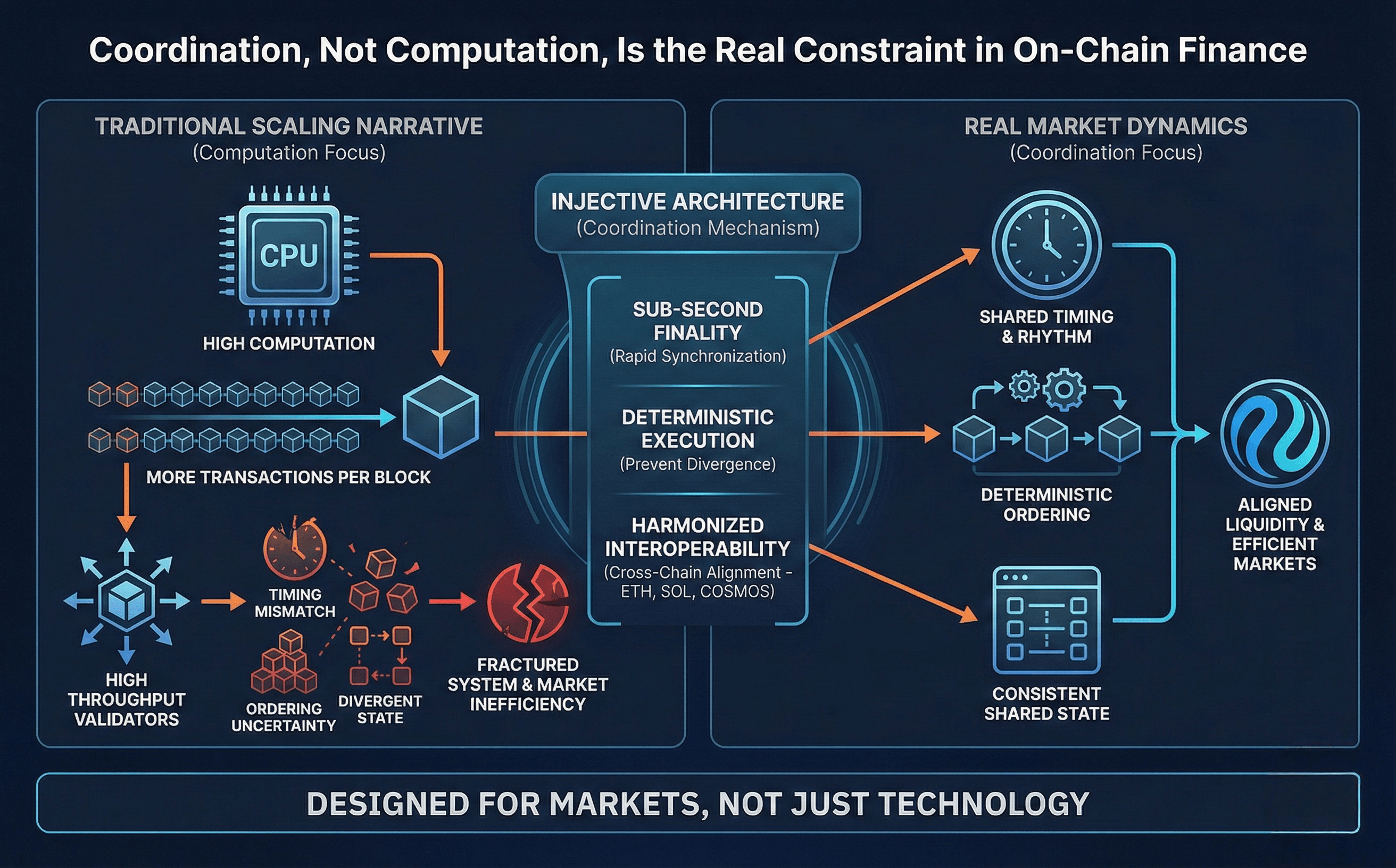
Big Insight — Coordination, Not Computation, Is the Real Constraint in On-Chain Finance
The blockchain industry often frames its scaling problem as a computational one. If blocks can process more transactions, if execution environments become more expressive, if validators can handle more throughput, then everything else will naturally fall into place. But this view oversimplifies how financial systems behave. In real markets, problems emerge when participants lose a shared sense of timing, ordering, and state. Arbitrage breaks down. Liquidations misfire. Cross-chain flows become mispriced. Liquidity providers retreat because they can no longer trust the rhythm of the system they are operating within.
This is the coordination problem, and it is remarkably underexplored.
Injective, unlike many Layer-1s, is architected around this problem rather than around the traditional scaling narrative. Sub-second finality is not simply a performance achievement; it is a coordination mechanism. Deterministic execution is not merely a developer convenience; it prevents divergence in shared assumptions. Interoperability across Ethereum, Solana, and Cosmos is not branding; it creates a harmonized cross-chain environment where liquidity can coordinate its behavior across networks that normally operate asynchronously.
Injective doesn’t try to eliminate uncertainty it tries to keep uncertainty from fracturing the system’s internal alignment. That distinction is subtle, but it is the difference between a network designed for technology and a network designed for markets.
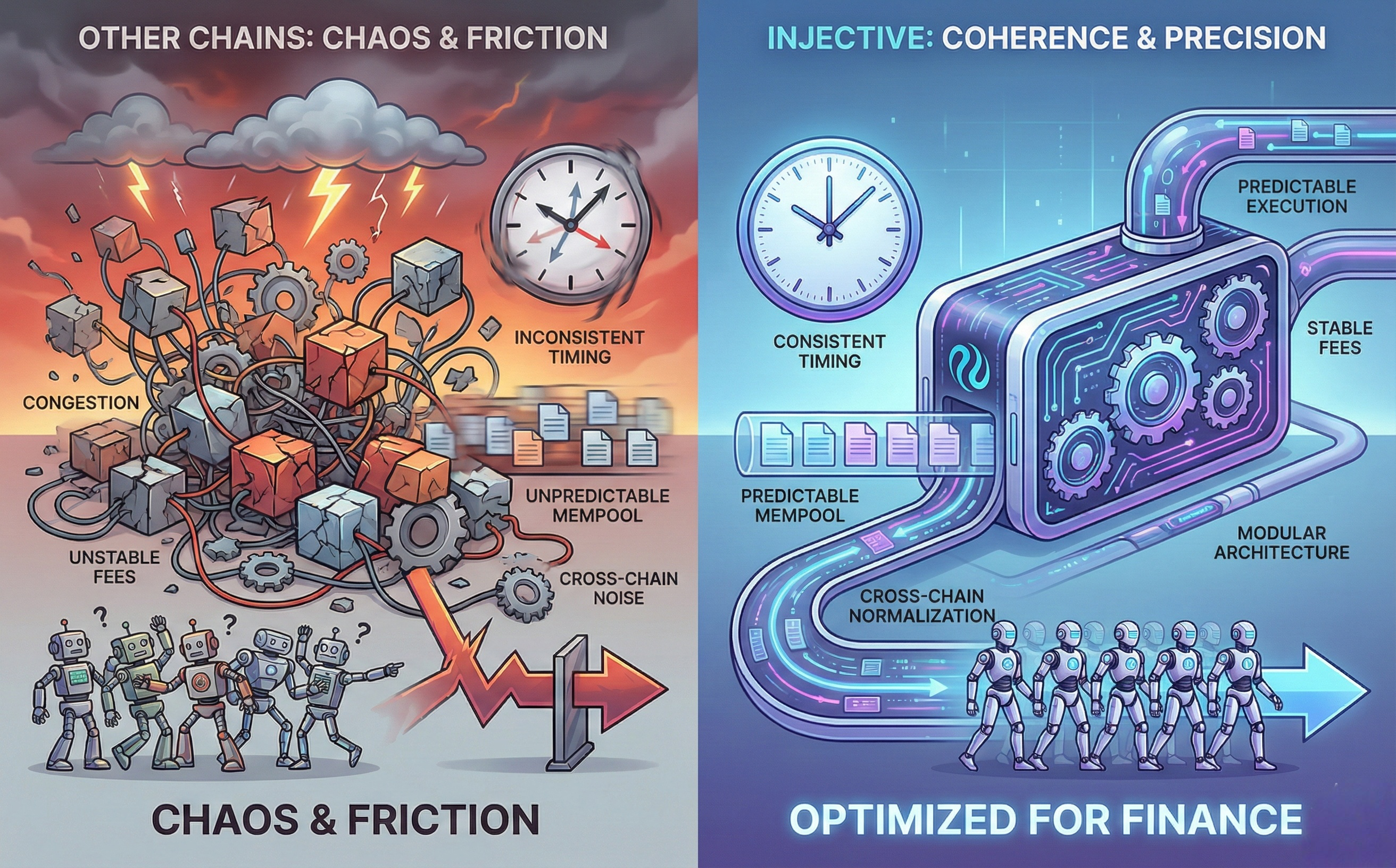
Key Challenges and Opportunities — Why Coordination Is Hard and Why Injective Handles It Better
Solving coordination at the blockchain layer is difficult because it requires more than raw throughput. It requires:
Consistent timing, even under volatile load
Predictable execution, regardless of congestion
Stable fee structures, so actors don’t need to hedge against the system
Cross-chain normalization, to ensure external noise doesn’t distort internal state
Reliable validator alignment, so the network behaves like a single coherent machine
Most chains fall short because they were not built with these priorities. They treat timing as flexible, execution as probabilistic, and congestion as unavoidable. This creates a feedback loop where the infrastructure forces the market to do extra work just to understand its behavior.
Injective offers a contrasting model. Its timing does not drift, even as transactions surge. Its mempool design avoids the unpredictable layering effect seen in other networks. Its interoperability stack integrates external messages into a consistent internal rhythm, smoothing out irregularities. Most importantly, its modular architecture keeps complexity contained rather than allowing it to leak across subsystems.
This approach doesn’t eliminate all trade-offs. A chain optimized for coordination will naturally be less focused on high-complexity computation or speculative experimentation. But Injective embraces this trade-off openly. It optimizes for coherence because coherence is what finance demands.
What This Means for Builders — Stability Reduces the Hidden Costs of Market Participation
Financial developers rarely talk about coordination explicitly. They talk instead about “predictability,” “consistency,” “timing guarantees,” or “execution clarity.” All of these are surface-level expressions of the same underlying concept: markets perform best when they can rely on an infrastructure layer that behaves like a metronome, not a mood.
Injective removes many of the hidden costs associated with developing in ecosystems where coordination is fragile. Builders don’t need to code around erratic block times. They don’t need defensive buffers for unpredictable fee spikes. They don’t need complex fallback logic for cross-chain synchronization. They don’t need to reset their models because the network behaved differently at high load.
The opportunity is not merely technical it is strategic. With stable coordination, developers can build systems that assume reliability rather than anticipate failure. This lowers capital requirements, increases strategy efficiency, and reduces operational risk. For professional builders, these benefits often matter more than abstract performance benchmarks.
Injective allows developers to think about markets instead of infrastructure an advantage that compounds the more complex the financial system becomes.

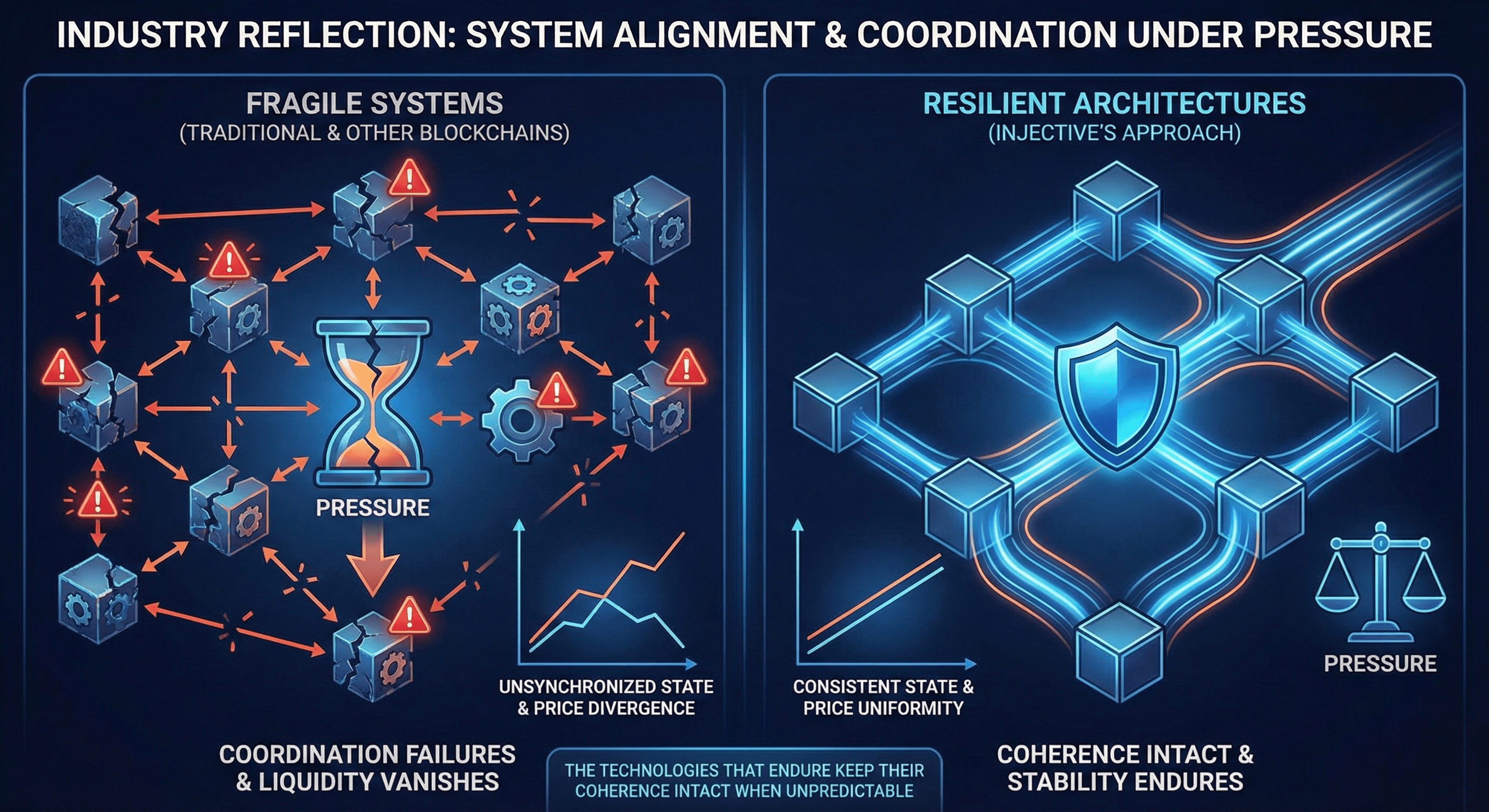
Industry Reflection — The Systems That Win Are the Ones That Stay Aligned Under Pressure
Coordination failures are subtle but devastating. In traditional markets, a delay of milliseconds can create entire categories of risk. Clearing mismatches create cascading losses. Unsynchronized state across trading venues leads to price divergence. And when systems lose alignment, liquidity vanishes almost instantly.
Blockchain ecosystems replicate these risks, often without acknowledging them. A chain that behaves one way under normal load and another under stress creates structural uncertainty. Markets adapt by reducing exposure, widening spreads, or abandoning certain strategies entirely.
Injective’s architecture behaves differently because it refuses to change its shape under pressure. The system under stress looks almost indistinguishable from the system at rest. This stability is not accidental; it is a product of a design philosophy that views coordination as the foundation of financial infrastructure.
In my experience, the technologies that endure are not the ones with the flashiest innovations they are the ones that keep their coherence intact when everything around them becomes unpredictable.
Injective appears built for exactly that moment.
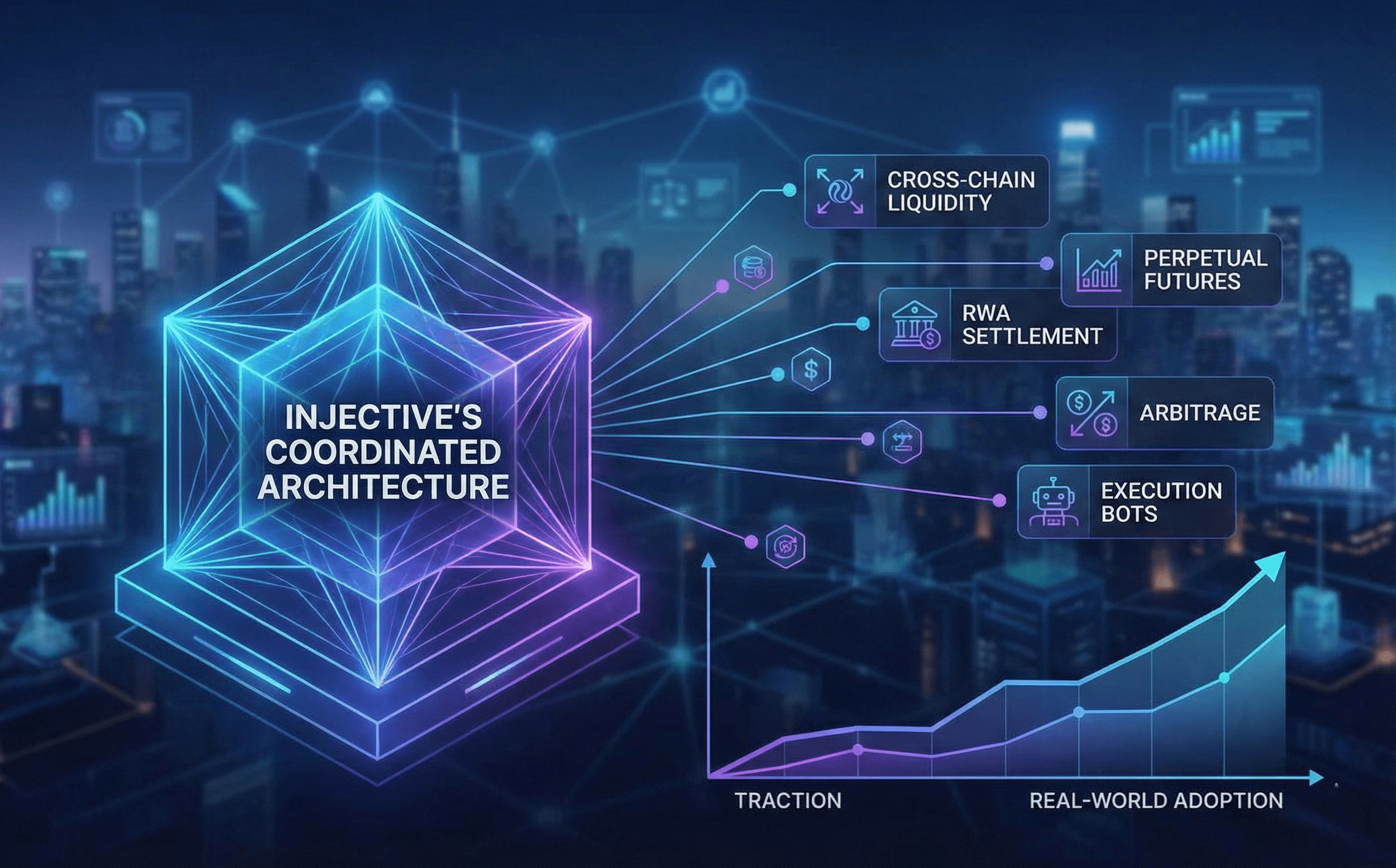
Traction — Where Injective’s Coordinated Architecture Is Already Showing Real-World Promise
One of the most compelling indicators of Injective’s early success is the type of builders choosing to adopt it. Not retail-driven speculative protocols, not meme-driven applications, but developers who understand the operational realities of multi-chain finance:
cross-chain liquidity routes
perpetual futures engines
real-world asset settlement layers
arbitrage platforms
execution bots requiring microsecond-timing stability
These builders are not selecting Injective for marketing reasons. They are selecting it because it solves a coordination problem they repeatedly encountered elsewhere.
The pattern is unmistakable: teams building serious financial infrastructure gravitate toward ecosystems that reduce uncertainty, not environments that maximize optionality. Injective’s specialized architecture offers clarity in a landscape defined by noise.
This kind of traction tends to build slowly but it builds a foundation that lasts.
Conclusion — Injective’s Future Depends on Its Ability to Continue Solving the Problems No One Talks About
The blockchain industry tends to focus on visible issues throughput, scalability, composability, ecosystem size. But the deeper, more structural problems often go unaddressed. Coordination is one of them, and it may be the problem that ultimately determines which networks become financial infrastructure and which remain experimental platforms.
Injective stands out because it recognizes this distinction. It prioritizes alignment over flexibility, coherence over expressiveness, and predictability over spectacle. Its design anticipates the needs of markets rather than the preferences of developers. And in doing so, it positions itself not merely as a fast chain or a cheap chain, but as a coordinated chain a network that understands what finance actually requires.
If decentralized finance is going to mature, it will need systems that behave like this. Systems that stay aligned when volatility rises. Systems that maintain clarity even when the environment becomes chaotic. Systems that solve the problems others don’t acknowledge.
Injective may be one of the few blockchains already engineered with that future in mind.


