
On December 6, the U.S. Department of Commerce's Bureau of Economic Analysis released the delayed personal income and spending data for September. Slightly lower-than-expected inflation has almost no impact on the judgment of the Federal Reserve's interest rate cuts next week, as the stagnation in consumer spending shows that the U.S. economy had already slowed down before the government shutdown in October.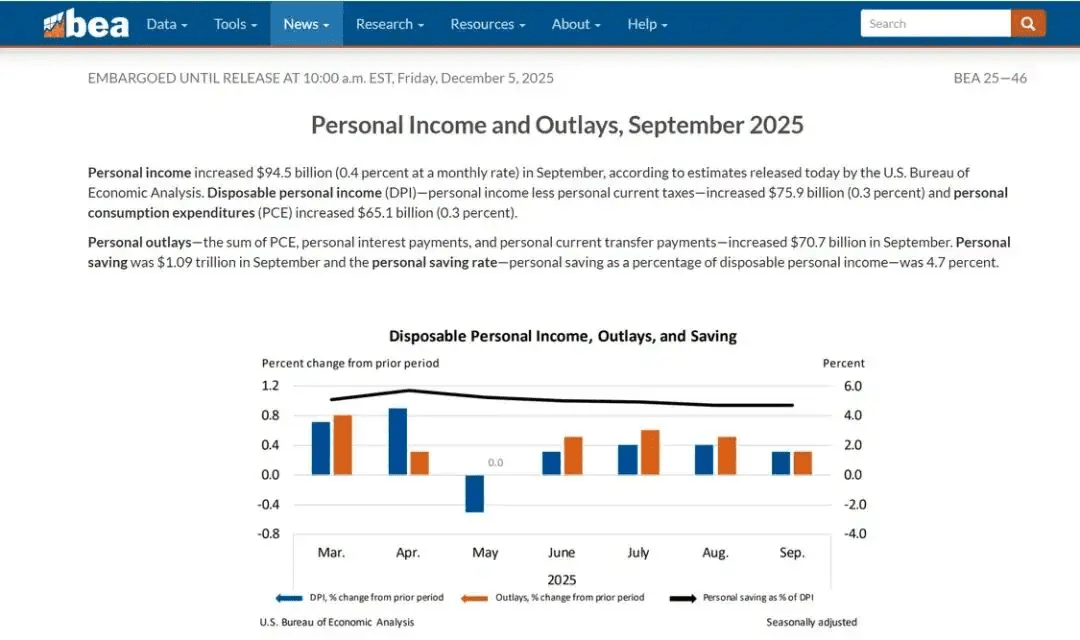
In terms of data, the U.S. personal consumption expenditures (PCE) price index for September rose 2.8% year-on-year and 0.3% month-on-month, both in line with expectations. The core PCE, which excludes food and energy prices, rose 2.8% year-on-year, slightly below market expectations and also lower than August's 2.9%.
Federal Reserve officials use the PCE price index as a primary policy tool for measuring inflation. While officials pay attention to both indicators, they generally believe that core PCE better reflects long-term inflation trends. Thus, in the context of the Federal Reserve's meeting next week, a core PCE that is below expectations naturally supports the narrative for interest rate cuts.
By category, prices of goods rose by 0.5% in September, reflecting the continued pass-through of tariffs to prices. Service prices increased by only 0.2%, food prices by 0.4%, and energy prices by 1.7%.
This report was originally scheduled for release on October 31, but was delayed to this week due to the longest government shutdown in U.S. history. As for inflation after October, the earliest we will know is from the November CPI on December 18 (which includes some October CPI data).
The PCE report on Friday also reflects signs of cooling in the American consumer market.
The report indicates that the 'real' personal spending growth, after excluding price changes, stagnated in September. This suggests that even before the U.S. government shutdown in October, Americans' wallets were already feeling tight.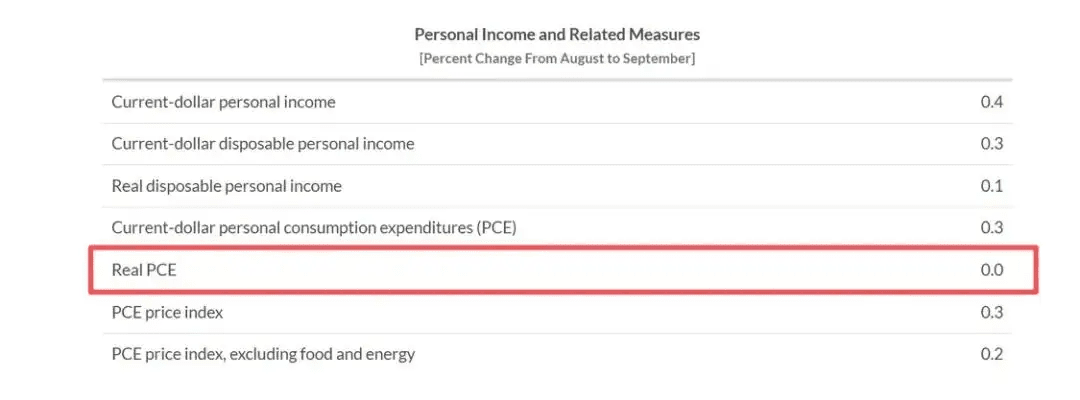
The BEA stated that the slowdown in spending growth is largely due to the largest decline in goods spending since May. Spending on automobiles and parts, clothing, and footwear has all decreased.
This sign also matches last week's September retail data: unadjusted retail purchases slowed in September, with significant declines in categories such as electronics, clothing, and sporting goods.
The September PCE report also shows that American consumers' real disposable income has barely grown for the second consecutive month. Wages and salaries (an unadjusted measure) increased by 0.4%, while asset income (an important support for wealthy households) has rebounded.


