


Today we continue to look at V God’s Possible futures of the Ethereum protocol written in October 2024, the fifth piece The Purge. It is suggested that those who are capable and willing to delve into it read the original text; here I can only give a rough description, and my ability is limited, making it difficult to explain in plain language!
In October 2024, Vitalik released The Purge — he believes that for Ethereum to survive the coming decades, it not only needs speed, scalability, and security, but must also fundamentally address the issues of 'storage bloat + protocol complexity.' In short, it's time for a 'protocol reduction / data cleaning' — to allow Ethereum to operate more efficiently, ensuring it is safer, more decentralized, and more sustainable.
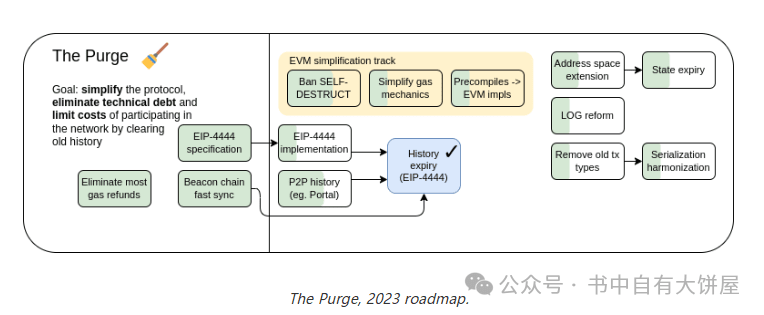
Core issue: Why is there a risk of "historical + state inflation"?
Historical data (blocks/transactions/receipts/account creations, etc.): Since the genesis block, all transactions, blocks, accounts, and contract creations on Ethereum have been permanently saved. Each new node has to download this history, leading to longer synchronization times and higher resource demands. A "fully synchronized" node may now require 1.1 TB + several hundred GB of disk space, just for the execution layer.
The increasing complexity of protocols: Every time a new feature is added or a mechanism optimized, there is a tendency to "add" rather than "subtract." Over time, code, features, compatibility, and optimization plans accumulate, becoming a large and difficult-to-maintain "technical debt."
If this trend does not change, ordinary users will find it increasingly difficult to run nodes — validating nodes will be monopolized by fewer "large mining farms / data centers / institutions," gradually weakening Ethereum's original intention of decentralization, anti-censorship, and open participation.
The Purge: A new vision for Ethereum — "History & State + Features" triple cleanup
To address the above issues, Vitalik proposed The Purge, which can be divided into three core parts:
1. History expiry
No longer requiring every node to permanently store all on-chain historical data. In other words, past blocks, transactions, receipts, account creation records... these "old histories" can be unloaded / archived / stored distributedly from ordinary nodes while only retaining data from a recent period (e.g., several months / 1 year).
The logic behind this is: The chain ensures consensus through hash links — if the current block is recognized by the majority of nodes, then its history (historical blocks / transactions) can be verified to be valid through methods such as Merkle proofs to any verifier. In other words, "Is the history real?" can be substituted with "a small amount of proof + a few storage nodes + distributed storage / archiving nodes" instead of "every node storing all history."
Theoretically, if there are enough nodes in the network, as long as the replication factor is ensured — even if each node only stores a small part of the historical data, the entire network's history can still be restored / verified.
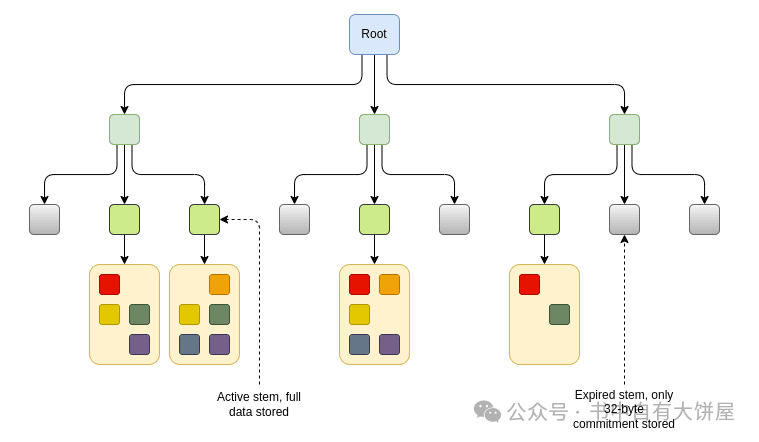
2. State expiry
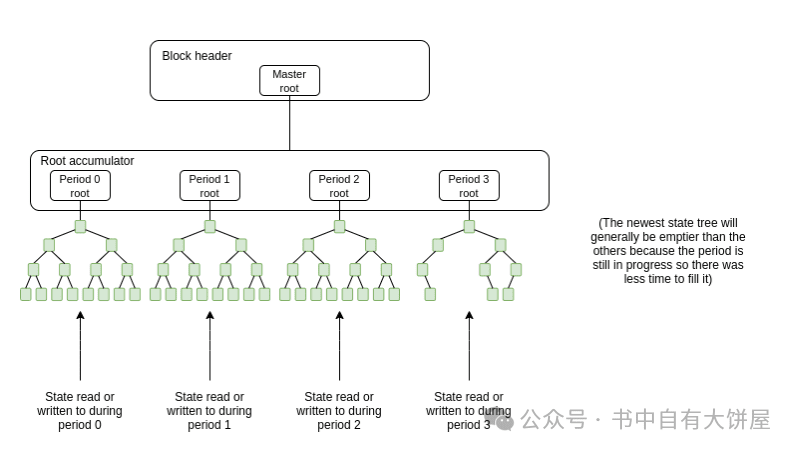
Not only is historical data expiring, but the "state" itself — that is, all account balances, contract states / storage / code, etc. — may also be periodically "reset / cleaned / compressed / archived." This way, active states stay updated while outdated / unused "dead states / inactive accounts / unused storage slots" are cleaned or archived.
This means that Ethereum will no longer maintain an eternally infinitely growing "state tree + historical database," but will divide through epochs / versions, allowing old states to be unloaded / migrated / re-stored as archived forms — reducing node maintenance burdens and storage pressures.
3. Feature / characteristic cleanup
For a long time, to be compatible, to introduce new features, and for backward compatibility, the Ethereum protocol and clients have continued to grow. The Purge also suggests that unnecessary / no longer widely used / replaceable / redundant features / opcodes / mechanisms should be timely eliminated / reconstructed / removed to reduce protocol complexity, lighten implementation burden, and decrease attack surface / maintenance costs.
In other words, this is a "subtractive optimization" — not just data, but also code / design / the protocol itself.
Potential benefits: Why should we support the Purge?
1. Decentralization & lower barriers: The requirements for nodes regarding storage / hardware / network are significantly reduced → Ordinary computers / lightweight devices may also run nodes → Decentralization is more guaranteed.
2. Improved synchronization speed / node availability: New nodes joining the network experience less synchronization pressure, significantly shortening synchronization time; node maintenance / migration is more convenient.
3. Protocol maintainability / security / simplicity | Features / code / data are lighter / clearer / more maintainable: Easier to audit, reduce bugs / vulnerabilities / technical debt.
4. Sustainable ecological development: Prevent the network from being unable to maintain / decentralization collapse due to historical inflation / excessive data; leave room for development in the coming decades.
5. Resource savings / cost reduction: Lower costs for nodes/storage/bandwidth, making it more user / developer / validator friendly.
In summary, the Purge is not just a technical optimization but also a strategic investment in the sustainability of Ethereum as a "public infrastructure" for the coming decades.
Difficulties, challenges, and controversies: The Purge is not just about "completing the process."
However, while The Purge's ideals are good, it faces many practical challenges and controversies for implementation / widespread deployment:
1. Compatibility / backward compatibility: Existing contracts / dApps / tools / wallets / node structures all assume that history + state permanently exist. If Purge cleans up state / history, it may break certain old contract logics / dependencies.
2. The availability and trust of historical data access: When history is no longer stored on every node but shifted to distributed / archived / third-party storage, who will ensure that historical data can still be reliably verified / restored, and whether the distributed storage / archiving node solutions are robust enough and decentralized is key.
3. High migration cost / Difficult community consensus: Introducing state expiry / address format changes / protocol cleanup / distributed historical storage mechanisms is a significant transformation, requiring extensive collaboration and support from the community / clients / infrastructure / ecological applications.
4. The philosophical / trust impact of data "permanence": Many people view blockchain as an important foundation for "permanently saving all data." If there is widespread cleanup / expiration, does this violate the spirit of blockchain's "eternal preservation"? Who is responsible? What is the impact on data archiving / auditing / legal / compliance / historical transparency? This is a question that must be faced.
The future of Ethereum: Lighter, more decentralized, and longer-lasting public infrastructure?
If The Purge succeeds, Ethereum may usher in a whole new form — it will no longer be that "data-rich mine / heavy asset highway," but rather an efficient, secure, lightweight "global digital ledger / settlement layer" that everyone can participate in.
- Ordinary computers, and even phones, may run nodes and participate in network validation.
- Historical / state / storage burdens are no longer barriers → Decentralized power may return to the community / ordinary users / small nodes.
- The protocol is clearer, simpler, and more maintainable → Easier to audit / upgrade / secure + lower bug risks.
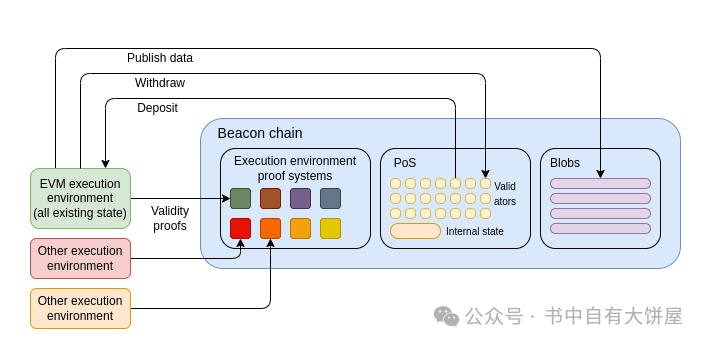
- More friendly to L2 / rollup / modular ecology — L1 serves as the security / settlement / consensus hub, while applications / computation / state / history are undertaken by a lighter / more flexible / modular structure.
In other words, the Purge may allow Ethereum to truly transition from a "world computer" to a "global digital settlement system + decentralized public infrastructure." This is not just a technical choice, but a reconstruction at the level of ideas / architecture / philosophy.
Conclusion: The Purge — possibly a key step for Ethereum towards a "century chain"
The Purge does not seem like a "flashy + hot upgrade"; it does not immediately bring down transaction fees and will not make NFTs cheaper right away. But it is a thoughtful approach to Ethereum's stability, decentralization, and sustainable development in the coming decades — a choice of architecture that is "responsible for the long term, responsible for the future."
If Ethereum can successfully "clean up history / state / redundancy / complexity," and establish a decentralized, reliable, distributed historical storage / proof / archiving mechanism, then it will truly become a public blockchain infrastructure that does not require high hardware barriers, where everyone can participate and verify.
Perhaps, in the near future, Ethereum will no longer be referred to as a "data-rich mine / heavy asset highway," but rather a light, sustainable infrastructure that everyone can equally participate in the "digital world."
>> For Ethereum to survive for 10 years, 20 years, or 50 years — it won't be through continuously adding features, but rather through timely "subtraction, cleanup, streamlining, and optimization." The Purge is likely a significant step towards its true journey into a century-long or millennia-long history.$ETH

