

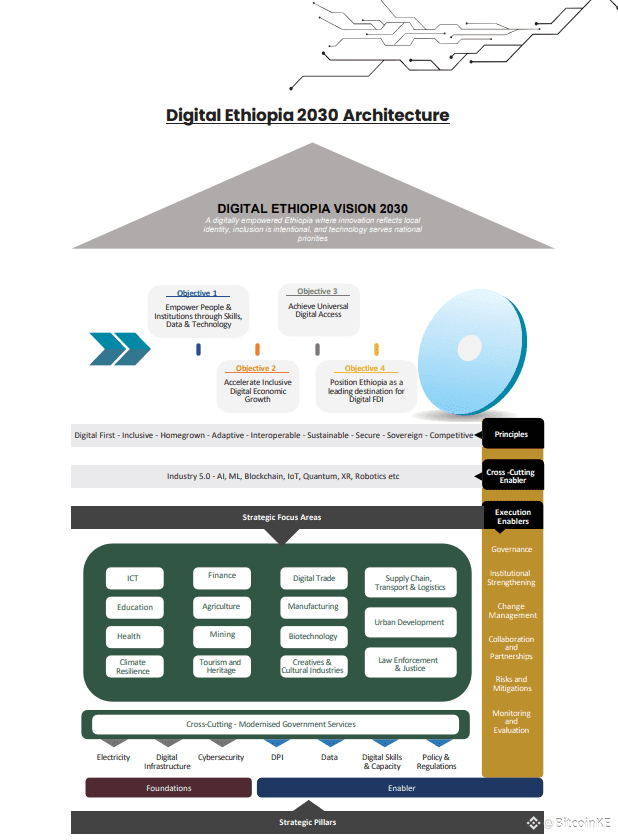
The Digital Ethiopia 2030 strategy is one of the most forward-leaning digital transformation blueprints on the continent – and notably, it integrates blockchain, distributed ledger technologies (DLT), and cryptocurrency-related policy directions across multiple sectors. Rather than treating blockchain as a niche technology, the strategy embeds it in national priorities ranging from mining governance to agriculture, logistics, finance, and digital trade.
Below is a breakdown of how the strategy addresses blockchain and crypto, and what it signals for Ethiopia’s digital future.
1.) Blockchain in National Digital Strategy (Industry 5.0)
The document identifies blockchain and distributed ledger technologies (DLT) as one of the core Industry 5.0 tools Ethiopia will prioritize to secure data, authenticate transactions, and underpin future digital systems.
The strategy explicitly lists:
Blockchain / DLT for secure, tamper-proof transactions
Use-cases tied to automation, real-time monitoring, and transparency.
This positions blockchain not as an experimental tool but a foundational component of Ethiopia’s long-term digital architecture.
2.) Blockchain for Mining Traceability (One of the Strongest Use-Cases)
The mining sector – a major source of export revenue – is slated for full-scale digital modernization.
Key blockchain mentions include:
• Blockchain-enabled traceability in mining
The strategy emphasizes blockchain for mineral provenance, compliance, and transparency:
Deploy blockchain-based traceability systems to ensure compliance and strengthen investor confidence.
Facilitate proof of origin, reduce fraud, and support export competitiveness.
• Rwanda case study included as a blueprint
The strategy highlights Rwanda’s pioneering role:
Blockchain traceability for tin
Minexx blockchain platform for artisanal miners
Over 50,000 tonnes of minerals tracked via blockchain systems These examples are directly recommended as models for Ethiopia.
Strategic impact:
Blockchain is framed as critical for:
Attracting responsible investment
Meeting global compliance and due-diligence requirements
Integrating artisanal miners into global, transparent supply chains
Kenya is aligning with the EU’s deforestation law, which means 1.2M farmers need to get on the map.
Dimitra is already making it happen.
This article explores how blockchain can bridge the traceability gap: https://t.co/SLcsodu54s#EUDR #Deforestation
— Dimitra Technology (@dimitratech) July 21, 2025
3.) Blockchain in Agriculture — Coffee Traceability and Export Premiums
Agriculture, especially coffee, receives a major blockchain application:
• Blockchain-based coffee traceability systems
The strategy calls for:
Blockchain for coffee certification and traceability, reinforcing Ethiopia’s premium global position.
Export-grade transparency from farmer to buyer
Support for AI-driven disease detection tied to blockchain records
This positions Ethiopian coffee for higher-value export markets where verifiable origin is critical.
Ethiopia Signs MOU with Cardano for a Blockchain-Powered Coffee Supply Chain and promises to train Blockchain developers in the country: https://t.co/McZ1nzkIdU pic.twitter.com/ct4v6WTola
— BitKE (@BitcoinKE) May 7, 2018
4.) Blockchain for Logistics, Supply Chain & Trade Corridors
Ethiopia’s logistics challenges are well known — high costs, inefficiency, and limited visibility. Digital Ethiopia 2030 introduces blockchain-driven reforms:
• Blockchain for supply chain traceability
The plan includes:
Blockchain-based platforms to record and timestamp transactions
Reducing disputes and enhancing cross-border transparency
Integration into multimodal transport and trade corridors
This brings Ethiopia closer to global standards in trade digitization, supporting AfCFTA digital trade protocols.
5.) Blockchain in Finance, Digital Trade & National Governance
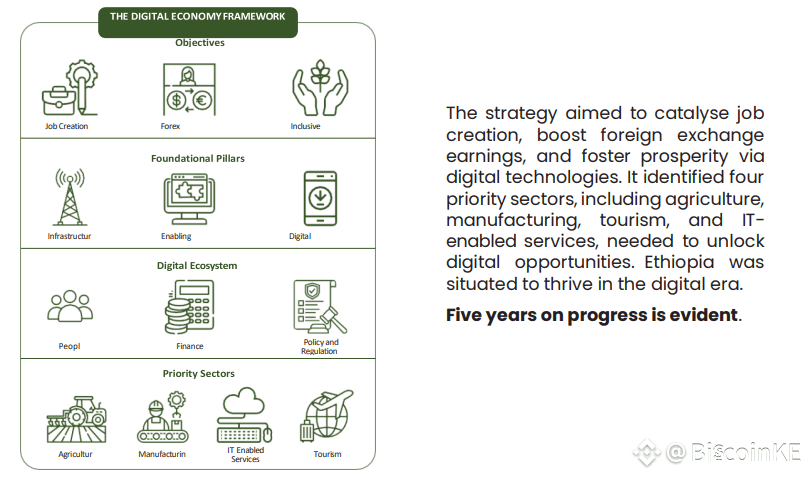
While Ethiopia’s financial sector remains tightly regulated, the strategy introduces several frontier policy directions:
• Blockchain-based remittances
Listed under Finance use-cases within Industry 5.0:
Blockchain-based remittances and fraud detection as future applications.
• Blockchain and crypto regulatory sandboxes
The strategy calls for supervised innovation environments covering:
Blockchain
Stablecoins
DeFi
Cryptocurrencies
This is highly notable – Ethiopia explicitly acknowledges crypto and DeFi as innovation sectors requiring regulated sandboxes rather than outright prohibition.
• Development of a national Blockchain & DLT Strategy
A governance-level commitment to:
National blockchain policy
Cross-sector interoperability
Secure data structures
This indicates alignment with global digital governance frameworks.
REPORT | Stablecoin Transfers Account for 43% of All Crypto Transfers Across Africa, Ethiopia is Fastest-Growing Market, Says Chainalysis
6.) Crypto Mining for Energy Monetization (Rare for a National Strategy)
One of the most striking direct mentions of crypto:
• Leveraging crypto mining to monetize surplus renewable energy
The government proposes:
A regulated framework for crypto mining
Using cheap renewable energy to attract miners
Redirecting part of mining revenue to rural electrification and grid expansion
This aligns Ethiopia with other energy-rich nations exploring industrial-scale crypto mining as part of energy strategy.
LIST | A Look At 10 Key Milestones Behind Ethiopia’s Rise As a Bitcoin Mining Haven in 2024
In this article, we explore the key milestones that propelled #Ethiopia into the ranks of global Bitcoin mining powerhouseshttps://t.co/EtQcpEBTBr @KalKassa @qrb_labs @WestDataGroup pic.twitter.com/tCxj4Wye4f
— BitKE (@BitcoinKE) January 3, 2025
7.) Blockchain in Coffee, Supply Chains, Health & Beyond
Additional mentions include:
Blockchain for border clearance in logistics and trade corridors.
Potential DLT-enabled healthcare data systems (inferred from Industry 5.0 stack).
Blockchain in educational credential verification (through digital ID + interoperable systems).
Blockchain within creative industries for metadata and rights management.
Cardano is pioneering change in Africa, collaborating with governments to address real-world issues.
5 million students will receive digital IDs on the #Cardano platform to combat fraudulent certifications.
Read more: https://t.co/IaKZk1birE pic.twitter.com/qgIUZ08eeV
— EMURGO Africa (@EmurgoAfrica) October 10, 2023
Overall Assessment: Ethiopia Is Quietly Building a Web3-Ready Digital State
The Digital Ethiopia 2030 strategy doesn’t treat blockchain or crypto as buzzwords — instead, it integrates them into high-value, high-impact national systems that genuinely benefit from decentralization and verifiable transparency.
Most advanced areas:
Mining governance (strongest and most immediate use-case)
Agricultural exports (coffee)
Trade & logistics compliance
Financial inclusion & remittances
Energy monetization via regulated crypto mining
Most forward-looking policy commitments:
Regulatory sandboxes for stablecoins, DeFi, crypto
Development of a national Blockchain & DLT Strategy
Ethiopia is moving toward a hybrid digital governance model where blockchain underpins trust, traceability, and cross-border interoperability. Unlike other states, the strategy does not reject crypto — it aims to regulate, integrate, and strategically leverage it.
USE CASE | GoldBod, the Official Ghana Gold Board, Set to Deploy Blockchain System to ‘Trace Every Gram of Gold by 2026’
Want to keep updated on crypto developments in Africa?
Join our WhatsApp channel here.
Follow us on X for the latest posts and updates
Join and interact with our Telegram community
_______________________________

